Showing posts with label sculpture garden. Show all posts

Wednesday, July 27, 2011

Noguchi Museum

Core (Cored Sculpture), Isamu Noguchi 1978
9/25/2010, Saturday
MUSEUMS: Noguchi Museum (1.5 hrs) ……………………..…… $10

This day marked our first exploration into Queens, the largest of New York City’s boroughs.  Queens doesn’t have the upscale attitude of Manhattan and seems a bit shabby next to its hip neighbor Brooklyn, but at least it doesn't have the "running gun-battle" reputation of the Bronx.  Most tourists in Queens are just passing through on their way to the two gigantic airports in this borough, but Paul and I have really enjoyed our subsequent visits here.  In Queens we’ve discovered great ethnic food and our favorite museums outside of Manhattan to date, such as the newly renovated high tech Museum of the Moving Image and the Louis Armstrong Museum (great tour).

Today we visited the Northwest-most corner of Queens, just across the river from Manhattan, consisting of the neighborhoods Long Island City and Astoria.  This area was once very industrial and it’s full of old factories and warehouses.  Some of these are still in use, like the old Steinway & Sons piano factory and the Brooks Brothers tie factory.  Others have been repurposed into the kinds of businesses that thrive in areas with low land values like Silvercup Studios where "Sex and the City" is filmed, and of course old warehouses make excellent (and cheap) artist studios.  Thus this region has the largest concentration of museums, art galleries and studios outside of Manhattan, you can see the highlights at the Long Island City Cultural Alliance.

Probably due to its limited residential space, this corner of Queens seems a particular favorite of the types of artists who need lots of room and very tolerant/non-existent neighbors (i.e. sculptors) and nearly all of NYC’s museums devoted to sculpture are located here: the Noguchi Museum, Socrates Sculpture Park and the SculptureCenter.  The Noguchi Museum and Socrates Sculpture Park are across the street from each other on the banks of the East River and made a good paring today.
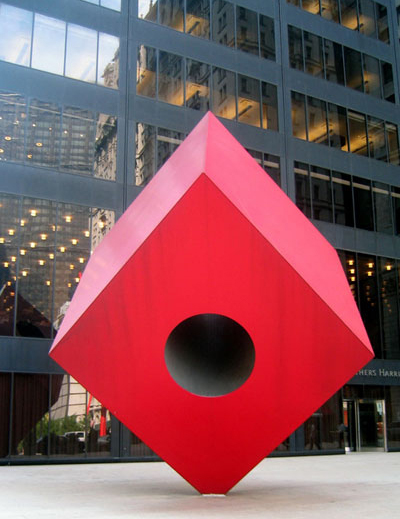
Red Cube, Isamu Noguchi 1968 (in NYC)
Without a doubt, the Noguchi Museum is the best regarded of the Queens sculpture museums.  Maybe you’ve never heard of Isamu Noguchi, but chances are good that you’ve seen his work.  His gigantic abstract sculptures were popular public works around the globe from the 1930’s until his death in 1988.  His most recognizable New York sculpture is probably the huge “Red Cube” in front of the HSBC building on Broadway but there are Noguchi sculptures in many of the world’s major cities, like Paris, Tokyo, Jerusalem, Los Angeles, Bologna and Munich.  Even Seattle, where Paul and I recently moved from, has a famous Noguchi sculpture.  Called “Black Sun,” it’s a giant flat black basalt circle with a hole in the center that frames a nice view of the Space Needle, but the source of its fame is the popular song “Black Hole Sun” by the Seattle band Soundgarden, reputed to be inspired by the sculpture.
Black Sun, Isamu Noguchi 1969 (in Seattle, WA)

Death (Lynched Figure), Noguchi 1934
One of the things that make the Noguchi museum stand out is that it was actually designed by the artist it exhibits.  In 1974 Noguchi bought a gas station across the street from his studio and gradually converted it into an exhibition space with a Japanese style walled garden at its center.  He even chose much of the work presented in the museum and determined how it was displayed.  Paul thought this very egocentric of Noguchi, and maybe it is, but I loved the way the intentions of the artist showed through in every part of his museum. 

Behind Inner Seeking Shiva Dancing Noguchi 1976-82
As an example, apparently Noguchi didn’t like to bias people with the names of his sculptures before they formed their own impression, so all of the names of art in his museum are displayed in small print on tiny white cards several feet away.  As the sculptures are fairly abstract, this made for some fun guessing games.  On the tour we were on the guide asked us to say what a particular sculpture looked like to us before reading the title.  Looking at the sculpture below, I thought it was a duck’s head, Paul saw a sideways letter S and another person guessed a baseball cap.  Noguchi’s intention?  The title was “Slowly Slowly,” in reference to a snail.  (Once it was pointed out it seemed obvious.)
.
Slowly Slowly, Isamu Noguchi 1966

The tour also went into detail on Isamu Noguchi’s life and his inspirations.  Born in 1904 as the illegitimate son of the Japanese poet Yone Noguchi and his American editor Léonie Gilmour, Noguchi was a brought up partly in Japan and partly in the U.S., but in the early 1900’s there was no way a half-Japanese half-American boy could fit in either culture and he was a lifetime misfit where ever he went.  
Floor Frame, Isamu Noguchi 1962

To me, his alienation came through in his work and I loved the shapes and textures of Noguchi’s stone sculptures in the museum’s elegant walled sculpture garden, but Paul was not a fan.  According to Paul, being a great artist is at least 50% self-promotion and he felt that the museum was the pinnacle of Noguchi’s showmanship and ego, and it left Paul cold.  Feel free to weigh in on the debate in the comments.

RATINGS FOR THE NOGUCHI MUSEUM:
Pauline: 9 out of 10.  Great modern sculpture in a beautiful setting.
Paul: 3 out of 10.  Art and ego left me cold.

Gallery in the Noguchi Museum
Images in this post, from the top:  Core (Cored Sculpture) Isamu Noguchi 1978, basalt, in the sculpture garden at the Noguchi Museum.  Exterior of the Noguchi Museum.  Red Cube Isamu Noguchi, 1968 site specific sculpture in painted steel.  Black Sun Isamu Noguchi 1969, basalt.  Death (Lynched Figure) Isamu Noguchi 1934, monel, steel, wood and rope.  Slowly Slowly Isamu Noguchi 1966, basalt.  Behind Inner Seeking Shiva Dancing Isamu Noguchi 1976-1982, basalt.  Floor Frame Isamu Noguchi 1962, bronze. Gallery in the Noguchi Museum.

Sunday, July 24, 2011

Socrates Sculpture Park

Socrates Sculpture Park
9/25/2010, Saturday
MUSEUM: Socrates Sculpture Park (30 min) …………..………. Free

Gold Rush, Rachel Beach 2010
With nearly 200 museums in New York City, it seems odd that there are very few sculpture gardens.  This gap in the museum line up is probably to to the city's sky high real-estate prices, but today we saw a sculpture park that found a way around that problem.  This park is called the Socrates Sculpture Park and it's located on the banks of the East River on land that was once an illegal dumpsite and polluted eyesore.  However in 1969 a coalition of artists and community members under the leadership of sculptor Mark di Suvero bought the land (probably very cheaply) and transformed it into an outdoor exhibition space for large contemporary sculpture.  Now this previous wasteland has walking paths, an artist in residency program, a public vegetable garden, farmers market and a free outdoor movie series in the summer.  It’s frequently referenced as a model of urban reclamation and revitalization.  
 .
Untitled Frank Haines
The Socrates Sculpture Park is across the street from the excellent Noguchi Museum (exhibiting the work of the famous modern sculptor Isamu Noguchi) and the two make a good pairing if you have them time.  Despite the name, the Socrates park is much less high-brow than the Noguchi Museum and has a slightly scruffy air.  You can still see the rotting docks and rusty cranes perched on its perimeter left over from its industrial past, yet the park is well tended and there is a wide variety of sculpture to see. 
 .
Sponge Piece for Socrates Jory Rabinovitz
Paul and I both agreed that the most beautiful thing in the park was the view of the Manhattan skyline across the river (see image below), and one sculpture thoughtfully provided a telescope to view it better, but there was a lot to see in the park as well.  I was amused by the stack of colorful sponges stacked up like they were on a flag pole (“Sponge Piece for Socrates” by Jory Rabinovitz), while Paul liked the black and yellow contrasts of “Gold Rush” by Rachel Beach and the talking rock “Megafaux” by Clive Murphy.  We didn’t like everything (the crumbling floating house failed to impress) but there was certainly a lot of variety and it made for an entertaining walk.
 .
RATINGS FOR THE SOCRATES SCULPTURE PARK:
Pauline: 3 out of 10.  Wide variety of contemporary sculpture in a riverfront park.
Paul: 3 out of 10.  Nice walk in the park is not ruined by the art.

View of the East River from Socrates Sculpture Garden
Images in this post, from the top:  Socrates Sculpture Garden, with Megafaux by Clive Murphy (2010) in foreground and the New York City skyline in the background.  Gold Rush Rachel Beach 2010, reclaimed wood beams and powder covered aluminum.  Untitled, Frank Haines 2010 mixed media.  Sponge Piece for Socrates, Jory Rabinovitz 2010, sponges, concrete and metal.  View of the East River and New York City skyline from the Socrates Sculpture Garden.

Friday, June 18, 2010

Derfner Judaica Museum/Art at the Hebrew Home

4/23/2010, Friday

MUSEUMS:
Hebrew Home at Riverdale:
  Art at the Home ……………...….. 30 min
  Derfner Judaica Museum …….… 30 min

COST:
Hebrew Home at Riverdale:
  Art Collection ………………....…. Free
  Derfner Judaica Museum …….… Free

Part of the fun of seeing ALL the museums of NYC is that, in addition to visiting popular attractions (like MOMA), we also get to tour some very unusual, hidden and even mysterious parts of the city we would never otherwise see, like unused subway tunnels (New York Transit Museum), an abandoned speakeasy (Museum of the American Gangster), and the inner sanctum of a 100 year old secret society of bookbinders (Grolier Club).  The location of today’s museum doesn’t sound as exotic as these, but it certainly isn’t a place we would normally visit, and, according to Paul, it was “the creepiest place so far.”

Today’s museums were located in a very large, very wealthy and very private retirement home, the Hebrew Home at Riverdale.  Riverdale is a neghborhood in the Bronx, but this quiet, leafy historic neighborhood on the bluffs overlooking the Hudson feels so far from the bustling urban-ness of the Bronx that it might as well be on the moon.  To reach the museum, we started on typical Bronx streets, full of people, elevated train noise and traffic, but after we turned and began our descent toward the river, the densely packed brick apartment complexes of central Bronx abruptly gave way to spacious graceful private homes, partially hidden behind immaculately prunned shrubbery and ancient trees casting heavy shadows on the road.  The roads narrowed, the people vanished, all street noise faded out, and by the time we reached the retirement home, the only noises were the wind in the trees, birdsong, and the faint sound of distant water.

A large black fence surrounds this complex in the forest, monitored by a security system that would do a prison proud.  All visitors must check in at the heavily guarded gate and submit to a thorough security check, including ID check, justification of visit and car search if deemed necessary.  There wasn’t a cavity search, but it felt like maybe the guard who did that was off for the day.  If you’re allowed past the checkpoint, you’re given a visitor’s pass and a narrow window of time to complete your business.  Neither Paul nor I asked what would happen if we stayed past our allotted time, and we knew we didn’t want to find out.


After the interrogation, we proceeded into the complex.  Despite the map provided at the gate, we got lost instantly.  In case you haven’t figured it out yet, this is not your average retirement home, and the place is huge.  Located on 19 manicured acres overlooking the Hudson River, the Hebrew Home has over 3,000 elderly residents, a fully staffed hospital, counseling center and rehab facility, and of course what we were there for: a 5,000 piece art collection, a Jewish history museum, and one of the larger sculpture gardens in NYC. 


There are virtually no signs (maybe they’re considered tacky?), so we found the first museum by entering one of the larger buildings and wandering around.  It turned out to be part of the hospital, so we had the bizarre and fairly disturbing experience of dodging gurneys and gowned patients while trying to find someone who didn’t look busy saving someone’s life to ask where any of the museums were.  Eventually we stumbled upon a lofty atrium-like structure overlooking the river called the Jacob Reingold Pavilion, the location of the Derfner Judaica Museum.

The objects in the Derfner Judaica Museum were originally the private collection of wealthy residents Ralph and Leuba Baum, and donated to the home upon their death.  This is how the home acquired most, if not all, of its extensive art collection, and after you realize that sad fact you begin to see every piece of art as representing a death at the home, just one of the many things that made this an intensely eerie experience.


A refugee from Nazi persecution, Ralph Baum (d. 1984) and his wife, Leuba (d. 1997) collected objects used by European Jews before the Holocaust, trying to persevere some of the history and memory of what was lost.  It’s an impressive collection of artifacts, ranging from ceremonial objects like elaborately decorated Torah cases and Hanukah lamps, to more personal items like kitchen spice containers and playing cards.  Paul thought it seemed the most personal of the Jewish museums we’ve seen, consisting largely of small but meaningful things people carried with them as they fled their homes, like a bridal belt worn by all of the women of a family on their wedding day, or a girl’s embroidered Matzah bag.  The object that made the greatest impression on me was an old Torah scroll, yellowed with age and partially charred, but still intact.  It had been pulled from the rubble of a synagogue near Hamburg burned to the ground by the Nazis on Kristall-nacht, the only one of 13 scrolls to survive.  It had been stored in a local police station, and when Ralph Baum returned to his hometown after the war, it was presented to him, the only survivor left to claim it.


In addition to the Judaica museum, the Hebrew Home also has an extensive art collection, comprised of 5,000 works by renowned artists such as Pablo Picasso, Frank Stella, Andy Warhol, and Joan Mitchell, as well as a large sculpture garden with breathtaking views of the Hudson River and Palisades. The art collection is recognized as a museum, but displayed in common areas throughout the complex.  To see it Paul and I essentially had to tour the retirement home.  I particularly liked the Warhol sketches of famous Jews, and the exhibition of Rachel Leibman’s collages made from images of ancient manuscripts.  Interspersed throughout the halls are also displays supposedly for children, including a huge model train garden designed by landscape architect Paul Busse, an antique doll collection, and a wall of creepy porcelain birds (they just stare at you with beady black eyes).  The art was nice, but it was difficult to just wander through other people’s parlors, feeling like outsiders as friendly residents asked whom we were there to see.  Paul had to constantly fight the urge to go talk to all those lonely people.

Our take on things: on the plus side, there were no crowds and the collections were interesting, particularly the Judaica museum and, oddly, the model train set.  However, their location in a swank retirement home, while certainly novel, made them difficult to get to and awkward to view.  We just could not shake the feeling that we were trespassers here.

Images in this post, from the top: three sculptures in the "River walk" sculpture garden of the Hebrew Home at Riverdale; "Illuminations" by Rachel Leibman; Torah scroll from Elmshorn Germany; “Artistic Palestine Play-Cards” from 1920 Jerusalem replaces the four usual suits with four symbols of religion and the land (fig, pomegranate, star of David and menorah). The kings are Ahasuerus, David, Saul and Solomon. The queens include Esther and the Queen of Sheba; "Olde West Garden Railroad" by Paul Busse, a model railroad depicting life in the 19th century American frontier; and Hanukkah Lamp, Bezalel School, Jerusalem, ca. 1920-29.