Thursday, September 23, 2010

Edgar Allan Poe Cottage/ Maritime Industry Museum

3/13/10; Saturday, continued

MUSEUMS:
Edgar Allan Poe Cottage ……..……................. 5 min
Maritime Industry Museum ………………..…... 1 hr

COST:
Edgar Allan Poe Cottage ……..…………..…... under construction
Maritime Industry Museum …………………... Free

PAUL HERE:  Continuing the story of our visit to the Bronx during the “Day of the Storm,” our third stop was the Edgar Allen Poe Cottage.  This is just off the Grand Concourse in the Bronx.  The Grand Concourse is an amazing street, easily one of the most aesthetically stunning streets I have ever seen.  Modeled after the Champs-Élysées in Paris, but larger in scope and length, the Grand Concourse is a 4 mile Art Deco masterpiece, and a drive down this road is a museum visit in its own right.

The Edgar Allan Poe Cottage was the final residence of the famous American author Edgar Allan Poe (1809-1849).  In this farmhouse, after losing his wife Virginia to tuberculosis, Poe wrote some of his best known works, including Annabel Lee, Ulalume, The Bells, and Eureka.  The tiny white cottage is located on a small triangle of land in the middle of the concourse (not surprisingly called Poe Park), next to a visitor’s center, which seems to be perpetually under construction.  When we went, the building was closed so we did not go inside.  However, I felt that navigating through a torrential rainstorm to see a tiny cottage was a fitting tribute to the tormented author, so we checked it off our list and ran back to the car to find someplace drier to visit.

PAULINE HERE:  I have to say something here.  Paul, bless his heart, is somewhat of a hopeless romantic.  While he saw a cottage in a park, I saw a dilapidated shed sitting at a bit of a slant in a muddy traffic island, surrounded by a rusty fence that had clearly been there a while.   The “cottage” is under construction for at least 2 years.  While it's difficult to imagine what they could possibly be doing to a shed in a traffic island that would take that long, it does mean that we won’t be able to visit it during the duration of our “Museum-a-thon.”  I’ll try to overcome my disappointment.

PAUL HERE: Our next stop was clear across the Bronx, east to the Throggs Neck peninsula where the East River meets Long Island Sound.  Our destination was the historic Fort Schuyler, a pre-Revolutionary War fort once part of a gauntlet of forts built to protect the New York harbor.  Fort Schuyler has been lovingly restored and now houses the State University of New York (SUNY) Maritime College (founded in 1874 it was the first college of commercial nautical instruction in the U. S.) and the Maritime Industry Museum.

The location of this particular museum, jutting out on a low peninsula into Long Island sound, was probably not the best choice to visit during a major storm.  However, it was open (kind of).  There was no one around as we made our way through Fort Schuyler to the museum, making it difficult to find the right door, and we wandered around the chapel and an empty library before we found our way.  The museum ended up being located in the hallways of the old fort, which also doubles as classroom space for the school.  This is important as there was a troop of Boy Scouts and Explorer Scouts getting maritime training during our visit there.  The hallways were largely echoing darkened corridors containing only ship pieces and models, but every once in a while we would surprise a scout intently working on a project, garnering quizzical looks, as if asking “I am required to be here during a massive storm, what’s your excuse?”

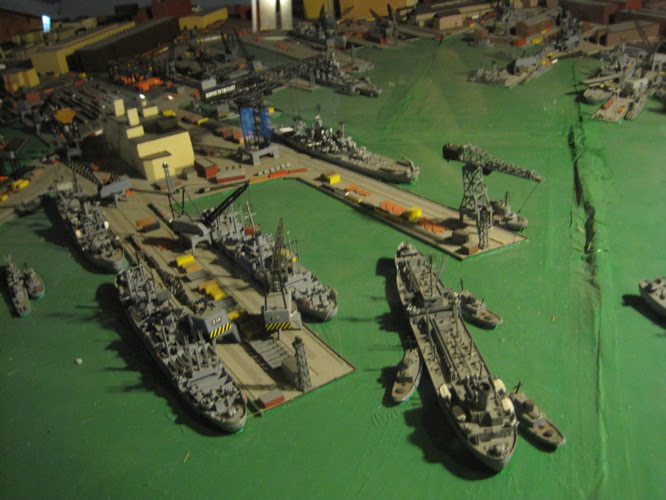
The Maritime Industry Museum houses exhibits on the history of the United States maritime industry, including commercial shipping, the merchant marine, and the port of New York, as well as exhibits on the history of Fort Schuyler.  It is a treasure trove of scale models of ships, artifacts from shipwrecks (including dinner plates from the Titanic), large pieces of shipping equipment, and a vast detailed history of the Port.  As we walked through the long, dimly lit barrel vaults of the old fort, we got a feel for the importance of the port, and the hard work and sacrifice of the people who ran it.  We also really felt the love some people have for ships.  There are at least a dozen detailed ship models of various classes and sizes, most of them built by a single person, Frank Cronican.  These are not just plastic snap-together models. No, these are hand made, delicately crafted models that are awe inspiring in their intricacy, and clearly took a huge amount of work. The man who built these models loved his ships. 

I think that is what sets this museum apart from others we have seen.  This museum feels like a labor of love.  There was a passion for the subject that we could feel in the bones of the place.  The museum is funded, staffed, operated and maintained strictly though volunteer support and donations.  Many Maritime College cadets volunteer time to serve as museum tour guides and provide exhibit construction and upkeep, and alumni participate in periodic "work parties" to do their share.  While the museum was modest, it made a very strong impression on both Pauline and I, and we were very happy to have braved the storm to see it. 

Images in this post, from the top: silhouette of a ship model in the Maritime Industry Museum, the front steps of the Bronx County Courthouse, located on the Grand Concourse; photograph of Edgar Allan Poe; entrance of Fort Schuyler; lobby of the Maritime Industry Museum; dinner plates recovered from the wreck of the U. S. S. San Diego; ship model in the hallway of the Maritime Industry Museum; scene from "A Day in the Life at the Brooklyn Naval Yard," a replica model of the Brooklyn Naval Yard during World War II circa 1942-44 built by Chief Yeoman Leo J. Spiegel, USN (ret.); sailor's wristwatch recovered from the wreck of the Relief Light Ship.

Monday, September 13, 2010

Valentine-Varian House / Lehman College Art Gallery

3/13/10, Saturday

MUSEUMS:
Valentine-Varian House ……………………… 1 hr
Lehman College Art Gallery …………………. 45 min

COST:
Valentine-Varian House ………………….…… $5 each
Lehman College Art Gallery …….……………. Free


PAULINE HERE: On Saturday March 13, the New York region experienced a terrible storm. Considered the worst in 30 years, a powerful Nor’easter tore through the area with wind gusts up to 60 mph and over 5 inches of rain.  Half a million people lost power, roads and homes flooded, and 6 people were killed by falling trees.  In the middle of the storm, Paul and I went to the Bronx to see museums.

The idea to go out in the storm was mine, and I’ll admit it was a bad one.  In my defense, I have to say that I was mislead by the wussy attitude of New Yorkers toward rain.  I’m from Seattle (where it rains, a lot).  This was my first spring in New York, and I had been repeatedly astonished by people canceling or changing plans due to rain.  If there is even the slightest chance of precipitation, New Yorkers bail on everything and stay home.  I’m still mystified.  What tragedy do they think will befall them if they venture out in the rain?  Do they melt?  Needless to say, no Seattle-ite would ever stay home due to rain; if you did, you’d be a shut-in September through June.  So when I heard it would rain today and was advised that we shouldn’t leave the house, I rolled my eyes and muttered snarky comments under my breath about New York pansies afraid to get wet.  (To be fair, Paul says similar things about Seattle-ites and snow.)  I didn’t check the weather report to see if perhaps this was an exceptional amount of rain.

Surprisingly, museum-hopping in a storm was a fun experience.  Sure one museum was closed due to power outages, but the museums that were open were NOT crowded.  In some places we had the full attention of chatty bored docents who admired our dedication (Valentine-Varian House).  At other museums we were the only customers, left alone to explore the echoing halls however we wanted (Maritime Industry Museum).  Paul has volunteered give me a break from writing and do the museum blogging today, and he’ll tell you all about it.

PAUL HERE: So when Pauline and I started out doing this project, we were committed to seeing all of the different boroughs of NYC.  The one that caused us the most trepidation was the most northern borough, The Bronx.  Most people only think of two things when it comes to The Bronx- Yankee Stadium and crime.  The crime-ridden reputation is so strong that one of our friends who is from the Bronx is often asked if he’s ever been shot, and how he survives.

While crime and the Yankees can still be part of the Bronx experience, they are both located in south Bronx.  Today we largely visited the north end, which is surprisingly wealthy and very, very nice.  However, the day we went into the Bronx was not so nice.  This particular Saturday had cold, gale-force winds, driving torrential rains, downed trees and broken umbrellas in abundance.  I questioned our reasons for gallivanting around in a torrential storm, but Pauline was made of sterner stuff.   She offered to drive, I agreed, and off we went.

Our first stop was the Valentine-Varian House, built in 1758 by blacksmith Isaac Valentine.  It’s the borough's second oldest house and oldest remaining farmhouse.  The house remained in the Varian family (which included Isaac Varian, New York's 63rd Mayor) until 1905.  Currently, it houses a few period furnishings, the Bronx Historical Society, and a small exhibit on Edgar Allen Poe, whose house is just down the road.  The house is small, and not in its original place.  We’ve noticed that house moving is a pretty common phenomena with historical houses- a new development wants the land, so the house gets pushed off.  Moving the Valentine-Varian took 2 days and is detailed in a series of pictures.  The stone house was ribbed with steel bands, pulled across the street by an enormous 48-wheel dolly, turned ninety degrees to rest in the street, then a nearby park was enlarged to include the site.

The house also holds a small but interesting presentation on the history of the Bronx.  The docent was extremely informative and told us great stories about when the Bronx was a bustling, wealthy city/borough. He also told us about the decline of the borough and its slow recovery.  There was also a nice discussion on Edgar Allen Poe, but we got sidetracked talking about the addictive qualities of sugar with the docent and two other guests taking refuge from the storm, so we did not examine it in depth.  Pauline and I both thought that this was a really good start to the day.  It took a little longer than we thought, primarily because I am really chatty, but it gave us a perspective on the Bronx we did not have, making it seem far less dangerous.

Our next stop was a short drive to the Lehman College Art Gallery.  Founded in 1931, Lehman College is one of the constituent colleges of the City University of New York and is named after Herbert Lehman, a former New York governor and United States senator.  It has a very well regarded art gallery, known for publicizing artists who are on the edge of being big.  We walked into the art gallery during an alumni event, and the place was set up for a nice reception.  Even after notifying them that we were not alumni, we were invited on a tour and offered all the coffee and dumplings we could eat.  They even asked us to pose in the group picture, so we’re probably featured in the alumni magazine. 

The tour focused on the exhibition: Nature, Once Removed: The (Un) Natural World in Contemporary Drawing. It was a mix of student and professional artists each representing natural scenes using “pop” and “post-pop” sensibilities. The art was very modern, used a lot of mixed media, and offered a really different approach to nature as compared to traditional representation.  I think I liked this more than Pauline.  It succeeded, at least partially, to distort and shift perspectives on nature.  Like most modern art, it seemed that it either made a strong impression, or none at all.

The second gallery had a exhibition called State of the Dao: Chinese Contemporary Art. This was another modern-contemporary exhibit focusing on the way Chinese culture has evolved over the years.  It featured Chinese artists exclusively, using media ranging from a short video to busts carved from phonebooks (see image at left).   It, like the previous exhibit, was hit or miss.  I personally think that this would have been better if we knew more about Asian art in general. As I have learned more about where these artist’s traditions came from (by going to a bunch of Asian museums since then), I’ve come to appreciate the works a little more.

All in all, the friendly open-ness of the people we met today in the Bronx belied the rough reputation of this borough.  The Valentine-Varian House is a small museum, but its exhibits on Bronx history and chatty, knowledgeable staff provided a great introduction to the Bronx.  The Lehman College exhibits were strong examples of what is good in contemporary art, and were diverse, thought provoking and generally well done.  While we are not alumni of Lehman College, the alumni association welcomed us as one of their own and they put on a nice show, despite the horrible weather. 


Images in this post, from the top:  Upright Shepherd Walker, by Nicholas Di Genova, 2006; 2 images of the New York City area after the March 13 storm; exterior of the Valentine-Varian House, taken on a nicer day than the day we visited; interior of the Valentine-Varian House; Untitled, by Daniel Johnston, 1998; Common Buzzard, by Jackie Hoving; Old Testament Prophet, by Long-Bin Chen, 2009; Watermelon, by Yang Jinsong.

Saturday, September 11, 2010

Museum of Biblical Art

Saturday, continued

TIME: 45 min
COST: $7 each

Opened in 2005, the Museum of Biblical Arts (MOBIA) is one of New York’s newer museums, but grown out of one of its older societies, the American Bible Society (founded in 1817).  It’s located in a modern glass-fronted building on Broadway, above a bookshop selling what you’d expect the American Bible Society to sell.  The museum had an odd security set up, with three security guards briskly patrolling its tiny two room space and peevishly demanding all of our pens, leading us to wonder what sort of violent graffiti artists normally frequent the place

Going in, I was a little worried that the museum might resemble a Christian Science Reading Room, but the museum is careful to take an educational and religiously neutral approach to the bible, viewing it as an important source of stories and symbols in Western art and offering exhibits on a wide range of art with biblical context.  To quote from its mission statement, “MOBIA takes no position on religion, only that the role of the Bible in literature and art is culturally profound.”  Past exhibits have included the influences of the bible on modern artists (Chagall’s Bible; Mystical Storytelling), cinema (Reel Religion; A Century of the Bible and Film), folk art (Self-Taught Artists, the Bible, and the American South), and, of course, medieval art (The Glory of Ukraine; Sacred Images from the 11th to the 19th Centuries).  One of the two exhibits on display today fell squarely in that latter category. 

Currated by Dr. Vivian B. Mann from the Jewish Theological Seminary, the exhibit “Uneasy Communion: Christians, Jews and the Altarpieces of Medieval Spain” used art of 14th- and 15th-century Spain to attempt to prove that Christian and Jewish artists of the time collaborated on the same pieces.  During this period, Spain was a multi-cultural society of Muslims, Jews and Christians, but many medieval Christian depictions of Jews are negative stereotypes and it’s often assumed that Jews lived apart, with little contact or co-mingling.  Yet this exhibit argued that that assumption may not be entirely correct, as artistic studios appear to have had both Jewish and Christian artists collaborating on the same pieces: Jews and conversos (Jews converted to Christianity) painting Christian altarpieces, and Christians illuminating Hebrew manuscripts.  Paul is fascinated by Spanish art and history and had been virtually drooling with anticipation to see this exhibit, timing our visit today to see it before it concluded.  (No, he’s not Spanish, just quirky.)  Unfortunately, he left feeling a little disappointed.

The first problem was that the exhibit was small, probably too small to illustrate its complicated historical subject.  There were only about 30 pieces (paintings, manuscripts, ceramic tiles and Jewish ceremonial objects) displayed in one small room.  All were on loan from other museums, most of which are in New York City (such as The Metropolitan Museum of Art and The Hispanic Society), with some paintings represented in photographs or reproductions.  It definitely seemed as if small, young MOBIA did not have enough clout to borrow items from further afield, but, to be more charitable, medieval art is notoriously fragile and doesn’t travel well, or without good reason.

The second problem was that much of the exhibit’s arguments and explanations were in tomb-like “catalog essays” tucked away in a nook at the back of the room, which Paul and I did not discover until we were ready to leave.  At this point we were a little frustrated and out of patience from trying to piece together the cryptic comments written on the walls in small print.  With some effort, we had determined a few things, like the fact that pointy halos in paintings meant the holy person in question was Jewish (see example at left), and that biblical Jews were often featured in places of prominence and honor in Christian alterpieces in Spain.  Also, many of the altarpieces featuring Jews had extremely detailed and knowledgeable depictions of Jewish temples and rites, for example, an early-15th-century painting illustrating the boy Jesus impressing doctors in a synagogue accurately represents what the interior of a medieval synagogue looks like (see picture above).  Also, a depiction of Zacharias contains elaborate details of Jewish objects and rites, such as a tik (Torah container) and an attendant holding a golden rope tied to the priest (allowing retrieval of his body if he died in the Holy of Holies; see picture at left).  It's unlikely that a Christian would know these details, suggesting that the artist was Jewish or converso.

The second exhibit at MOBIA was “Pearl of Great Price,” a selection of about 20 bibles from the Rare Bible Collection of the American Bible Society.  The society has been collecting for nearly 200 years and has over two thousand bibles and manuscripts.  Much of the collection has a historical focus, with bibles in original/ancient languages (i.e. Greek and Hebrew) documenting the history of bible text in early translations.  However the bibles on display today were of less scholarly interest, chosen as crowd pleasers for the beauty of their covers and illustrations, or association with exotic locales, historical events and/or celebrities. 

We saw the first folio Bible printed in America, elegant woodblocks of early bibles printed in Japan and gorgeous silver inlays on Chinese bibles meant for royalty.  We tried (usually unsuccessfully) to pick out words in translations into exotic languages, such as Delaware, Bengali or Malay, and marveled over the gigantic Braille bible made for Helen Keller.  It was a fun exhibit, but Paul and I would have appreciated learning more about the background and history of each bible.  Looking at them, you knew that each bible had a story to tell, about why it was made and the people who fought battles (sometimes literally) to print them, but, regrettably, those stories weren’t part of the exhibit, so they were reduced to being just nifty books. 

Our take on things: The Museum of Biblical Arts is a very small, very new museum, with both good and bad points.  I was disappointed by the lack of detail in the exhibits, but pleasantly surprised by the museum’s scholarly and non-preachy approach to biblical art.  Paul was dissatisfied by its limited space and items, but applauded their ambition in tackling a complicated historical subject.  We both think that, given time (and a reduction of their security), this museum could develop into a very interesting space.
.
Images in this post, from the top: The Prophet Daniel, from the Altarpiece of Santa Cruz by Miguel Jiménez and Martín Bernart, 1485–87 (A painting from the Altarpiece of the True Cross that singles out three Hebrew prophets, stressing their importance by placing them at the eye level of the congregation.); exterior of the Museum of Biblical Arts;  Christ Among the Doctors, anonymous, early 15th century (Painting is set in a medieval synagogue bearing a distinct resemblance to one discovered during a recent excavation of a Jewish quarter in Lorca.);  Annucation to Zacharias, from the Retablo of St. John the Baptist by Domingo Ram, late 15th century.  (This painting is set in the Holy of Holies in the Jerusalem Temple. The prophet is dressed as the high priest on Yom Kippur, and fidelity to Jewish ritual is extensive, including the tik, bells on the garment hem, and the chain around the prophet’s leg held by a priest outside the sacred space.); four selections from the Rare Bible Collection at MOBIA.


Sunday, August 22, 2010

NY Public Library for the Performing Arts / Rose Museum

5/15/2010, Saturday
MUSEUMS:

Rose Museum ……………………………………...…. 20 min

COST:
New York Public Library for the Performing Arts … Free
Rose Museum ………………………..……...………. Free


The New York Public Library (NYPL) is not like other libraries. The first difference you notice is its size. As we’ve come to expect from all things in New York, the library is really big. With 50 million items (20 million of which are books), it’s among the world’s largest libraries, ranking with the Library of Congress, Bibliothèque nationale de France, and the British Library. The second difference is its collection, consisting of more than standard library fare, with outstanding historical and research materials such as Jefferson's copy of the Declaration of Independence, ancient maps from 15th century Florence, and Columbus’s first letters back to Spain describing the new world.
It’s not just the collection that’s large; the NYPL system consists of 87 individual libraries spread out over Manhattan, the Bronx and Staten Island. We’d highly recommend a visit to the “main branch” as a great stop on any NYC tour. It’s an impossible-to-miss landmark Beaux-Arts building on Fifth Avenue (see picture above), with huge lions on either side of the marble columned facade and an upstairs reading room as grand as any European palace. It’s iconic enough to be featured in movies from “Ghostbusters” to “Sex In the City.” However, it’s not a museum, so that’s not where we went today.

In addition to the 81 lending libraries and the Andrew Heiskell Braille and Talking Book Library for the blind, NYPL has 4 non-lending research libraries: the Humanities and Social Sciences Library; the Schomburg Center for Research in Black Culture; the Science, Industry and Business Library; and the New York Public Library for the Performing Arts. This last library is situated in a prime location within Lincoln Center (see picture at right), between the famous Juilliard School and the home of the Metropolitan Opera. It houses one of the worlds most extensive collections of materials on the performing arts, and is particularly known for its non-book materials, such as historic recordings, videotapes, autographed manuscripts, correspondence, sheet music, stage designs, press clippings, programs, posters and photographs.

A few times a year, the librarians at the New York Public Library for the Performing Arts pull a few things out of the collection and exhibit them in a small space set aside from the library stacks. We’re still not sure if it’s technically a museum, but due to the fact that most of the collection is in media format (not books), it certainly makes for some entertaining exhibits. Just finishing up now is an expose on W. C. Fields (“The Peregrinations & Pettifoggery of W. C. Fields”), featuring his comic radio broadcasts, diagrams of his famous juggling and billiards acts, numerous photos and lots of film clips. While we were visiting, the exhibit was The Jazz Loft Project,” about a more mysterious and haunting subject.

In 1957, celebrated photographer W. Eugene Smith quit his job at Life magazine, moved out of the home he shared with his wife and four children in a charming village in Westchester County, and into a dilapidated five-story loft building at 821 Sixth Avenue in New York City’s wholesale flower district. He wired the space for sound and furnished it with pianos and drum sets. For the next 8 years, this loft served as the late night haunt of NYC’s jazz scene, playing hosts to the biggest names of the age (Charles Mingus, Zoot Sims, Bill Evans, and Thelonious Monk) and countless underground characters. 

Smith obsessively documented events in the loft, taking 740 reel-to-reel tape recordings (approx. 4000 hours) and nearly 40,000 photographs, but always setting himself apart. Paul felt he was the muse of the beat generation, bearing witness to the rise of New York jazz, and perhaps forming the catalyst for what elevated the scene to greatness. Major figures to minor players, all did their time in the loft and are captured forever on his tapes.


Yet the “Jazz Loft Project” isn’t about the obsession of one man, but two. Sam Stephenson of the Duke Center for Documentary Studies spent 13 years transcribing these tapes (to the tune of half a million dollars) and researching the events of the loft. His curation of the tapes and photographs made the exhibit possible. 

Walking into the gallery set the mood. The room was dimly light and all around played the haunting strains of jazz, recorded from the loft. The room’s black glass walls held stark black and white photos of late night jam sessions and conversations at dimly lit parties, everyone with a drink in their hand, a cigarette in their mouth and an instrument at the ready. It seemed as if there’s never been an era that captured cool quite like the 50’s. At the end of the room, hidden in a dim nook, was a wall of TV’s and headphones set up to listen to the interviews of the surviving musicians, the NPR broadcast about the project, or the tapes themselves. Both Paul and I found the exhibit to be a fascinating documentation of the merging of madness, obsession and music.

In the same performing arts theme, Paul and I also saw the Rose Museum today, the museum chronicling the history of Carnegie Hall (see picture at left). The Rose Museum is a tiny place, tucked up a narrow stairway in a hard to find corner of the great hall. It exhibits a small collection of brochures and memorabilia from the famous musicians and tenants of the hall. On one wall, a flat screen TV shows a live broadcast of whatever is happening on the main stage. While we were there it played a rehearsal of what appeared to be a Chinese opera/dramatic musical, all done in plain clothes with scripts in hand and the actors stopping frequently to try a scene in different ways. I hadn’t seen a rehearsal since grade school and it was fun to watch, despite the fact that I don’t speak Chinese.

Our favorite parts of the Rose Museum were about the history of this iconic place, including the opening of Carnegie Hall in 1891 with the American debut of Pyotr Ilyich Tchaikovsky. “Tchaikovsky’s opening-night appearance set an auspicious precedent for the array of classical musicians and conductors for whom the Hall would become the essential venue in the United States. Henceforth, a success at Carnegie Hall would be the litmus test of greatness.” We also learned about how the hall was nearly destroyed in 1960 by developers, but saved at the eleventh hour by a cadre of musicians and politicians headed by Isaac Stern. From this story and others, it was clear that many of the musicians who play here develop a deep love of this American icon, and this love has saved Carnegie Hall more than once.

Our take on things: Both the New York Library of the Performing Arts and the Rose Museum delve into the history and culture of performing arts in NYC and both are free, but otherwise they have little resemblance. The New York Library of the Performing Arts features well-researched and atmospheric multi-media exhibits that are well worth the time.  However, definitely check into what’s showing before you go, as subjects vary widely, and you might not find all of them equally fascinating (i.e. past exhibit “The New York Choral Society: The First 50 Years”). The Rose Museum was a much less meaty museum, but this hidden corner of Carnegie Hall might be worth exploring, particularly for lovers of classical music.


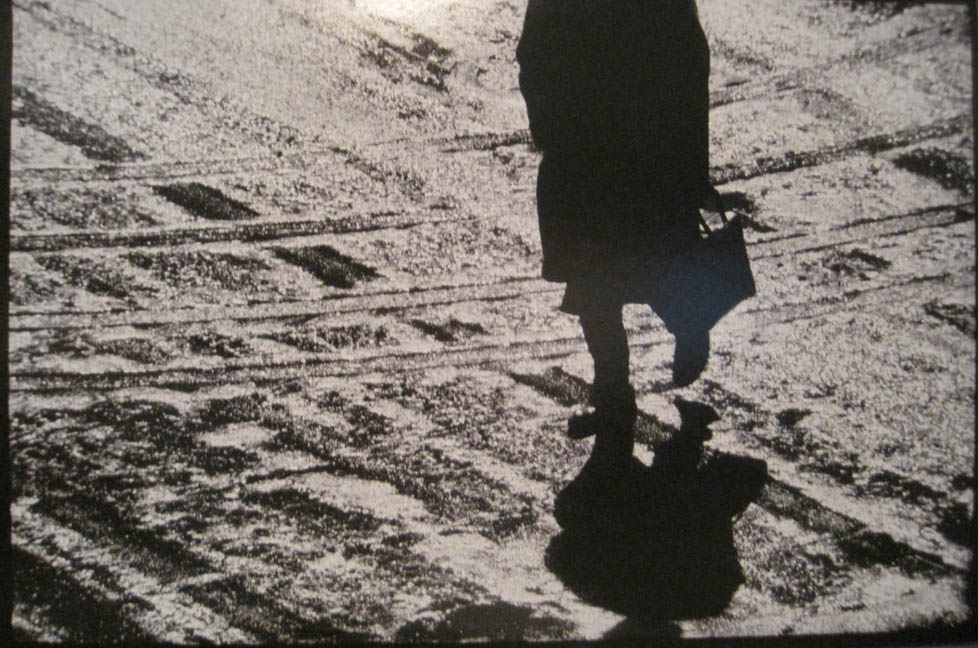
Images in this post, from the top: Arthur Taylor, by W. Eugene Smith from the Jazz Loft Project; the facade of the New York Public Library main branch on 5th Avenue; section of Lincoln Center; four photographs by W. Eugene Smith from the Jazz Loft Project (Vic Dickenson and Pee Wee Russell, Thelonious Monk and Town Hall band, Zoot Sims on saxophone, and David X. Younng's canvases and Jimmey Raney on guitar) exterior of Carnegie Hall; self portrait caricature of the tenor Enrico Caruso from the Rose Museum collection; Isadora Duncan's scarf from the Rose Museum collection; Untitled, by W. Eugene Smith from the Jazz Loft Project.

Monday, August 9, 2010

Whtney Museum of American Art

5/21/2010, Friday (continued)
:
TIME: 2.5 hrs
COST: Normally $18, but we went Friday after 6 for "pay what you wish" admission.

The Whitney Museum of American Art (a.k.a. the Whitney) is the “other” modern art museum in New York.  Mind you, there are a number of modern art museums in this city, but the Whitney is the only one that even tries to compete with the big guns, the Guggenheim and the Museum of Modern Art (a.k.a the MOMA).


It doesn’t succeed, mind you.  How can you compete with a 150,000 work collection from the likes of van Gogh, Picasso and Salvador Dali?  Instead, the Whitney seems like a plucky younger sister museum: younger and smaller, but bolder and more brazen.  It doesn’t have the classics like van Gogh’s “Starry Night”, but instead manages to carve out a niche for itself in the newest art movements and most current artists.  100 years from now, the people exhibited in the Whitney might be the Picasso’s of their age, or forgotten has-beens.  The greatness of any given work is still to be decided and that makes the Whitney’s collection excitingly edgy, perhaps the one area where it trumps MOMA, just a little. 

The Whitney was founded by Gertrude Vanderbilt Whitney (see painting at right by Robert Henri), heiress of both the great Vanderbilt and Whitney (Standard Oil) fortunes. But even with so great a patroness, the Whitney has struggled for respect throughout its history.  In Gertrude’s time, the focus of the art world was on Europe, yet she valued art from her own country and collected only under recognized modern American artists.  When her 700 work collection outgrew her Greenwich Village house, Gertrude tried to donate it to first the Metropolitan Museum of Art and then MOMA, but neither museum wanted the collection.  Consequently, in 1931, she founded her own museum, and the Whitney has celebrated the American avant garde ever since, persevering through thousands of controversial reviews and attempting to win over a very skeptical public. 

We were lucky to visit during the Whitney Biennial, a prominent and much-debated event in the art world that takes over the museum every two years and attracts long lines of visitors.  The Biennial exhibits current works from living, generally young American artists.  All works are sold to collectors after the show, with the Whitney selecting favorites to enter its collection.  It’s considered very prestigious for an artist to get a work into the show and it’s a great launcher of careers.  However, the biennial is probably better known for the smackdown it takes from critics, artists and the public alike.

This year, in an attempt to respond to that criticism, the Whitney devoted an entire floor to a special exhibit called “Collecting Biennials,” consisting of works the Whitney kept from past biennials.  This turned out to be our favorite part of the museum, as it featured a great range of art, from dated one-hit wonders to familiar modern classics.  There were many artists that Paul and I recognized, even with our limited knowledge, such as Jackson Pollock, Edward Hopper, Andy Warhol, Jasper Johns and Georgia O'Keeffe, clearly making the point that the Whitney exhibited these great American artists when they were still young and struggling for acceptance.  Attached to the exhibit, there was a room of newspapers and magazines collecting every review of the 75 Whitney Biennials, so you could look back and see who really turned out to be right: the Whitney or the critics.


My favorite part of the museum was the section spotlighting Edward Hooper (see picture above), an artist in the 30’s and 40’s who participated in the first-ever Whitney annual (later to become the biennial) in 1932 as an unknown.  Soon after, his career began a meteoric rise that has continued after his death, with the Whitney holding the largest collection of his works in the world.  I enjoyed his quiet but tense paintings of the streets of New York and Brooklyn, somehow capturing the loneliness of modern city life in streetscapes and faceless figures.  Other works that caught my eye (and made me laugh) were the life-sized squishy toilet  (“Soft Toilet” by Claes Oldenburg) and the huge sculpture made of hair that looked like a cross between dreadlocks and an exploding spider (“Untitled” by David Hammons).

The rest of the biennial was a dizzying mix of sculpture, photography, painting, mixed media, and a large amount of filmed performance art.  The latter made for a lot of movie watching.  We went during a pay-what-you-wish time (Friday evening), so the museum was full, but unlike MOMA’s free night, many Whitney visitors at this time seemed to be students, with tightly held clipboards, busy pencils and very serious expressions.  We guessed that it must be part of an end-of-term project at some of NYC’s many art schools.  The students were much more uptight and pushier than your average museum patron, giving us hard looks and impatient gestures if we did anything that could be interpreted as disruptive, like standing in front of a sign (me) or whispering during a movie (Paul).  It felt like the place was full of very young, very pretentious, very bossy librarians. 


The meaning of some of the art was clear, like the series of photographs depicting the wedding of a young Marine who lost an arm, his face, and much of his skull in a suicide bombing (“Marine Wedding” by Nina Berman).  Yet most of the Whitney’s collection was much more puzzling, like the 50 foot picture of smoke ("Smoke Knows" by Pae White), the gigantic macramé wallhanging ("Untitled; The Year We Make Contact" by Piotr Uklanski), or the ceramic couch covered in newspaper clippings (“Couch For a Long Time” by Jessica Jackson Hutchins).

Paul particularly liked the performance pieces with a psychological bent, such as the movie of men performing bizarrely rigid calisthenics, reenactments of a set of gymnastic exercises prescribed by German physician Daniel Gottlob Moritz Schreber in the 1850’s (“Ärztliche Zimmergymnastik”, by Jesse Aron Green).  One of Schreber’s sons committed suicide, and another had several infamous bouts with mental illness, giving the performance a decidedly sinister air.  Another of Paul’s favorites was the documentary-style movie of H. M., a man who, after experimental surgery to cure epilepsy in the 1950s, lost the ability to remember any new information beyond a 20-second span (“H. M.” by Kerry Tribe).  Psychology plays a big part in Paul's life, and after years of hearing about H. M.'s condition, Paul found it awe inspiring to actually see it portrayed. The same film was shown on two screens, with one being 20 seconds behind the other to highlight that interval, and the fragile nature of human perception.  Paul also thought the tiny gnome village in the Whitney stairwell was a nice touch.  It made him smile after a long day of museum hopping.

In conclusion, Paul and I where somewhat overwhelmed by the Whitney’s collection.  It felt disjointed and, as is common with modern art, we often felt like we missed the point, or that the point needed far too much explanation.  However, we found many pieces that we liked, that made us think, or squirm, or even smile, and we loved the Whitney’s devotion to the young artists of this country (it felt very patriotic), and its fierce independent spirit.  Thus we would recommend this museum to the open minded museum goer.  We promise that you’ll at least be entertained, even if you hate everything.


Images in this post: Vertical Red White Light, by Josh Brand, 2009; exterior of the Whitney Museum of American Art; Gertrude Vanderbuilt Whitney, by Robert Henri, 1916; Summer Days, by Georgia O'Keeffe, 1936; Early Sunday Morning, by Edward Hopper, 1930; Soft Toilet, by Claes Oldenburg, 1966; Untitled by David Hammons, 1992; Smoke Knows, by Pae White, 2009; Untitled (The Year We Make Contact), by Piotr Uklanski, 2010; Ärztliche Zimmergymnastik, by Jesse Aron Green, 2008; Baby, by Thomas Houseago, 2010.