Monday, October 18, 2010

Museum of Arts and Design

Landscape I, by Levi van Veluw
5/15/2010 Saturday, continued
MUSEUM: Museum of Arts and Design
TIME: 1.25 hrs
COST: $15 each

Museum of Arts and Design
The Museum of Arts and Design exhibits contemporary art, but with a twist.  It focuses on the art and design of hand-made "crafts," exhibiting objects made primarily in 1 of the 5 traditional craft materials (clay, glass, wood, metal, and fiber).  I thought the twist really worked for the museum, making it stand out from the other contemporary galleries we’ve seen.  The art was applied and approachable, and exhibits had a 3-dimensional and sculptural feel.  Paul disagreed.  He thought the limitation to 5 materials was a gimmick that the museum didn't really stick to.  Also, he felt that the museum was either arts OR design; many of the design exhibits didn't work as art, and the art exhibits didn’t work as design.  He liked it when pieces hit that “sweet spot” and combined both, but felt that was rare.  We’ll leave it too the reader (and museum-goer) to decide for themselves.

Untitled, by Shokosai Hayakawa
Sagittarius, by Shen Shaomin
If the focus on crafts and craft materials is a gimmick, at least the museum comes by it honestly.  For 46 years it has exhibited the work of American craftspeople, first as the Museum of Contemporary Crafts, then the American Craft Museum.  Its founder and patroness, Aileen Osborn Webb, sought to bring awareness to the artistry and beauty of handmade objects in an age of machine-made products.  Today, the museum has broadened its scope and includes both traditional crafts (e.g. baskets and pottery, see example at left), as well as objects made more for their expressive and conceptual content (i.e. art, see example at right).  

In 2002, the museum moved into a modern 9 story building on the famous Columbus Circle, facing the southwest corner of Central Park.  We were lucky enough to walk in just as the (free) guided tour began and got extensive explanations of the exhibits, which was much appreciated.  The guide followed what we've come to realize is the preferred mode of museum viewing: starting at the top and working down.  We’d recommend taking the stairs at this museum, as there were installations in the stairwells, such as blown glass goblets and painted murals.

Cauda Equina, by Keith Bentley
The top floor is dedicated to open studios, with young artists actively working on projects.  While we were visiting, there was a woman cobbling bizarre shoes and a group of people putting together a bicycle made entirely out of bamboo.  (The next thing in renewable resources?)  According to the guide, the next two floors down were dedicated to the “fiber” part of the museum, with fiber interpreted as anything organic.  The exhibit was called “Dead or Alive,” and presented the works of 30 different artists who work in organic materials that were once part of living organisms.

Skull, by Jan Fabre
It was an interesting collection, high on the ick factor but fascinating, like a particularly bizarre insect.  There were fanciful skeletons of extinct or mythical creatures made entirely from chicken bones from fast food dinners (I shudder to picture the artist’s cholesterol levels), a delicate chandelier of lit dandelion puffs, a shaggy horse-like taxidermy animal made from the manes of slaughtered horses (picture above), abstract sculptures made of pigeon feathers, a motorcycle with a cow skeleton frame (picture below), a suit of sticks, and lots of things made from dead bugs, including dried butterfly wallpaper, a beetle casing skull (picture at right), and a silk worm cocoon chandelier.
Mad Cow Motorcycle, by Billie Grace Lynn

Tides, by Ferne Jacob
Kuskokwim, by Fran Reed
The next floor down contained the clay and wood exhibits, showing an odd collection of 1960’s semi-abstract ceramic sculptures and a number of baskets.  Most of the baskets were non-functional and clearly meant to be modern artistic statements, such as the baskets made of coiled thread (picture at left) or dried fish (picture at right).  I enjoyed the exhibit, feeling it stretched and challenged the idea of what a basket was, but Paul felt these impractical containers had lost the essence of what a basket was.  According to Paul, “If you can’t put something in a basket, it’s not a basket.”
Wedding Neckpiece, Berber, Siwa Oasis, Egypt;  Miao Neckrings, China; Pair of Anklets, Upper Egypt

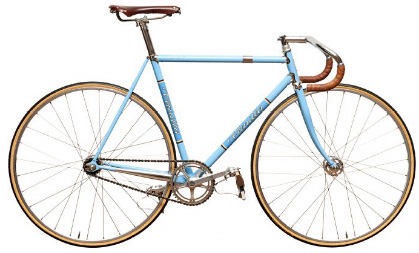
The lowest exhibition floor was entirely devoted to metal.  There was a section on the jewelry of tribal peoples in North Africa, India, and Southeast Asia.  Most of the pieces looked heavy and uncomfortable, prized less for beauty and more as a show of wealth, used for trading or as a transfer of wealth in dowries.  It made for an interesting commentary on the history and practicality of jewelry.  The rest of this floor harbored a massive collection of bicycles in the exhibit “Bespoke: The Handbuilt Bicycle.”  For once, I agreed with Paul.  Neither or us saw much art of what looked like perfectly normal bicycles, but then we aren’t avid cyclists so we’re probably missing something.

Our take on things:  The Museum of Arts and Design was our second design museum.  The first, the Cooper-Hewitt National Design Museum, focused purely on design and design innovations, and was fairly technical.  The Museum of Arts and Design took a completely different approach and concentrated more on art, often seeming to leave design out of the equation.  We both liked its novel uses of traditional craft materials and felt that the museum’s exploration of art in common objects (and things made from common objects) made for largely interesting and approachable exhibits.  However, Paul would have liked to see more exhibits with both art AND design.

The bar at Robert
One last note:  The top floor of the building is devoted to a posh restaurant by the name of “Robert.”  Robert has a cool retro 60’s vibe with neon pink carpeting and sculpted plastic furniture, but the real reason to go is the view.  The restaurant’s floor to ceiling windows frame a gorgeous panorama of Central Park and the ultra swank condominiums of Park Avenue.  As this was our 4th museum of the day, Paul and I split a 12-dollar pot of tea and relaxed in the bar, ogling the view and watching glamorous young woman in super high New York heels negotiate the treacherously slick tile floors.  (No one fell, but there were some close calls.)  We thought the experience well worth 12 dollars.

Fragile Future 3, by Lonneke Gorkijn and Ralph Nauta
Images in the post, from the top: Landscape I, by Levi van Veluw, 2008; Image of the Museum of Art and Design; Untitled, by Shokosai Hayakawa, 2000, interlaced bamboo; Sagittarius, by Shen Shaomin, 2005, chicken bones, bone meal, glue; Cauda Equina, by Keith Bentley, 1995-2007, 1.4 million hand knotted horse hairs, fabric, taxidermy mannequin, resin; Skull, by Jan Fabre, 2001, mixture of wing cases of scarabs on plastic, stuffed animal; Mad Cow Motorcycle, by Billie Grace Lynn, 2008, cow bones, bicycle frame, electric motor; Tides, by Ferne Jacobs, 2002-2003, coiled waxed linen thread; Kuskokwim, by Fran Reed, 1994, silver salmon skin, felt tip pen, dyed and undyed gut, driftwood, cane; Wedding Neckpiece, Berber, Siwa Oasis, Egypt, 19th - 20th century, silver; Miao Neckrings from China, 20th century; Pair of Anklets from Upper Egypt, 19th century; interior of the restaurant Robert; Fragile Future 3, by Lonneke Gorkijn and Ralph Nauta, 2010, phosphorous, bronze, dandelion puffs.

Tuesday, October 5, 2010

What 60 Museums Have Taught Us


We’ve just finished our 60th museum, and have thus completed one third of our 180 museum goal.  Seeing 60 museums in 9 months has taught us a great deal; we’ve learned many things about art, some things about museums, and a little about ourselves.  In the hopes that what we've learned can help future museum-goers, we offer this list:

Always, Always, Always Get the Audio Guide

Museum goers are often idealistic.  “It’s art.  It should elicit a response on its own.  It shouldn’t need explanation.”  Then you find yourself standing in front of a stack of Tupperware (Cooper-Hewitt National Design Museum), three nearly identical pictures of goldfish bowls (Matisse exhibit at MOMA) or a basketball suspended in an aquarium (New Museum of Contemporary Art), and you suddenly realize, you’ve got nothing…. 

It so much better to dial a number and have some erudite curator murmur in your ear, “Tupperware was revolution in food conservation, leading to changes in kitchen design and the way meals were prepared after WWII.  Also, its all woman sales force and home marketing was an influence on women’s liberation and a radical change in marketing strategy;” or “Notice the use of white paint in the first painting, creating luminosity in the fish bowl, while the painting on the left uses dark shadows in the room to emphasize the bowl.  Matisse was experimenting with the abstraction of light, which can never be painted, only represented.”  We didn’t get the audio guide at the New Museum of Contemporary Art, so we’ll aways wonder about that basketball.


Start at the Top and Work Your Way Down

Most museums are designed to be seen from the top down.  Detailed, high profile exhibits are placed on upper floors, and the lobby floor is generally the least interesting.  Paul and I have learned that, when in a multi-floor museum, take the elevator to the top, then work your way down; if possible, use the stairs to move between floors as you descend.  It’s the most efficient way to see a museum.  If you don’t believe us, try it some time.


Small Museum Does Not Mean Small Amount of Time

When we started this project, we assumed two things about the 180 museums of New York: 1) that while New York City has several very large, very famous museums (i.e. the Metropolitan Museum of Art and the Natural History Museum), the bulk of the 180 would be much smaller affairs; and 2) that we could get through these smaller museums quickly.  “We’ll breeze through large swaths of them in 30 minutes or less,” I naively assumed.

We were right about the first assumption.  Outside of a few famous behemoths, most NYC museums aren’t very large (NYC real estate prices being extremely good motivation for small floor plans).  However, we were completely wrong on the second. Small museums have to fight for both patrons and financial survival, and as a result many are focused and captivating places with jewel-like collections: small but breathtaking.  Also, they’re often staffed by zealots.  People who have given up their Saturday, spending the entire day on their feet, without pay, just to talk to you about one particular subject.  These are not the sort of people you ignore. 


Free Times: Not Always a Good Idea

At small museums, free times can be a nice bargain, but at larger, more well-known museums, you should weigh the worth of a good deal against the inconvenience of standing in long lines and fighting through the crowds that will lie between you and every painting.  Sometimes it’s best to pay full price.

One addendum to this: if you’re looking for a bargain, there are other ways.  You can usually find coupons to the popular attractions like Madam Tussauds, Ripley’s Believe It Or Not, and the Discovery Times Square Exposition on the web, and many other museums post discounts or coupons on their websites, particularly during the off seasons (spring and fall).  Additionally, students often receive significantly reduced admission, and even get in free at some museums, so it pays to ask if you happen to have a student ID.  Lastly, for the daring bargain hunter, several of the largest, most expensive museums (i.e. The Met, The Museum of Natural History and The Cloisters) are actually “suggested donation” museums.  You can pay just a penny, if you’re brave enough to push the coin across the counter.

Don’t Bring Knives to a Jewish Museum

Most museums put a guard at the door, a few guards in the rooms, cover the place with cameras and leave it at that.  However, Jewish museums can be more serious about security (for understandable reasons), and add metal detectors and purse/coat searches to the gauntlet.  Paul’s pocketknife does not go over well.


Be Prepared to Pay More Than the Admission Price

Transportation, parking, coat check fees, snacks, drinks, programs and souvenirs- it all adds up.

Maritime Museums: The Museums of the Common Man

New York City has a port city since it’s creation and salt water runs deep in its veins.  The city has a number of maritime museums (8 at last count), and most are built, staffed and maintained entirely by volunteers.  These are not members of the rich upper crust behind so many Manhattan museums, these are ordinary people with jobs and busy lives who give their time, their sweat, and their personal collections, making these spaces feel both passionate and intimately personal.  Maritime museums are not the prettiest museums, but in a world of expensive, polished, high profile collections, they stand out as being more honest, and have an emotional resonance that cannot be ignored. 

Modern Art and Contemporary Art May Sound Like the Same Thing, But They're Not

The exact definition may be debatable, but generally modern art means art produced 1860 – 1960, while contemporary art means art produced 1960 – present.  The two are VERY different.  Modern art involves the exploration of unique styles and a trend toward abstraction (Impressionism, Cubism, Surrealism, etc), while contemporary art breaks down the borders between all styles and media, and anything goes.  Don’t walk into to a contemporary art museum like the Whitney or P.S.1 and expect to see anything as mundane as a “painting,” and the impact of a Picasso painting at the Guggenheim is going to be very different from a pile of life-like male genitalia (Black Narcissus) at the New Museum of Contemporary Art.


You Don’t Know What Kind of Art You’re Going to Like Until You See It


Paul:  Seeing 60 museums have confirmed his love of photography and iconography.  He’s realized that he doesn’t particularly like modern art, and to his utter shock, has discovered that he enjoys a great deal of contemporary art, particularly performance art.

Pauline:  Seeing 60 museums have confirmed her love of modern art and architecture.  She’s realized that she doesn’t hate medieval painting as much as she’d thought, and to her utter shock, has discovered that she enjoys some contemporary art, particularly sculpture.


Worst Borough to Drive: Brooklyn 

Worst Borough to Park: Manhattan 


Best Museum Café: Café Sabarsky at the Neue Gallery 

Best Pizza in New York City: Deninos on Staten Island (in our humble opinion) 


Images in this post, from the top: In the upper collage, listing the museums from left to right:  Seventh Regiment Armory Conservancy; Whitney Museum of American Art; Cooper-Hewitt National Design Museum; Paley Center for Media; The Guggenheim Museum; Rubin Museum of Art; Museum of the City of New York; Austrian Cultural Forum; Morgan Library and Museum; Wave Hill House; Scandinavia House.  Images below the collage: One Ball Total Equilibrium Tank (1985), by Jeff Koons; New Museum of Contemporary Art, with diagram; interior of the Guggenheim on Pay-What-You-Wish Friday; no pocketknives; Before the Mirror (1876), by Manet; Supper Sister (1999), by Lisa Lou.  Lower museum collage: Enid A. Haupt Conservatory at the New York Botanical Gardens; Jewish Museum, Museum of Biblical Art; Neue Gallery; Valentine-Valerian House.

Thursday, September 23, 2010

Edgar Allan Poe Cottage/ Maritime Industry Museum

3/13/10; Saturday, continued

MUSEUMS:
Edgar Allan Poe Cottage ……..……................. 5 min
Maritime Industry Museum ………………..…... 1 hr

COST:
Edgar Allan Poe Cottage ……..…………..…... under construction
Maritime Industry Museum …………………... Free

PAUL HERE:  Continuing the story of our visit to the Bronx during the “Day of the Storm,” our third stop was the Edgar Allen Poe Cottage.  This is just off the Grand Concourse in the Bronx.  The Grand Concourse is an amazing street, easily one of the most aesthetically stunning streets I have ever seen.  Modeled after the Champs-Élysées in Paris, but larger in scope and length, the Grand Concourse is a 4 mile Art Deco masterpiece, and a drive down this road is a museum visit in its own right.

The Edgar Allan Poe Cottage was the final residence of the famous American author Edgar Allan Poe (1809-1849).  In this farmhouse, after losing his wife Virginia to tuberculosis, Poe wrote some of his best known works, including Annabel Lee, Ulalume, The Bells, and Eureka.  The tiny white cottage is located on a small triangle of land in the middle of the concourse (not surprisingly called Poe Park), next to a visitor’s center, which seems to be perpetually under construction.  When we went, the building was closed so we did not go inside.  However, I felt that navigating through a torrential rainstorm to see a tiny cottage was a fitting tribute to the tormented author, so we checked it off our list and ran back to the car to find someplace drier to visit.

PAULINE HERE:  I have to say something here.  Paul, bless his heart, is somewhat of a hopeless romantic.  While he saw a cottage in a park, I saw a dilapidated shed sitting at a bit of a slant in a muddy traffic island, surrounded by a rusty fence that had clearly been there a while.   The “cottage” is under construction for at least 2 years.  While it's difficult to imagine what they could possibly be doing to a shed in a traffic island that would take that long, it does mean that we won’t be able to visit it during the duration of our “Museum-a-thon.”  I’ll try to overcome my disappointment.

PAUL HERE: Our next stop was clear across the Bronx, east to the Throggs Neck peninsula where the East River meets Long Island Sound.  Our destination was the historic Fort Schuyler, a pre-Revolutionary War fort once part of a gauntlet of forts built to protect the New York harbor.  Fort Schuyler has been lovingly restored and now houses the State University of New York (SUNY) Maritime College (founded in 1874 it was the first college of commercial nautical instruction in the U. S.) and the Maritime Industry Museum.

The location of this particular museum, jutting out on a low peninsula into Long Island sound, was probably not the best choice to visit during a major storm.  However, it was open (kind of).  There was no one around as we made our way through Fort Schuyler to the museum, making it difficult to find the right door, and we wandered around the chapel and an empty library before we found our way.  The museum ended up being located in the hallways of the old fort, which also doubles as classroom space for the school.  This is important as there was a troop of Boy Scouts and Explorer Scouts getting maritime training during our visit there.  The hallways were largely echoing darkened corridors containing only ship pieces and models, but every once in a while we would surprise a scout intently working on a project, garnering quizzical looks, as if asking “I am required to be here during a massive storm, what’s your excuse?”

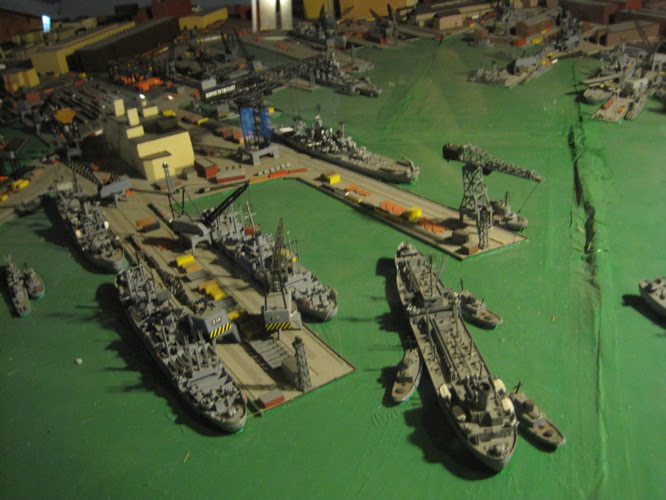
The Maritime Industry Museum houses exhibits on the history of the United States maritime industry, including commercial shipping, the merchant marine, and the port of New York, as well as exhibits on the history of Fort Schuyler.  It is a treasure trove of scale models of ships, artifacts from shipwrecks (including dinner plates from the Titanic), large pieces of shipping equipment, and a vast detailed history of the Port.  As we walked through the long, dimly lit barrel vaults of the old fort, we got a feel for the importance of the port, and the hard work and sacrifice of the people who ran it.  We also really felt the love some people have for ships.  There are at least a dozen detailed ship models of various classes and sizes, most of them built by a single person, Frank Cronican.  These are not just plastic snap-together models. No, these are hand made, delicately crafted models that are awe inspiring in their intricacy, and clearly took a huge amount of work. The man who built these models loved his ships. 

I think that is what sets this museum apart from others we have seen.  This museum feels like a labor of love.  There was a passion for the subject that we could feel in the bones of the place.  The museum is funded, staffed, operated and maintained strictly though volunteer support and donations.  Many Maritime College cadets volunteer time to serve as museum tour guides and provide exhibit construction and upkeep, and alumni participate in periodic "work parties" to do their share.  While the museum was modest, it made a very strong impression on both Pauline and I, and we were very happy to have braved the storm to see it. 

Images in this post, from the top: silhouette of a ship model in the Maritime Industry Museum, the front steps of the Bronx County Courthouse, located on the Grand Concourse; photograph of Edgar Allan Poe; entrance of Fort Schuyler; lobby of the Maritime Industry Museum; dinner plates recovered from the wreck of the U. S. S. San Diego; ship model in the hallway of the Maritime Industry Museum; scene from "A Day in the Life at the Brooklyn Naval Yard," a replica model of the Brooklyn Naval Yard during World War II circa 1942-44 built by Chief Yeoman Leo J. Spiegel, USN (ret.); sailor's wristwatch recovered from the wreck of the Relief Light Ship.

Monday, September 13, 2010

Valentine-Varian House / Lehman College Art Gallery

3/13/10, Saturday

MUSEUMS:
Valentine-Varian House ……………………… 1 hr
Lehman College Art Gallery …………………. 45 min

COST:
Valentine-Varian House ………………….…… $5 each
Lehman College Art Gallery …….……………. Free


PAULINE HERE: On Saturday March 13, the New York region experienced a terrible storm. Considered the worst in 30 years, a powerful Nor’easter tore through the area with wind gusts up to 60 mph and over 5 inches of rain.  Half a million people lost power, roads and homes flooded, and 6 people were killed by falling trees.  In the middle of the storm, Paul and I went to the Bronx to see museums.

The idea to go out in the storm was mine, and I’ll admit it was a bad one.  In my defense, I have to say that I was mislead by the wussy attitude of New Yorkers toward rain.  I’m from Seattle (where it rains, a lot).  This was my first spring in New York, and I had been repeatedly astonished by people canceling or changing plans due to rain.  If there is even the slightest chance of precipitation, New Yorkers bail on everything and stay home.  I’m still mystified.  What tragedy do they think will befall them if they venture out in the rain?  Do they melt?  Needless to say, no Seattle-ite would ever stay home due to rain; if you did, you’d be a shut-in September through June.  So when I heard it would rain today and was advised that we shouldn’t leave the house, I rolled my eyes and muttered snarky comments under my breath about New York pansies afraid to get wet.  (To be fair, Paul says similar things about Seattle-ites and snow.)  I didn’t check the weather report to see if perhaps this was an exceptional amount of rain.

Surprisingly, museum-hopping in a storm was a fun experience.  Sure one museum was closed due to power outages, but the museums that were open were NOT crowded.  In some places we had the full attention of chatty bored docents who admired our dedication (Valentine-Varian House).  At other museums we were the only customers, left alone to explore the echoing halls however we wanted (Maritime Industry Museum).  Paul has volunteered give me a break from writing and do the museum blogging today, and he’ll tell you all about it.

PAUL HERE: So when Pauline and I started out doing this project, we were committed to seeing all of the different boroughs of NYC.  The one that caused us the most trepidation was the most northern borough, The Bronx.  Most people only think of two things when it comes to The Bronx- Yankee Stadium and crime.  The crime-ridden reputation is so strong that one of our friends who is from the Bronx is often asked if he’s ever been shot, and how he survives.

While crime and the Yankees can still be part of the Bronx experience, they are both located in south Bronx.  Today we largely visited the north end, which is surprisingly wealthy and very, very nice.  However, the day we went into the Bronx was not so nice.  This particular Saturday had cold, gale-force winds, driving torrential rains, downed trees and broken umbrellas in abundance.  I questioned our reasons for gallivanting around in a torrential storm, but Pauline was made of sterner stuff.   She offered to drive, I agreed, and off we went.

Our first stop was the Valentine-Varian House, built in 1758 by blacksmith Isaac Valentine.  It’s the borough's second oldest house and oldest remaining farmhouse.  The house remained in the Varian family (which included Isaac Varian, New York's 63rd Mayor) until 1905.  Currently, it houses a few period furnishings, the Bronx Historical Society, and a small exhibit on Edgar Allen Poe, whose house is just down the road.  The house is small, and not in its original place.  We’ve noticed that house moving is a pretty common phenomena with historical houses- a new development wants the land, so the house gets pushed off.  Moving the Valentine-Varian took 2 days and is detailed in a series of pictures.  The stone house was ribbed with steel bands, pulled across the street by an enormous 48-wheel dolly, turned ninety degrees to rest in the street, then a nearby park was enlarged to include the site.

The house also holds a small but interesting presentation on the history of the Bronx.  The docent was extremely informative and told us great stories about when the Bronx was a bustling, wealthy city/borough. He also told us about the decline of the borough and its slow recovery.  There was also a nice discussion on Edgar Allen Poe, but we got sidetracked talking about the addictive qualities of sugar with the docent and two other guests taking refuge from the storm, so we did not examine it in depth.  Pauline and I both thought that this was a really good start to the day.  It took a little longer than we thought, primarily because I am really chatty, but it gave us a perspective on the Bronx we did not have, making it seem far less dangerous.

Our next stop was a short drive to the Lehman College Art Gallery.  Founded in 1931, Lehman College is one of the constituent colleges of the City University of New York and is named after Herbert Lehman, a former New York governor and United States senator.  It has a very well regarded art gallery, known for publicizing artists who are on the edge of being big.  We walked into the art gallery during an alumni event, and the place was set up for a nice reception.  Even after notifying them that we were not alumni, we were invited on a tour and offered all the coffee and dumplings we could eat.  They even asked us to pose in the group picture, so we’re probably featured in the alumni magazine. 

The tour focused on the exhibition: Nature, Once Removed: The (Un) Natural World in Contemporary Drawing. It was a mix of student and professional artists each representing natural scenes using “pop” and “post-pop” sensibilities. The art was very modern, used a lot of mixed media, and offered a really different approach to nature as compared to traditional representation.  I think I liked this more than Pauline.  It succeeded, at least partially, to distort and shift perspectives on nature.  Like most modern art, it seemed that it either made a strong impression, or none at all.

The second gallery had a exhibition called State of the Dao: Chinese Contemporary Art. This was another modern-contemporary exhibit focusing on the way Chinese culture has evolved over the years.  It featured Chinese artists exclusively, using media ranging from a short video to busts carved from phonebooks (see image at left).   It, like the previous exhibit, was hit or miss.  I personally think that this would have been better if we knew more about Asian art in general. As I have learned more about where these artist’s traditions came from (by going to a bunch of Asian museums since then), I’ve come to appreciate the works a little more.

All in all, the friendly open-ness of the people we met today in the Bronx belied the rough reputation of this borough.  The Valentine-Varian House is a small museum, but its exhibits on Bronx history and chatty, knowledgeable staff provided a great introduction to the Bronx.  The Lehman College exhibits were strong examples of what is good in contemporary art, and were diverse, thought provoking and generally well done.  While we are not alumni of Lehman College, the alumni association welcomed us as one of their own and they put on a nice show, despite the horrible weather. 


Images in this post, from the top:  Upright Shepherd Walker, by Nicholas Di Genova, 2006; 2 images of the New York City area after the March 13 storm; exterior of the Valentine-Varian House, taken on a nicer day than the day we visited; interior of the Valentine-Varian House; Untitled, by Daniel Johnston, 1998; Common Buzzard, by Jackie Hoving; Old Testament Prophet, by Long-Bin Chen, 2009; Watermelon, by Yang Jinsong.

Saturday, September 11, 2010

Museum of Biblical Art

Saturday, continued

TIME: 45 min
COST: $7 each

Opened in 2005, the Museum of Biblical Arts (MOBIA) is one of New York’s newer museums, but grown out of one of its older societies, the American Bible Society (founded in 1817).  It’s located in a modern glass-fronted building on Broadway, above a bookshop selling what you’d expect the American Bible Society to sell.  The museum had an odd security set up, with three security guards briskly patrolling its tiny two room space and peevishly demanding all of our pens, leading us to wonder what sort of violent graffiti artists normally frequent the place

Going in, I was a little worried that the museum might resemble a Christian Science Reading Room, but the museum is careful to take an educational and religiously neutral approach to the bible, viewing it as an important source of stories and symbols in Western art and offering exhibits on a wide range of art with biblical context.  To quote from its mission statement, “MOBIA takes no position on religion, only that the role of the Bible in literature and art is culturally profound.”  Past exhibits have included the influences of the bible on modern artists (Chagall’s Bible; Mystical Storytelling), cinema (Reel Religion; A Century of the Bible and Film), folk art (Self-Taught Artists, the Bible, and the American South), and, of course, medieval art (The Glory of Ukraine; Sacred Images from the 11th to the 19th Centuries).  One of the two exhibits on display today fell squarely in that latter category. 

Currated by Dr. Vivian B. Mann from the Jewish Theological Seminary, the exhibit “Uneasy Communion: Christians, Jews and the Altarpieces of Medieval Spain” used art of 14th- and 15th-century Spain to attempt to prove that Christian and Jewish artists of the time collaborated on the same pieces.  During this period, Spain was a multi-cultural society of Muslims, Jews and Christians, but many medieval Christian depictions of Jews are negative stereotypes and it’s often assumed that Jews lived apart, with little contact or co-mingling.  Yet this exhibit argued that that assumption may not be entirely correct, as artistic studios appear to have had both Jewish and Christian artists collaborating on the same pieces: Jews and conversos (Jews converted to Christianity) painting Christian altarpieces, and Christians illuminating Hebrew manuscripts.  Paul is fascinated by Spanish art and history and had been virtually drooling with anticipation to see this exhibit, timing our visit today to see it before it concluded.  (No, he’s not Spanish, just quirky.)  Unfortunately, he left feeling a little disappointed.

The first problem was that the exhibit was small, probably too small to illustrate its complicated historical subject.  There were only about 30 pieces (paintings, manuscripts, ceramic tiles and Jewish ceremonial objects) displayed in one small room.  All were on loan from other museums, most of which are in New York City (such as The Metropolitan Museum of Art and The Hispanic Society), with some paintings represented in photographs or reproductions.  It definitely seemed as if small, young MOBIA did not have enough clout to borrow items from further afield, but, to be more charitable, medieval art is notoriously fragile and doesn’t travel well, or without good reason.

The second problem was that much of the exhibit’s arguments and explanations were in tomb-like “catalog essays” tucked away in a nook at the back of the room, which Paul and I did not discover until we were ready to leave.  At this point we were a little frustrated and out of patience from trying to piece together the cryptic comments written on the walls in small print.  With some effort, we had determined a few things, like the fact that pointy halos in paintings meant the holy person in question was Jewish (see example at left), and that biblical Jews were often featured in places of prominence and honor in Christian alterpieces in Spain.  Also, many of the altarpieces featuring Jews had extremely detailed and knowledgeable depictions of Jewish temples and rites, for example, an early-15th-century painting illustrating the boy Jesus impressing doctors in a synagogue accurately represents what the interior of a medieval synagogue looks like (see picture above).  Also, a depiction of Zacharias contains elaborate details of Jewish objects and rites, such as a tik (Torah container) and an attendant holding a golden rope tied to the priest (allowing retrieval of his body if he died in the Holy of Holies; see picture at left).  It's unlikely that a Christian would know these details, suggesting that the artist was Jewish or converso.

The second exhibit at MOBIA was “Pearl of Great Price,” a selection of about 20 bibles from the Rare Bible Collection of the American Bible Society.  The society has been collecting for nearly 200 years and has over two thousand bibles and manuscripts.  Much of the collection has a historical focus, with bibles in original/ancient languages (i.e. Greek and Hebrew) documenting the history of bible text in early translations.  However the bibles on display today were of less scholarly interest, chosen as crowd pleasers for the beauty of their covers and illustrations, or association with exotic locales, historical events and/or celebrities. 

We saw the first folio Bible printed in America, elegant woodblocks of early bibles printed in Japan and gorgeous silver inlays on Chinese bibles meant for royalty.  We tried (usually unsuccessfully) to pick out words in translations into exotic languages, such as Delaware, Bengali or Malay, and marveled over the gigantic Braille bible made for Helen Keller.  It was a fun exhibit, but Paul and I would have appreciated learning more about the background and history of each bible.  Looking at them, you knew that each bible had a story to tell, about why it was made and the people who fought battles (sometimes literally) to print them, but, regrettably, those stories weren’t part of the exhibit, so they were reduced to being just nifty books. 

Our take on things: The Museum of Biblical Arts is a very small, very new museum, with both good and bad points.  I was disappointed by the lack of detail in the exhibits, but pleasantly surprised by the museum’s scholarly and non-preachy approach to biblical art.  Paul was dissatisfied by its limited space and items, but applauded their ambition in tackling a complicated historical subject.  We both think that, given time (and a reduction of their security), this museum could develop into a very interesting space.
.
Images in this post, from the top: The Prophet Daniel, from the Altarpiece of Santa Cruz by Miguel Jiménez and Martín Bernart, 1485–87 (A painting from the Altarpiece of the True Cross that singles out three Hebrew prophets, stressing their importance by placing them at the eye level of the congregation.); exterior of the Museum of Biblical Arts;  Christ Among the Doctors, anonymous, early 15th century (Painting is set in a medieval synagogue bearing a distinct resemblance to one discovered during a recent excavation of a Jewish quarter in Lorca.);  Annucation to Zacharias, from the Retablo of St. John the Baptist by Domingo Ram, late 15th century.  (This painting is set in the Holy of Holies in the Jerusalem Temple. The prophet is dressed as the high priest on Yom Kippur, and fidelity to Jewish ritual is extensive, including the tik, bells on the garment hem, and the chain around the prophet’s leg held by a priest outside the sacred space.); four selections from the Rare Bible Collection at MOBIA.