Tuesday, July 27, 2010

7th Regiment Armory Conservancy / Asia Society

5/21/2010, Friday (continued): 

MUSEUMS:
Asia Society and Museum ………………..... 30 min

COST:
Seventh Regiment Armory Conservancy …. $12 each
Asia Society and Museum ……................… $10, but free after 6 on Friday
.
When we were making the list of museums in New York City for this project, we found most museums easily enough.  Most had reasonable P.R. and made the lists on New York Parks and Recreation or tourist information sites.  But during our travels we’ve found a few museums not mentioned in any guide.  We’ve come to call these the “hidden museums of New York,” known only to locals and a select few in the arts crowd. 

The Seventh Regiment Armory Conservancy (called “the Armory” by those in the know) is one of these hidden museums.  We discovered it through an article about the artist who exhibited there this month, but if I hadn’t read the arts section of the newspaper that day, we would have walked right by it today.  Which is actually a bit ironic, as the Armory is gigantic.  It takes up an entire city block on the Upper East Side, and its 55,000 square foot drill hall is among the largest interior spaces in NYC, just shy of Grand Central Station.

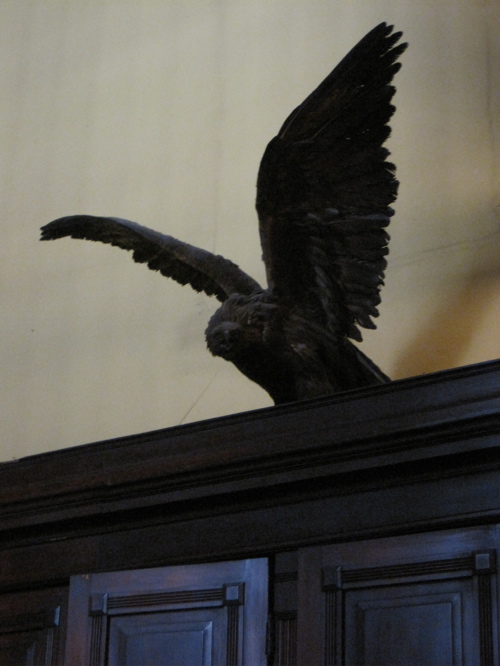
As you might expect from an unpublicized museum, the Armory is an odd duck: part military museum, part historic Gilded Age men’s club, and part exhibit hall for ultra modern performance art.  I am confident that no where else in the world can you walk through 6 inch thick armored oak doors and iron portcullis, past a stuffed eagle and a mounted moose head sitting next to a restored gatling gun lit by a nearby Tiffany stained glass window to see a 25 foot pile of laundry being picked up and dropped repeatedly by an 80 foot orange crane.  Yet that is exactly what we did today.  It’s going to be hard to top this one for bizarre museum experiences.

As with any place (or person) with this much quirkiness and character, the Armory has quite a past and has served a hodgepodge of rolls, as everything from a drill hall to indoor tennis courts to a synagogue.  It was originally built between 1877 and 1881 for the Seventh Regiment of the National Guard, State of New York.  This regiment was formed in 1806 to protect the city, after British frigates blockading New York Harbor fired at passing vessels.  It saw some action quelling riots in 1849 and helped with city fire fighting, but after NYC formed its own police and fire departments the regiment became largely ceremonial, serving as an honor guard and participating in civic events such as the inauguration of the Brooklyn Bridge in 1883 and the Statue of Liberty in 1886.


As a ceremonial guard, the regiment morphed into an elite men’s club for the sons of the city's wealthiest Gilded Age families, acquiring the nickname “Silk Stocking Regiment.”  Vanderbilts, Van Rensselaers, Roosevelts, Tiffanys, Stewarts and Livingstons all served here, and it was the immense wealth of these families that built the Armory we see today; the only armory in the United States built and furnished entirely with private funds.  And it took a lot of funds indeed.  The building itself was designed by Charles W. Clinton, the premier Gothic revivalist and designer of the famed Astor Hotel, and a veteran of the regiment himself.  He designed the exterior as a mock medieval fortress with brick crenellations, musket ports, arrow slits and a central tower. 

Inside, the club areas are lavish, designed by the era’s most prominent artists such as Louis Comfort Tiffany and Stanford White, and have been called “the single most important collection of 19th century interiors to survive intact in one building” by the New York City Landmarks Preservation Commission.  These rooms are undergoing a long restoration process, but wandering around in them is free and we highly recommend it.  Apparently two of the rooms are the only known Tiffany interiors to survive intact, and all of them are gorgeous even in their semi-neglected state.  If you squint your eyes as you wander you feel as if you can spy the shimmer of glamorous gowns and hear the clink of champagne glasses in some long ago cocktail party of New York’s storied past.
.

To raise money for the restoration, the Armory’s massive drill hall is rented out as an event and art space.  It's been used for Shakespeare festivals, operas, and most commonly, extremely large art installations.  While we were visiting we saw “No Man’s Land,” by Christian Boltanski, a performance art piece consisting of a 25-foot-high mound of used clothing, surrounded by a field of coats arranged in squares.  Every few minutes a five-story crane plucked a random piece of clothing from the top of the clothes pile, then released them to flop down haphazardly.  As we wandered among the clothes, we heard a ceaseless drum of heart beats emanating from poles at the corners of the squares.

Both Paul and I liked the exhibit.  I thought it was at least bizarre enough to be interesting, though I did come out of there wondering if I had let the laundry go too long again.  Paul loved it (as is usual for performance art) and saw it as a comment on the randomness of life: who gets chosen and who gets left behind.  Parts of the installation seemed designed to be reminiscent of a concentration camp, with a wall of numbers blocking off the entrance to the exhibit and rusty poles with low wires like fencing, although the meaning was vague enough to be open to interpretation and the people wandering the exhibit didn’t seem sure of how to take it.  Despite its size, the space felt claustrophobic, with narrow paths and low hanging lights, and dozens of heartbeats surrounding you from all sides.  Paul stood in line at an ersatz doctor’s office to get his heartbeat recorded for the exhibit, and even talked me into doing it.  Now our heartbeats will be preserved together in a permanent archive (Les Archives du Coeur) on an island off the coast of Japan.  I guess its kind of romantic, in a weird artsy sort of way.  (Paul knows its romantic in a weird artsy sort of way.)

The next museum was the Asia Society, a global organization “working to strengthen relationships and promote understanding among the people, leaders, and institutions of the United States and Asia.”  Our impression was that this organization was really more society than museum, as the gallery space was modest and much of the building closed off into what appeared to be conference space.  Looking online, the Asia Society has a full lecture schedule and seems focused on business development, with talk titles like “Why One Loves to Hate Globalization,” “Hong Kong’s Political Reforms: What Lies Ahead?,” and “Doing Business with Japan: Perspective of Australian Companies.”  Oddly, during our visit we couldn’t get a good grasp on what the goals and purpose of the society actually were, and it seemed somewhat mysterious.  Paul wonders what shadowy organizations really run the place, and what are they up to?

The art of the society is based around John D. Rockefeller’s exquisite collection of 280 Asian artifacts, which are displayed and interpreted in a variety of exhibits year round.  Today’s exhibit was “Pilgrimage and Buddhist Art,” focusing on objects from or about the major sites of Buddhist pilgrimages.  Unfortunately, the exhibits weren’t well explained, and we had to attempt to eavesdrop on a tour guide in a noisy gallery to make much sense of it.  Essentially, it looked like a lot of very similar looking Buddha statues to us

Our take on things: We found the Armory to be one of the hidden gems of NYC, well worth a look, both for the lovely designs of a by-gone era, and bizarre large-scale modern art installations.  The Asia Society seemed more focused on business than art, but might be worth a look, particularly if you go on a Friday evening when its free (as we did).  Otherwise, for the same 10 dollars, we might recommend seeing the Rubin Museum instead, with its much more extensive, varied and better explained collection of Buddhist art.

Images in this post: “No Man’s Land,” by Christian Boltanski, in the Armory drill hall; pictures of the interiors of the Seventh Regiment Armory Conservancy, including stuffed eagle, stained glass window, ceiling detail, paneling detail, and a room in the armory; two close ups of “No Man’s Land,” by Christian Boltansk; Asia Society logo on exterior of the building; Buddha Shakyamuni, Tibet 11th century; Buddha Shakyamuni with Kneeling Worshippers, Myanmar/Burma 14-15th century; Buddha Shakyamuni, India, Bihar, 9-10th century.

Tuesday, July 20, 2010

Grolier Club

5/21/2010; Friday (continued)
 
TIME:  1.5 hr
COST:  Free

Imagine an enigmatic 126-year old society in New York with an arcane name, peculiar interests, and membership by invitation only.  According to rumors, many of New York’s wealthiest and most influential are counted among its members, including the Mayor and Chief of Police.  Sound like a conspiracy in the Da Vinci Code?  It’s called the Grolier Club, and entrance to the society’s stately Upper East Side townhouse is restricted (of course), but the general public is allowed into its lower floors for four exhibits per year.

The Grolier Club was founded January of 1884, as a society of bibliophiles devoted to the “book arts.”  The founders were an odd mix of printers, bookbinders, printing press manufacturers, editors and collectors of fine books, concerned that the age old arts of printing and typography were in a rapid decline, brought about by “mechanized presses, machine-made papers, and a general slackening of standards” (from Hard Times at the Grolier Club, by Eric Holzenburg).  To quote from the Grolier Club’s constitution, the object of the club is "to foster the study, collecting, and appreciation of books and works on paper, their art, history, production, and commerce.”  To this end, the society publishes and maintains a large private library of books about books (e.g. book making and book collecting), and generally promotes education and appreciation of the book arts. 

The club is named after Jean Grolier de Servières, Treasurer General of France in the 1500’s, and one of the great book collectors of all time.  Grolier’s library contained the great literary works of the time, but it was more than just a good read; Grolier prized books for their physical beauty.  He designed printings just for him and his friends using the finest paper, painted compartments, gilded covers and initials in lavish colors, and he is apparently legendary (in bookish circles) for using the highest quality of bindings and requiring the widest of margins (a status symbol in bookbinding).  He was such a well known book connoisseur that many of the best printers and binders of the era (Garuffi, Étienne Niger and Budé) dedicated printings to him, and books from his library are considered some of the finest examples of the book arts to this day. 

As you can imagine, the exhibitions the Grolier Club puts on are somewhat specialized.  Themes have included modern fine presses ("K. K. Merker: Serving the Muse / Stone Wall Press and Windhover Press"), printing techniques ("One Text, Two Results: Printing on Paper and Vellum”), outstanding private libraries ("The Book Room: Georgia O'Keeffe's Library in Abiquiu"), and book binding ("The Art of Victorian Bookbindings").  Today’s exhibition "Bound For Success" presented the top 117 bookbindings from the 2009 International Bookbinding Competition, organized by Designer Bookbinders (one of the foremost societies in the world devoted to the craft of bookbinding) and the Bodleian Library at Oxford University. 

The contest was simple (if you’re a bookbinder).  Each contestant was given the same book to bind in his or her own fashion.  For 2009, that book was “Water,” an anthology of poems in several languages on the title subject.  The top 25 best bindings were awarded a sterling silver bone folder (a bookbinders tool for folding paper- yes, I had to look up what a "bone folder" was), with modest cash awards going to the top two bindings.  As should be obvious by now, Paul and I are great fans of books, but until now we had given no thought to the “book arts.”  I must confess that after seeing these masterpieces, our shelves of paperbacks look quite shabby indeed.  

The craftsmanship and creativity was amazing.  Books were made from all kinds of materials, from the traditional leathers and fabrics, to plastic, metal, wood and glass.  First prize went to Alain Taral of France, who created a book from wood veneers overlapping in delicate waves to look like water.  Second prize went to Jenni Grey (UK) who constructed covers out of embroidered fabric, etched acrylic and silver wire draped to create water-like shadowing (see images of both prizewinners below).  One of my favorites was white ceramic with a rubber stopper (like a sink), another overlapped layers of leather to create the look of parched earth on the front, and fertile watered earth on the back (see image above).  Paul’s favorite was shaped from a crystalline material to look like a splash.  He declared that he would have made his book waterproof, encased in neoprene with a diver’s mask on the front.  We were all set to enter this year's contest, if we just knew something about bookbinding. 
.
 
In addition to the larger shows, the Grolier Club mounts a number of smaller scale exhibits featuring the collections of Grolier Club members.  At the discretion of the collector these shows are occasionally opened to the public.  We were lucky enough to be allowed up the 2nd floor to see one of these, laid out in a library room with perfect conspiracy theory décor: wood paneling, dark antiques, red oriental carpet (to disguise the bloodstains) and a fireplace (to throw incriminating evidence into).

The exhibit was called “Beyond the Text: Artists’ Books from the Collection of Robert J. Ruben,” and contained over 60 pop-up books, if the definition of pop-up books is expanded to all types of 3-dimensional book.  How many types of 3-D books are there, you ask?  Well, in addition to the “traditional” pop-up, there are accordion books, foldout books, box books, scrolls, tunnel books, and some things that are just kind of sculptures with words on them.  We saw them all.  There was an addition of the book “Flatland” describing life in a 2-D world, that unfolded as you read it into a 2-D surface, with the characters (lines, circles and polygons) depicted as cutouts between the lines of text.  Interestingly, while we often link pop-up books with children's books, most were on serious subjects, such as Tatana Kellner’s “71125: Fifty Years of Silence” devoted to her mother's experiences in a concentration camp.  Inside a plain pine box was a life-like cast of a forearm with the inked tattoo of her concentration camp number.  The arm was embedded in the text and turning the pages revealed more and more of the story, and more and more of forearm and hand.


In Summary:
Paul and I both enjoyed this museum.  The exhibits are perhaps a little simple and not terribly well explained but I’ll never look at a book quite the same way again, now that I know that they are capable of being such lovely works of art.  And just try to leave here without fantasizing about being a member of one of New York’s ancient secret societies, imagining what rich and fabulous book collectors talk about with the Mayor at their invitation-only tea parties in the private rooms of the 5th floor.

Rating:
Pauline: 8 out of 10 for a unique take on an old subject (books), interesting art and mysterious old-school NY location. 
Paul: 8 out of 10.  The best ultra-exclusive club run by the elite of New York that I've ever been too.
.
Images in this post, from the top: the Grolier Club's lower gallery; prize winners from the International Bookbinders Competition, listed from the top with their ranking, #6 Edgard Claes, #11 Eduardo Gimenez, #15 Jana Kaden, #13 Per-Anders Hubner, #22 Mary Norwood, #16 George Kirkpatrick, #1 Alain Taral, #2 Jenni Grey, #12 Killi Grunback, #27 Christine Sieber; two pop-up books from the "Beyond the Texts" exhibit, including Tatana Kellner’s “71125: Fifty Years of Silence"; and lastly, prize winner from the International Bookbinders Competition #23, Andrea Odametey.

Monday, July 19, 2010

American Folk Art Museum

5/21/2010; Friday 
MUSEUMS:
American Folk Art Museum ……………....….... 45 min

COST:
American Folk Art Museum ……….....……....… $12 for both (with 2 for 1 coupon)

This is the day we finally did it.  After months of trying, we’ve broken the 4 museum barrier and seen 5 complete museums in a single day!  You may not be impressed, but let me give some background.  When we first started this project, we assumed two things about the 180 museums of New York, critical to the success of this project: 1) that while New York City has several very large, very famous museums (i.e. the Metropolitan Museum of Art, the Natural History Museum, and the Guggenheim), the bulk of the 180 would be much smaller affairs; and 2) that we could get through these smaller museums quickly.  “We’ll breeze through large swaths of them in 30 minutes or less,” I naively assumed.

We were right about the first assumption.  Outside of a few famous behemoths, most NYC museums aren’t very large (NYC real estate prices being extremely good motivation for small floor plans).  However, we were completely wrong on the second.  Small museums have to fight for both patrons and financial survival, and as a result many are focused and captivating places with jewel-like collections: small but breathtaking.  Also, they’re often staffed by zealots.  People who have given up their Saturday, spending the entire day on their feet, without pay, just to talk to you about one particular subject.  These are not the sort of people you ignore.  So, while we spent 2 hrs in the Guggenheim, fighting the crowds and viewing the Picassos in this large and justifiably famous museum, we spent almost as long in the tiny one room Onassis Cultural Center, viewing ancient paintings that are surely some of Greece’s national treasures, and we spent even longer (3 hrs) in the miniscule Van Courtland House Museum listening to a detailed lecture on life in the 1800’s given by a very passionate and well informed docent/historian. 

Most of today’s 5 museums were small (with the exception of the Whitney), and the majority held true to the rule of small museums being well worth the time.  In fact one of these (the Grolier Club) ranked among our favorite museums to date.  We made it through all 5 in one day by being willing to spend nearly 7 hours just seeing museums (a 10 hour day when you including transit time, lunch and one coffee break), an experience that we wouldn’t recommend to the novice museum viewer, and one we probably won’t repeat too often.
.
Paul was looking forward to the first museum of the day, the American Folk Art Museum.  Neither of us had been exposed to much folk art, but Paul (as an amateur historian) was interested in its historical context.  We were also looking forward to the museum’s impressive facade of tombasil; a white bronze alloy used in boat propellers and tombstones, and never before used architecturally.  The tombasil was indeed impressive, appearing both stone-like and metallic (see picture of facade above), and it stood out from the rest of midtown like someone had dropped a 4-story tombstone between office buildings.  Paul, who has a fascination with tombstones, was captivated and declared his intention to one day encase his house with it.  (Pauline is hoping he forgets about this if we every buy a house.)  Regrettably, the facade ended up being the best thing about the museum. 

I think our dissatisfaction was less about the art itself, and more about the museum’s vision which came off as highly fragmented and kind of ditsy.  We liked quite a bit of the historical pieces; there was a lovely section on women’s art in 1800’s America (with detailed quilts and sweet family portraits), a nice collection of painted duck decoys, and a few striking weathervanes (see the weathervane of an angel at the top of this post).  However, the museum mixed in a lot of the very trendy “outsider art,” defined as art done by self taught artists working outside of cultural norms.  I think it saw this as a kind of contemporary folk art.  The outsider art displayed included works by the mentally disabled, the clinically insane, and things that appeared to be the inexpert doodling of perfectly average people.  There was an entire floor devoted to a series of battered rough magazine picture collages done by a janitor in Chicago (see image at right).


In summary, to us, it felt like the American Folk Art Museum had a ragtag and confusing collection, with no real direction or focus.  We felt the best pieces were those that connected to the people and events of an era, but most of the outsider art seemed abstract and disconnected.  Even the concept of outsider art itself was not well defined, as several featured “outsiders” are successful artists and teach art themselves, making them decidedly “insiders.”  I left the museum feeling a bit confused, like I had missed the point somehow.  Paul left feeling a bit ripped off.  Twelve bucks is a lot to pay for doodles and duck decoys. 


Images in this post, from the top: Archangel Gabriel Weathervane, United States c. 1840; tombasil facade of the American Folk Art Museum; Girl with Cat and Dog, Ammi Phillips (1788-1865) Amenia, NY; Untitled (Man and Boy, twice), Henry Darger; Untitled (Vehicle 82/82), Dwight Mackintosh (1906-1999), Oakland CA; Loon, Artist unidentified, New England, 20th century.

Monday, June 21, 2010

Wave Hill

4/23/2010; Friday, continued

MUSEUM: Wave Hill ………………….…….. 1.5 hrs
COST: …………………...……………..…….. $8 each

After visiting the museums in the Hebrew Home at Riverdale, we stopped by the other museum in this leafy Bronx neighborhood, Wave Hill.  Wave Hill consists of two historic estates on the cliffs above the Hudson River that have been combined and converted into a public botanical garden.  The houses of those estates, Wave Hill House and Glyndor House, are still present but access is limited to their gallery and event spaces.  The real attraction at Wave Hill isn’t the historic buildings or even the immaculate gardens.  It’s the stunning vistas of the New Jersey Palisades, huge shear cliffs rising out of the Hudson River on the western shore, visible from numerous locations in the gardens.  The most classic views are found at Pergola Overlook (pictured above) and the Elliptical Garden, but most of the vegetation of Wave Hill seems specifically grown to frame this view.
Wave Hill was once the private estate of George W. Perkins, financier and former partner of J.P. Morgan, who spent years accumulating properties along the Hudson River which were deeded to the City of New York in 1960.  Perkin's involvement in the Palisades Interstate Park Commission was pivotal in preserving the Palisades, once heavily quarried for railroad ballast. 

The Perkins family resided in Glyndor House and leased Wave Hill House to a series of illustrious tenants.  Theodore Roosevelt's family rented Wave Hill during the summers of 1870 and ‘71, when the future president was 12 and 13.  By some accounts, Teddy's time here deepened his love of the outdoors that would later prompt him to preserve millions of acres of American parkland.  Mark Twain leased the estate from 1901-1903, setting up a treehouse parlor in the branches of a chestnut tree on the lawn.  Of winter at Wave Hill he wrote, “I believe we have the noblest roaring blasts here I have ever known on land; they sing their hoarse song through the big tree-tops with a splendid energy that thrills me and stirs me and uplifts me and makes me want to live always.”  Another famous nature lover to stay at these estates was pioneering naturalist and proponent of evolution Thomas Henry Huxley.  Huxley was astounded by the Palisades across the river, declaring them one of the world's greatest natural wonders.

Paul and I thought that the views of the Palisades were indeed great, but the gardens themselves were also worthy of a look.  Paul was impressed by the massive 100-year-old copper beach and the enormous American elm, which Wave Hill claims to be the largest tree in New York City.  Other good garden sites were the monocot gardens (though Paul and I had to struggle to remember our botany to identify it), and the wild garden with its hidden gazebo.  Paul claims that the whole time we were wandering he kept thinking of “Fern Hill,” a pastoral poem from his favorite poet, Dylan Thomas; see the first stanza below.

Wave Hill House is now used as a gallery space, with rotating exhibits that pay homage to it’s nature-loving heritage.  While we were there the main exhibit was “Propagating Eden: Techniques of Nature Printing in Botany and Art.”  Nature printing is a technique of creating impressions from the surfaces of organic forms, such as a leaf, flower, feather or bone, and it was an interesting collection of a type of art that I haven’t seen since summer camp, when we made cards with fern leaf impressions.  Paul and I both thought the most interesting piece was “earth/pool #3,” prints from zinc plate that had been buried for a year in a vernal pond, allowing the nitrogen to etch its surface, resulting in an abstract but peaceful image (see image below). 


In summary, the art and gallery spaces of this museum were modest, and don’t take much time to view.  The reason people come to Wave Hill is the gardens and the magnificent views, so if you go, be sure to come in good weather, bring your strolling shoes and pack a picnic.


First stanza of “Fern Hill”, by Dylan Thomas:

Now as I was young and easy under the apple boughs
About the lilting house and happy as the grass was green,
    The night above the dingle starry,
         Time let me hail and climb
    Golden in the heydays of his eyes,
And honoured among wagons I was prince of the apple towns
And once below a time I lordly had the trees and leaves
         Trail with daisies and barley
     Down the rivers of the windfall light. 

Images in this post, from the top: view from the Pergola Overlook at Wave Hill; Glyndor House; the Elliptical Garden, "Spring Tree" by Dan Beyton; "Imprints from Nature" by J. E. Parritt; and “earth/pool #3” by Kate Temple, 2006.

Friday, June 18, 2010

Derfner Judaica Museum/Art at the Hebrew Home

4/23/2010, Friday

MUSEUMS:
Hebrew Home at Riverdale:
  Art at the Home ……………...….. 30 min
  Derfner Judaica Museum …….… 30 min

COST:
Hebrew Home at Riverdale:
  Art Collection ………………....…. Free
  Derfner Judaica Museum …….… Free

Part of the fun of seeing ALL the museums of NYC is that, in addition to visiting popular attractions (like MOMA), we also get to tour some very unusual, hidden and even mysterious parts of the city we would never otherwise see, like unused subway tunnels (New York Transit Museum), an abandoned speakeasy (Museum of the American Gangster), and the inner sanctum of a 100 year old secret society of bookbinders (Grolier Club).  The location of today’s museum doesn’t sound as exotic as these, but it certainly isn’t a place we would normally visit, and, according to Paul, it was “the creepiest place so far.”

Today’s museums were located in a very large, very wealthy and very private retirement home, the Hebrew Home at Riverdale.  Riverdale is a neghborhood in the Bronx, but this quiet, leafy historic neighborhood on the bluffs overlooking the Hudson feels so far from the bustling urban-ness of the Bronx that it might as well be on the moon.  To reach the museum, we started on typical Bronx streets, full of people, elevated train noise and traffic, but after we turned and began our descent toward the river, the densely packed brick apartment complexes of central Bronx abruptly gave way to spacious graceful private homes, partially hidden behind immaculately prunned shrubbery and ancient trees casting heavy shadows on the road.  The roads narrowed, the people vanished, all street noise faded out, and by the time we reached the retirement home, the only noises were the wind in the trees, birdsong, and the faint sound of distant water.

A large black fence surrounds this complex in the forest, monitored by a security system that would do a prison proud.  All visitors must check in at the heavily guarded gate and submit to a thorough security check, including ID check, justification of visit and car search if deemed necessary.  There wasn’t a cavity search, but it felt like maybe the guard who did that was off for the day.  If you’re allowed past the checkpoint, you’re given a visitor’s pass and a narrow window of time to complete your business.  Neither Paul nor I asked what would happen if we stayed past our allotted time, and we knew we didn’t want to find out.


After the interrogation, we proceeded into the complex.  Despite the map provided at the gate, we got lost instantly.  In case you haven’t figured it out yet, this is not your average retirement home, and the place is huge.  Located on 19 manicured acres overlooking the Hudson River, the Hebrew Home has over 3,000 elderly residents, a fully staffed hospital, counseling center and rehab facility, and of course what we were there for: a 5,000 piece art collection, a Jewish history museum, and one of the larger sculpture gardens in NYC. 


There are virtually no signs (maybe they’re considered tacky?), so we found the first museum by entering one of the larger buildings and wandering around.  It turned out to be part of the hospital, so we had the bizarre and fairly disturbing experience of dodging gurneys and gowned patients while trying to find someone who didn’t look busy saving someone’s life to ask where any of the museums were.  Eventually we stumbled upon a lofty atrium-like structure overlooking the river called the Jacob Reingold Pavilion, the location of the Derfner Judaica Museum.

The objects in the Derfner Judaica Museum were originally the private collection of wealthy residents Ralph and Leuba Baum, and donated to the home upon their death.  This is how the home acquired most, if not all, of its extensive art collection, and after you realize that sad fact you begin to see every piece of art as representing a death at the home, just one of the many things that made this an intensely eerie experience.


A refugee from Nazi persecution, Ralph Baum (d. 1984) and his wife, Leuba (d. 1997) collected objects used by European Jews before the Holocaust, trying to persevere some of the history and memory of what was lost.  It’s an impressive collection of artifacts, ranging from ceremonial objects like elaborately decorated Torah cases and Hanukah lamps, to more personal items like kitchen spice containers and playing cards.  Paul thought it seemed the most personal of the Jewish museums we’ve seen, consisting largely of small but meaningful things people carried with them as they fled their homes, like a bridal belt worn by all of the women of a family on their wedding day, or a girl’s embroidered Matzah bag.  The object that made the greatest impression on me was an old Torah scroll, yellowed with age and partially charred, but still intact.  It had been pulled from the rubble of a synagogue near Hamburg burned to the ground by the Nazis on Kristall-nacht, the only one of 13 scrolls to survive.  It had been stored in a local police station, and when Ralph Baum returned to his hometown after the war, it was presented to him, the only survivor left to claim it.


In addition to the Judaica museum, the Hebrew Home also has an extensive art collection, comprised of 5,000 works by renowned artists such as Pablo Picasso, Frank Stella, Andy Warhol, and Joan Mitchell, as well as a large sculpture garden with breathtaking views of the Hudson River and Palisades. The art collection is recognized as a museum, but displayed in common areas throughout the complex.  To see it Paul and I essentially had to tour the retirement home.  I particularly liked the Warhol sketches of famous Jews, and the exhibition of Rachel Leibman’s collages made from images of ancient manuscripts.  Interspersed throughout the halls are also displays supposedly for children, including a huge model train garden designed by landscape architect Paul Busse, an antique doll collection, and a wall of creepy porcelain birds (they just stare at you with beady black eyes).  The art was nice, but it was difficult to just wander through other people’s parlors, feeling like outsiders as friendly residents asked whom we were there to see.  Paul had to constantly fight the urge to go talk to all those lonely people.

Our take on things: on the plus side, there were no crowds and the collections were interesting, particularly the Judaica museum and, oddly, the model train set.  However, their location in a swank retirement home, while certainly novel, made them difficult to get to and awkward to view.  We just could not shake the feeling that we were trespassers here.

Images in this post, from the top: three sculptures in the "River walk" sculpture garden of the Hebrew Home at Riverdale; "Illuminations" by Rachel Leibman; Torah scroll from Elmshorn Germany; “Artistic Palestine Play-Cards” from 1920 Jerusalem replaces the four usual suits with four symbols of religion and the land (fig, pomegranate, star of David and menorah). The kings are Ahasuerus, David, Saul and Solomon. The queens include Esther and the Queen of Sheba; "Olde West Garden Railroad" by Paul Busse, a model railroad depicting life in the 19th century American frontier; and Hanukkah Lamp, Bezalel School, Jerusalem, ca. 1920-29.

Sunday, June 6, 2010

Museum of Modern Art (MOMA)

3/12/2010, Friday

TIME: 1.5 hr
COST: $20 each

The Museum of Modern Art (MOMA) is one of the world’s greatest museums.  Oh sure, there are bigger museums and a few with greater collections (but not many), but there is little doubt that MOMA has a huge influence in the art world and on the public at large.  Quite simply, it’s a legend.  Unfortunately, our visit this day was fraught with peril and mishap and we didn’t see as much of it as we would have liked, but we can’t blame that on the museum.  Our troubles really started when a tree fell in Dobbs Ferry, but more on that later.

Much of MOMA’s fame is derived from its massive collection (over 150,000 works), which includes iconic works such as Vincent van Gogh's Starry Night, Picasso's Les Demoiselles d'Avignon, Salvador Dali's Persistence of Memory, and Andy Warhol’s Marilyn Monroe, and is considered by some to be the best collection of modern Western masterpieces in the world.  But this museum doesn’t collect just paintings.  MOMA has 6 different departments: Painting and Sculpture, Architecture and Design, Photography, Prints and Illustrated Books, Drawings, and Film and Media.  Film and Media alone has 22,000 films and 4 million film stills. 

A substantial portion of MOMA’s fame comes not from its collection, but from it’s daring.  Past and present curators have held true to the philosophies behind modern art, and love to shake things up.  The Architecture and Design, Film, and Photography departments were the first of their kind in any museum.  Groundbreaking MOMA exhibitions have included Fantastic Art, Dada, Surrealism (1936), The Family of Man (1955), and Primitivism (1984).  Right now the exhibit just finishing up is a series of performance pieces featuring, among other things, 38 completely naked men and women in various poses, including lying under a skeleton and facing each other in a doorway that visitors have to push past.  Needless to say, the exhibit attracted a great deal of media attention, and not just because there were naked people in a museum.  Apparently not all visitors have kept their hands to themselves

Even MOMA’s origins are controversial, with its beginnings forged in a long lasting marital disagreement in New York’s most famous family, the Rockefellers.  John D. Rockefeller Jr. was brought up a strict Baptist, with a deep respect for traditional values and a love of traditional art.  His extensive collection of medieval art forms the core of the Cloisters (a huge medieval museum in Manhattan).  However, his wife, Abby Aldrich Rockefeller, had completely different tastes.  She loved modern art.  J.D. became increasingly disturbed by the art his wife brought into their home, and as a result the allowance he gave her was quite modest in relation to the fortune he controlled.  Despite her limited funds, Abbey managed to amass a large collection of prints and small paintings during the 1920’s and 30’s.  One might say she eventually won their argument, as their sons Nelson and David became avid lovers of modern art, and if you ever visit Kykuit, the Rockefeller estate in Hudson Valley, you’ll find Nelson’s large collection of modern art and sculpture looking very jarring and out of place next to his father’s Neoclassical architecture and nymph fountains.  The guide of the Kykuit tour I took called it a textbook case of a son’s rebellion, just done with a bit more money than most.


Due to Abby Aldrich Rockefeller’s more limited funds, MOMA began as collaboration between her and two of her friends, Lillie P. Bliss and Mary Quinn Sullivan (pictured above from left to right), over an idea Abby proposed literally over lunch.  Nelson Rockefeller later remarked, "It was the perfect combination. The three women ... had the resources, the tact and the knowledge of contemporary art that the situation required. More to the point, they had the courage to advocate the cause of the modern movement in the face of widespread division, ignorance and a dark suspicion that the whole business was some sort of Bolshevik plot." 

In keeping with MOMA’s revolutionary attitudes, the headline exhibit when we visited featured the works of Hollywood superstar Tim Burton, not someone you’d normally think of being exhibited in a museum (see entrance to the exhibit in picture at left).  In case you’ve been living under a rock for the last three decades, Burton is famous for his dark and quirky films, featuring sensitive misfits triumphing over a world of repressive mediocrity.  His biggest hits include “Pee-wee’s Big Adventure,” “Beetlejuice,” “Edward Scissorhands,” “The Nightmare Before Christmas,” and “Batman.”  The exhibit featured models, costumes and set pieces from his well-known films, but also many non-film works, such as sketches, photography and even sculpture.  Burton was an illustrator for Disney early in his career, and is a talented sketch artist.  I particularly liked the pieces he drew during his childhood in Burbank California, like his drawing for the parks department litter campaign.  Paul was fascinated by the big pink angora sweater worn by Johnny Depp in “Ed Wood.”  The exhibit also featured earlier and less well known short films, like the excellent “Vincent”, depicting a young boy who fantasizes that he is his (and Burton's and Paul’s) hero Vincent Price, with Price himself providing narration. 

The works all feature Burton’s particular brand of gothic macabre horror, which is funny and a little scary at the same time, and has made him famous.  Both Paul and I like many of his films, but the exhibit highlighted a problem that we both have with Burton’s work.  It all feels homogenous, with very little variety, and after wandering around looking at caricature after caricature with exaggerated proportions and bizarre disfigurements, we actually felt a bit bored.  Burton isn’t trying to say anything new with his art, he just seems stuck in the same “weirdo makes good” rut that he’s always been in.  All in all, the exhibit was fun for a while, but ultimately a bit of a let down.  Paul found a humorous short video to help explain our perceptions of Burton's lack of originality. 

The Burton exhibit generated a lot of fuss in the press, and was heavily advertised.  It’s been held up as an example of a shift in museum attitudes.  Many museums have been attempting to throw off their stodgy image and attract a younger audience.  To do this, they’re hiring younger curators and embracing popular trends, like Burton.  (This show was currated by the shockingly young 37-year-old Rajendra Roy, chief curator of film at MOMA.)  The strategy seems to have worked in this case, as Burton visitors were relatively young, averaging in their 30’s, and the show was a blockbuster.  Every weekend was completely sold out, which is where our problems began.

As we don’t live or work in Manhattan, it can be difficult for us to get into the city during the week.  I managed to get a ticket for a Friday afternoon visit (one of the few left) and Paul and I arranged to be free that afternoon so we could drive into the city BEFORE rush hour.  However, that afternoon a tree fell in Dobbs Ferry, knocking out power to all traffic lights in the vicinity, and Paul was stuck in a 2-hour traffic jam on his way home.  From there on it was a disaster, for now we were driving into the city during rush hour (another 2 hour traffic jam).  When we finally arrived at the museum, we were cranky, exhausted and extremely late for our ticketed time.  Fortunately the museum is open late on Fridays and they were still willing to let us in to the exhibit.  Unfortunately, the museum is open late on Fridays because that when it is free and it was completely packed.  We had to fight our way through crowds to see every piece in the Burton exhibit, and when we were done with that we just couldn’t face the rest of the museum in these insane crowds.  We had both seen MOMA in its entirety when we visited New York as tourists 2 years ago, so we called it a day and went home.

In conclusion, of course we would recommend MOMA for a visit; it’s in all NYC tourist guides for good reason, but try to avoid the crowds if you can. 

Images in this post, from the top: "Baboon Boy," by Tim Burton, in the lobby of MOMA; A visitor at MOMA walks between Jacqueline Lounsbury and Layard Thompson in "Imponderabilia," from the exhibit "Marina Abramovic: The Artist Is Present"; John Bonafede in "Nude with Skeleton," from the exhibit "Marina Abramovic: The Artist Is Present"; photograph of sculpture in the gardens of Kykuit, the historic Rockefeller estate; photographs of Abby Aldrich Rockefeller, Lillie P. Bliss and Mary Quinn Sullivan (from left to right); entrance to the Tim Burton exhibit; sculpture at the Tim Burton exhibit;"The boy with nails in his eyes" figure; sketch from the short film "Vincent," by Tim Burton.