Showing posts with label ancient art. Show all posts

Thursday, June 23, 2011

Brooklyn Museum

Winged Genie, Nimrud, Assyria c. 883-859 BCE
 7/24/2010, Saturday
TIME: 3 hrs
COST: $10 each

Mask for Mblo Masquerade, Baule
We hate to admit it, but we have come to dread going to Brooklyn.  We don’t want to disparage the borough: it has great restaurants, cool nightlife and an interesting and diverse culture, but somehow we always have a horrible experience.  Traffic is horrendous, parking non-existent and Brooklyn museums seem to open and close on a whim, seldom updating their WebPages.  Twice now we’ve taken a wrong turn on Brooklyn’s labyrinthine expressways and ended up in an orthodox Jewish neighborhood, with everyone wearing black hats and frock coats and glaring at us, while our GPS keeps insisting that we have reached our destination.  In our three visits to Brooklyn, we’ve managed to see only three museums.  To give you an idea of how horrible that is, in three visits to Queens (Brooklyn’s larger, supposedly rougher neighbor), we’ve seen eight museums, not including one we visited twice.  Simply put, Brooklyn has been a nightmare, and we are positive that our last museums will all be in this most difficult borough.

Pierre de Weissant, Monumental by Auguste Rodin
On this very hot day in July we visited the amazing Brooklyn Museum, and while we did take a few wrong turns in heavy traffic (as usual), we consider it our most successful Brooklyn trip (largely because the museum in question was open).  We were joined by our friends Peter and Petra, visiting from Canada.  The Brooklyn Museum has a massive art collection and an international reputation, but I think our motivation for visiting this museum today had more to do with finding good air-conditioning on a scorching day, and judging from the large number of people loitering and ignoring the lovely Rodin's in the indoor sculpture garden, we were not alone.

We went to breakfast beforehand at a local restaurant we choose based on air conditioning and the advertised “soul food.”  There were a fair number of people eating good looking, interesting southern food, but unfortunately our menus had nothing but very plain breakfast entrees, and we were not allowed to order anything else.  Annoyed, we ate our dry omelets and boring pancakes while everyone around us dug into delicious looking fried chicken and biscuits and gravy.  It set a bad precedent for Brooklyn, making the place seem closed and elitist, and future visits have not dispelled this feeling for us, but at least we were able to order the excellent strawberry lemonade, so Paul maintains that it wasn't all bad.
 .
Brooklyn Museum
The Brooklyn Museum is a gigantic building (over half a million square feet), and is the lynchpin of a lovely complex of Victorian parks and gardens in this area, including Prospect Park, Brooklyn Botanic Gardens, and the Prospect Park Zoo.  The museum’s core is a splendid Beaux-Arts building, but it has a contemporary glass and steel entrance that gives it a modern vibe.  Walking in, our first impression was that it is huge.  In nearly any other city, this would be THE dominant museum.  It’s million-piece collection of art and historical pieces should be spoken in the same breath as the Met and the British museum in scope and range.  It’s truly impressive how much this museum crams into one building.  The museum is noted for major collections in Ancient Egyptian and Near East artifacts, the Art of Africa, American Art, Decorative Arts, and Feminist Art, and there are always several large temporary exhibitions as well.  We found this all very daunting but we jumped in and started looking around.  
 .
The Last Supper by Andy Warhol 1986

One of the publicized exhibitions during our visit was a collection of Andy Warhol’s later works.  Titled “Andy Warhol: The Last Decade” it examined his commercial and artistic ventures during his last years.  Clips of his TV show and his gigantic series of “Last Supper” paintings were notable, but none of us are huge fans of pop art or Warhol in general.  We agreed that it was an interesting exhibit, but despite the fame of the artist, he didn’t really capture our interest.

Tree Evening Dress by Charles James 1955
Evening Ensemble by Norman Norell 1970
A bigger hit with us was the exhibitAmerican High Style: Fashioning a National Collection.”  This exhibit was a collaboration between the Brooklyn Museum and the Costume Institute at The Metropolitan Museum of Art focusing on the most renowned clothes from the Met’s fashion collection.  The exhibit consisted of approximately eighty-five outfits and a grand selection of hats and shoes, covering early America to modern times and detailing the evolution of high fashion over the last 200 years.  Pauline loved the emphasis on clothing shape and structure.  The extensive exhibit text explained that the shape of clothes was once derived largely from rigid internal garments such as corsets, but modern clothing has transitioned to shapes derived from cloth selection and careful tailoring, resulting in less stiff looking clothes.  Paul and Petra were particularly fascinated by the evolution of footwear, noting that high heels and ribbons on shoes have gone in and out of fashion over the years, for both men and women.

George Washington by Gilbert Stuart
The American Art section is famous for the iconic portrait of George Washington by Gilbert Stuart, but there was wide selection portraits of different people, famous and otherwise.  Peter and Petra spent some time playing what they claimed was a traditional Canadian game called “Dude or Not Dude.”  In it players decide whether portraits of women were in fact woman, or men in drag.  There were a number of portraits where arguments could be made either way, and Peter and Petra debated things like whether that was a 5 o’clock shadow or just a shadow.  It was a little surreal, but now when we see a portrait such as the one of Mrs. Thomas Mumford IV below, we can’t help wondering “Dude or not dude?”

Mrs Thomas Mumford IV by William Johnston
Another area that stuck out for us in the American section was an exhibit on landscapes, with one area concentrating totally on waterfalls.  (Paul grew up near Niagara Falls and has worked as a tour guide there, so this is a subject near to his heart.)  This part of the exhibit showed many different ways that waterfalls have been represented in art: such as realistic oil paintings, romantic Hudson River School paintings, direct modeling in sculpture and abstract representations in contemporary art.  Examining the different styles made us consider what each brought to the common subject and what they were able to evoke, turning a simple landscape piece into a thought-provoking exhibit.  This was one of the first times we’ve really thought beyond the wall text about what the curator was trying to say with an exhibit (bringing us one step closer to being real art critics).
.
Niagra, by Louis Remy Mignot 1866

Moorish Smoking Room, Worsham-Rockefeller House
The fourth floor of the Brooklyn Museum is devoted to two installations: the Decorative Arts Center and the Elizabeth A. Sackler Center for Feminist Art.  Demonstrating just how big this museum is, the Decorative Art Center takes the rather grandiose approach of including several entire houses and over twenty rebuilt furnished rooms.  They range from the older, plainer wood paneled Reuben Bliss house (1754) to more opulent rooms like the Moorish Smoking Room from the Worsham-Rockefeller House (1881).  Paul wanted to move into the Art Deco styled Weil-Worgelt study (1928); we only got him to leave after he took detailed photos of the paneling, muttering about “future plans.”  
.
Weil-Worgelt Study by Alavoine, 1923

The Dinner Party, by Judy Chicago, 1974-79
Also on this floor was the Center for Feminist Art, which is most well known for the major installation “The Dinner Party” by Judy Chicago.  The Dinner Party comprises a massive triangular table with thirty-nine place settings, each commemorating a woman from history or myth.  The settings consist of embroidered runners, gold chalices and utensils, and painted porcelain plates with raised motifs.  All the items in each place setting are rendered in styles appropriate to the individual women being honored.  The names of another 999 women are inscribed in gold on the white tile floor below the triangular table.  The amount of intricate work was stunning.  The exhibit came with a booklet explaining why each woman was included: some were well known and obvious (e.g. Mary Wollstonecraft, Georgia O’Keefe and Sacagawea) but others were much more obscure (Elizabeth Blackwell? Ethyl Smyth? Anna van Schurman?), with the implication being that maybe they shouldn’t be.
Mary Wollstonecraft place setting from The Dinner Party, by Judy Chigaco

Senwosret III, Hierakonpolis c 1836 BCE
Nespanetjerenpere c 945 BCE
Our last stop of the day was the impressive Egyptian section on the third floor.  It was packed with carvings and wall reliefs, and had some very impressive mummy cases.  Petra and Pauline were particularly intrigued by the Mummy Chamber, which had a number of human and animal mummies, a 25 foot long scroll of the book of the dead, and detailed instructions on the different ways that mummies were made. (They were all pretty disgusting.)  The museum has done CT scans of several mummies and has movies showing how everything is preserved.  Petra and Pauline felt that this was both educational and gruesomely fascinating.  The rest of the exhibit was broken down into the major epochs of the classical period and made for an interesting historical narrative of the area around the Nile River. 

Madonna of Humility, Sano di Pietro, 1405
By the time we finished the Egyptian exhibit, the museum was getting ready to close, so we got a cup of coffee, sat down to reflect and play “spot the Canadian.”  (Hint: If they are wearing “Roots” brand clothing head to toe, they are probably Canadian.)  We’d covered a lot of ground in three hours, but still had only seen about 70% of the museum and, despite the fact that the African Art section was closed for an exhibit change, we could have easily spent another few hours.  All of us had found the Brooklyn Museum to be both engaging and educational, and we were impressed by the huge variety of high quality exhibits.  It wasn’t quite the Met in size or scope, but it seemed more manageable and certainly less crowded, and it was a great place to spend a hot summer day.

RATINGS FOR THE BROOKLYN MUSEUM:
Pauline: 9 out of 10.  Gigantic museum with amazing variety and range.
Paul: 8 out of 10.  It would be the best museum in any other city but New York City.

Images in this post, from the top: Winged Genie. Nimrud, Assyria (modern-day Iraq) 883–859 B.C.E. Alabaster.  One of many panels that once adorned the palace of King Ashur-nasir-pal II.  Mask for Mblo Masquerades, Baule, Ivory Coast, late 19th century.  This mask's delicate, symmetrical features, ornate hairstyle, and smooth surface exemplify personal beauty and composure.  Pierre de Wiessant, Monumental by Auguste Rodin (French) 1887, bronze 1979.  Exterior of the Brooklyn Museum.  The Last Supper by Andy Warhol, 1986, acrylic and silkscreen ink on linen.  "Tree" Evening Dress Charles James, 1955.  Rose pink silk taffeta; white silk satin; red, pink and white tulle.  Evening Ensemble, Norman Norell, 1970–71. Gold organdy, beaded gold silk jersey.  George Washington by Gilbert Stuart, 1796.  Standing in the classical pose of an orator, Washington appears in civilian clothing, but holds a sword that recalls his military achievements and suggests the might of his presidency.  Mrs. Thomas Mumford VI by William Johnston, 1763, the first portraitist to work in Connecticut, where he enjoyed the patronage of prominent colonists.  Niagara by Louis Rémy Mignot 1866.  Throughout the nineteenth century, few landscape forms were more recognizable than Niagara Falls, often employed to embody the natural might that underlay America's promise.  Moorish Smoking Room, from the Worsham-Rockefeller House, 1864–65, remodeled 1881.  Weil-Worgelt Study, originally part of the Park Avenue apartment of Mr. and Mrs. Milton Weil, decorated by Alavoine of Paris circa 1928–30.  The room is in the style now known as Art Deco, paneled in veneers of palisander and olive and a painted lacquered panel designed by Henri Redard and executed by Jean Dunand.  The Dinner Party, by Judy Chicago (1974-79) with a detail of the Mary Wollstoncraft place settingCartonnage of Nespanetjerenpere. Egypt, probably Thebes, circa 945–718 B.C.E. Linen or papyrus mixed with plaster, pigment, glass, lapis lazuli.  The decoration here associates its occupant, the priest Nespanetjerenpere, with divine resurrection. Senwosret III. Egypt, from Hierakonpolis, circa 1836–1818 B.C.E. Granite. A powerful king of the Egyptian Twelfth Dynasty.  Madonna of Humility, by Sano di Pietro, Italian 1405-1481.

Sunday, June 12, 2011

Hipanic Society of America

Portrait of the Duchess of Alba by Francisco De Goya, 1797
7/17/2010, Saturday
TIME: 45 min
COST: Free

Harpy door detail
Our favorite experiences of this great museum adventure have been discovering the hidden treasures of New York City.  This city is so packed full of wonders that not even natives know them all, and every now and then we stumble upon jewels of world-renown overlooked by the masses passing by on the sidewalk.  One good example is the 7th Regiment Armory, once a golden age men’s club whose gilded but unrestored halls show off the last known intact interiors by Tiffany and Stamford White, with mother of pearl inlays and stained glass glistening in every corner, but visitors are so rare you feel outnumbered by ghosts of Rockefellers.  Then there’s the Neue Gallery, exhibiting legendary Germanic artists like Klimt and Klee, including a painting that set the record in 2006 for the largest sum ever paid for a painting, but mention it to a New Yorker and you’ll probably just get a puzzled look.
 
The Holy Family, by El Greco, 1590
Today we found the best “hidden treasure” yet.  Hidden in a semi-dodgy largely residential neighborhood on the upper Upper West Side is the Hispanic Society of America.  From the name you might picture contemporary Latin American art, but you’d be wrong.  For that you should check out El Museum del Barrio on the northern reaches of Museum Mile.  Instead, the Hispanic Society houses what appears to be the largest collection of Spanish treasures this side of the Prado

Bowl, Manises (Valencia), ca. 1370-1400
All the legends of historical Spain are here: portraits by Francisco de Goya, Diego Velázquez and El Greco line the walls, you’ll find yourself stumbling over tombs of 16th century Spanish noblemen and marveling at first-century Iberian mosaics, medieval pottery and Roman busts.  This museum’s collection is so renowned that it makes loans to museums like the Met and the Frick, and when Queen Sofia of Spain came to New York, this is the museum she picked to see.  Yet most New Yorkers have never heard of it, and despite its free admission, visitors are few and far between.

The Hispanic Society of America, in Audubon Terrace
The reason for this can only be explained by the Hispanic Society’s location, far from the art rich areas of Midtown and the Upper East Side, well outside tourist zones, and not somewhere the average New Yorker would go without a reason.  The area of the city (called Washington Heights) is so desolate that we had difficulty even finding a place for lunch.  But we felt the museum well worth the hassle. 

El Cid, by Anna Hyatt Huntington
The Hispanic Society is located in a lovely Beaux Arts complex called Audubon Terrace, built in 1904 by Archer M. Huntington, heir to a vast railroad fortune.  Huntington envisioned the terrace as a museum complex and it once housed the American Geographical Society, the Museum of the American Indian and the American Numismatic Society, but most left for the greater crowds of the touristy Financial District.  Now the terrace is largely empty, filled only by impressive statuary such as the gigantic statue of El Cid in front of the museum.  However you might recognize its echoing expanse as you search for the museum entrance; it was a film site of the popular TV show Law and Order where it was depicted as Hudson University.

Central exhibit hall of the Hispanic Society

Once you step into the museum, you can understand why this museum didn’t leave with the others when the neighborhood went downhill.  The exhibit halls are breathtaking: long galleries of deep red terra cotta and dark wood, intricately carved and tiled, with spacious balconies and expansive lead framed skylights throughout the building.  Our single complaint was that it was not air conditioned, but this was a big problem as it was mid-July and temperatures were in the upper 90’s.  It was so hot that the museum canceled the tour for the day due to worries about the guide’s health.  We managed to survive, but were certainly not comfortable.  Earlier this year, after an equally sweltering day in an un-air conditioned historic house, Paul made me swear to pick only air-conditioned museums on hot days.  I had thought a museum with art of this quality would have central air, but was obviously wrong and had to endure some grumbling from Paul’s direction as we made our way into the museum.

Paul may not have liked the temperature, but his grumbling stopped when he saw what the museum contained.  Paul has been obsessed with Spain and Spanish culture since he visited it on a school trip when he was 11.  Since then his obsession has branched into many areas of his life.  He can give lectures on Spanish history and wanted to model our patio in Seattle on the Court of the Lions in the Alhambra (if only we'd had a little more cash).  He is a fantastic self-taught Spanish cook, with 4 different kinds of paprika stacked next to the stove and a legendary bravas sauce recipe that he sweet-talked out of a Barcelona chef.  Paul has been a fanatic fan of the Spanish National Soccer team since the 1980’s and has hours of Flamenco and Fado music, often musing that he might have been a Flamenco dancer in a past life.

Lucienne Breval como Carmen by Zuloaga
In an interesting parallel, the founder for the Hispanic Society, Archer M. Huntington, also had a lifelong obsession with Spain that started at the age of 12 after reading an account of the Gypsies of Spain called ''The Zincali.”  As a young boy, Huntington learned to read Arabic and his early attempt at writing was a novel of the adventures of the heroic knight ''Amadis of Gaul,'' parodied in ''Don Quixote.''  (The Hispanic Society has a first edition of “Don Quixote,” of course.)  As an adult, Huntington hired photographers and painters to chronicle disappearing Spanish rural culture, and his goal in life was to be the champion of Spanish art outside of Spain, which, with the help of his family’s money, he certainly became.  It makes me wonder what Paul would do with a similar fortune.

Portrait of a Little Girl by Diego Velazquez
Paul’s favorite Spanish artists are Francisco de Goya and Diego Velázquez from Spain’s great Golden Age, and the Hispanic Society has beautiful examples of each, such as de Goya’s striking “Portrait of the Duchess of Alba” (1797) that greets you as you enter with an imperious finger pointed to the floor (see image at top of post), and Diego Velázquez’s petite “Portrait of a Little Girl” (c. 1638-44) tucked away on the second floor balcony, rumored to be a portrait of Velázquez’s granddaughter.  But the paintings that blew us away were the more modern canvases of Joaquín Sorolla y Bastida (1863-1923).   

The Vision of Spain, by Sorolla, in its own room at the Hispanic Society
Sorolla is the great Spanish impressionist, called the “master of light” for his sunlight drenched scenes.  In 1911, Sorolla was employed by Huntington to paint a chronicle of Spain.  Over the next 8 years Sorolla visited every province of Spain and painted 14 enormous canvases, largely on site using locals as models and depicting regional costumes and occupations.  Together these are called “The Vision of Spain,” and they take up an entire room in the Hispanic Society.  Each painting celebrates the landscape and culture of its region in gorgeous sun drenched panoramas of laborers, dancers and locals out for a good time.  Flamenco dancers stomp in a crowded market in Seville, fisherman bargain on the wharves of Ayamonte and mounted ranchers herding cattle in Andalusia seem to meet your eyes below their wide brimmed hats.
Andalusia, The Round Up, by Sorolla, part of The Vision of Spain
The paintings are actually more well-known in Spain than in New York.  During a recent restoration of the Hispanic Society, “The Vision of Spain” took a two-year tour of Spain’s major museums and 2 million people lined up to see these paintings, breaking all attendance records.  It was the most successful exhibition in Spanish history. Yet if you see it in New York, chances are you’ll be the only visitor.

IN SUMMARY
The Hispanic Society is a world-class museum than no one in New York City seems to know about, so this is one museum where you won’t have to fight the crowds.  We both felt it well worth the trip to Washington Heights.  However we’d recommend not going on a hot day unless they install air-conditioning.

RATING: Hispanic Society of America
Pauline: 10 out of 10.  World-class art, beautiful interiors and the thrill of discovering a hidden gem. 
Paul: 9 out of 10.  Nearly a perfect museum, but they need air-conditioning.

Detail of Seville, The Dance, by Sorolla, part of The Vision of Spain
Images in this post, from the top: Portrait of the Duchess of Alba by Francisco De Goya y Lucientes, 1797.  Door detail on Audubon Terrace.  The Holy Family, by Doménikos Theotokópoulos (El Greco), c. 1590.  Bowl, Manises (Valencia), ca. 1370-1400.  Exterior of the Hispanic Society of America, in Audubon Terrace.  El Cid, by Anna Hyatt Huntington, notable American sculptress and wife of the museum founder Archer M. Huntington.  Central exhibit hall of the Hispanic Society.  Lucienne Bréval como Carmen by Ignacio Zuloaga y Zabaleta.  Portrait of a Little Girl by Diego Rodríguez de Silva y Velazquez c. 1638-44.  8 of the 14 paintings of The Vision of Spain, by Joaquín Sorolla y Bastida (1911-1919), exhibited in one room at the Hispanic Society.  Andalusia, the Round Up, by Sorolla, part of The Vision of Spain.  Detail of Seville, The Dance, by Sorolla, part of The Vision of Spain.

Saturday, September 11, 2010

Museum of Biblical Art

Saturday, continued

TIME: 45 min
COST: $7 each

Opened in 2005, the Museum of Biblical Arts (MOBIA) is one of New York’s newer museums, but grown out of one of its older societies, the American Bible Society (founded in 1817).  It’s located in a modern glass-fronted building on Broadway, above a bookshop selling what you’d expect the American Bible Society to sell.  The museum had an odd security set up, with three security guards briskly patrolling its tiny two room space and peevishly demanding all of our pens, leading us to wonder what sort of violent graffiti artists normally frequent the place

Going in, I was a little worried that the museum might resemble a Christian Science Reading Room, but the museum is careful to take an educational and religiously neutral approach to the bible, viewing it as an important source of stories and symbols in Western art and offering exhibits on a wide range of art with biblical context.  To quote from its mission statement, “MOBIA takes no position on religion, only that the role of the Bible in literature and art is culturally profound.”  Past exhibits have included the influences of the bible on modern artists (Chagall’s Bible; Mystical Storytelling), cinema (Reel Religion; A Century of the Bible and Film), folk art (Self-Taught Artists, the Bible, and the American South), and, of course, medieval art (The Glory of Ukraine; Sacred Images from the 11th to the 19th Centuries).  One of the two exhibits on display today fell squarely in that latter category. 

Currated by Dr. Vivian B. Mann from the Jewish Theological Seminary, the exhibit “Uneasy Communion: Christians, Jews and the Altarpieces of Medieval Spain” used art of 14th- and 15th-century Spain to attempt to prove that Christian and Jewish artists of the time collaborated on the same pieces.  During this period, Spain was a multi-cultural society of Muslims, Jews and Christians, but many medieval Christian depictions of Jews are negative stereotypes and it’s often assumed that Jews lived apart, with little contact or co-mingling.  Yet this exhibit argued that that assumption may not be entirely correct, as artistic studios appear to have had both Jewish and Christian artists collaborating on the same pieces: Jews and conversos (Jews converted to Christianity) painting Christian altarpieces, and Christians illuminating Hebrew manuscripts.  Paul is fascinated by Spanish art and history and had been virtually drooling with anticipation to see this exhibit, timing our visit today to see it before it concluded.  (No, he’s not Spanish, just quirky.)  Unfortunately, he left feeling a little disappointed.

The first problem was that the exhibit was small, probably too small to illustrate its complicated historical subject.  There were only about 30 pieces (paintings, manuscripts, ceramic tiles and Jewish ceremonial objects) displayed in one small room.  All were on loan from other museums, most of which are in New York City (such as The Metropolitan Museum of Art and The Hispanic Society), with some paintings represented in photographs or reproductions.  It definitely seemed as if small, young MOBIA did not have enough clout to borrow items from further afield, but, to be more charitable, medieval art is notoriously fragile and doesn’t travel well, or without good reason.

The second problem was that much of the exhibit’s arguments and explanations were in tomb-like “catalog essays” tucked away in a nook at the back of the room, which Paul and I did not discover until we were ready to leave.  At this point we were a little frustrated and out of patience from trying to piece together the cryptic comments written on the walls in small print.  With some effort, we had determined a few things, like the fact that pointy halos in paintings meant the holy person in question was Jewish (see example at left), and that biblical Jews were often featured in places of prominence and honor in Christian alterpieces in Spain.  Also, many of the altarpieces featuring Jews had extremely detailed and knowledgeable depictions of Jewish temples and rites, for example, an early-15th-century painting illustrating the boy Jesus impressing doctors in a synagogue accurately represents what the interior of a medieval synagogue looks like (see picture above).  Also, a depiction of Zacharias contains elaborate details of Jewish objects and rites, such as a tik (Torah container) and an attendant holding a golden rope tied to the priest (allowing retrieval of his body if he died in the Holy of Holies; see picture at left).  It's unlikely that a Christian would know these details, suggesting that the artist was Jewish or converso.

The second exhibit at MOBIA was “Pearl of Great Price,” a selection of about 20 bibles from the Rare Bible Collection of the American Bible Society.  The society has been collecting for nearly 200 years and has over two thousand bibles and manuscripts.  Much of the collection has a historical focus, with bibles in original/ancient languages (i.e. Greek and Hebrew) documenting the history of bible text in early translations.  However the bibles on display today were of less scholarly interest, chosen as crowd pleasers for the beauty of their covers and illustrations, or association with exotic locales, historical events and/or celebrities. 

We saw the first folio Bible printed in America, elegant woodblocks of early bibles printed in Japan and gorgeous silver inlays on Chinese bibles meant for royalty.  We tried (usually unsuccessfully) to pick out words in translations into exotic languages, such as Delaware, Bengali or Malay, and marveled over the gigantic Braille bible made for Helen Keller.  It was a fun exhibit, but Paul and I would have appreciated learning more about the background and history of each bible.  Looking at them, you knew that each bible had a story to tell, about why it was made and the people who fought battles (sometimes literally) to print them, but, regrettably, those stories weren’t part of the exhibit, so they were reduced to being just nifty books. 

Our take on things: The Museum of Biblical Arts is a very small, very new museum, with both good and bad points.  I was disappointed by the lack of detail in the exhibits, but pleasantly surprised by the museum’s scholarly and non-preachy approach to biblical art.  Paul was dissatisfied by its limited space and items, but applauded their ambition in tackling a complicated historical subject.  We both think that, given time (and a reduction of their security), this museum could develop into a very interesting space.
.
Images in this post, from the top: The Prophet Daniel, from the Altarpiece of Santa Cruz by Miguel Jiménez and Martín Bernart, 1485–87 (A painting from the Altarpiece of the True Cross that singles out three Hebrew prophets, stressing their importance by placing them at the eye level of the congregation.); exterior of the Museum of Biblical Arts;  Christ Among the Doctors, anonymous, early 15th century (Painting is set in a medieval synagogue bearing a distinct resemblance to one discovered during a recent excavation of a Jewish quarter in Lorca.);  Annucation to Zacharias, from the Retablo of St. John the Baptist by Domingo Ram, late 15th century.  (This painting is set in the Holy of Holies in the Jerusalem Temple. The prophet is dressed as the high priest on Yom Kippur, and fidelity to Jewish ritual is extensive, including the tik, bells on the garment hem, and the chain around the prophet’s leg held by a priest outside the sacred space.); four selections from the Rare Bible Collection at MOBIA.


Tuesday, July 27, 2010

7th Regiment Armory Conservancy / Asia Society

5/21/2010, Friday (continued): 

MUSEUMS:
Asia Society and Museum ………………..... 30 min

COST:
Seventh Regiment Armory Conservancy …. $12 each
Asia Society and Museum ……................… $10, but free after 6 on Friday
.
When we were making the list of museums in New York City for this project, we found most museums easily enough.  Most had reasonable P.R. and made the lists on New York Parks and Recreation or tourist information sites.  But during our travels we’ve found a few museums not mentioned in any guide.  We’ve come to call these the “hidden museums of New York,” known only to locals and a select few in the arts crowd. 

The Seventh Regiment Armory Conservancy (called “the Armory” by those in the know) is one of these hidden museums.  We discovered it through an article about the artist who exhibited there this month, but if I hadn’t read the arts section of the newspaper that day, we would have walked right by it today.  Which is actually a bit ironic, as the Armory is gigantic.  It takes up an entire city block on the Upper East Side, and its 55,000 square foot drill hall is among the largest interior spaces in NYC, just shy of Grand Central Station.

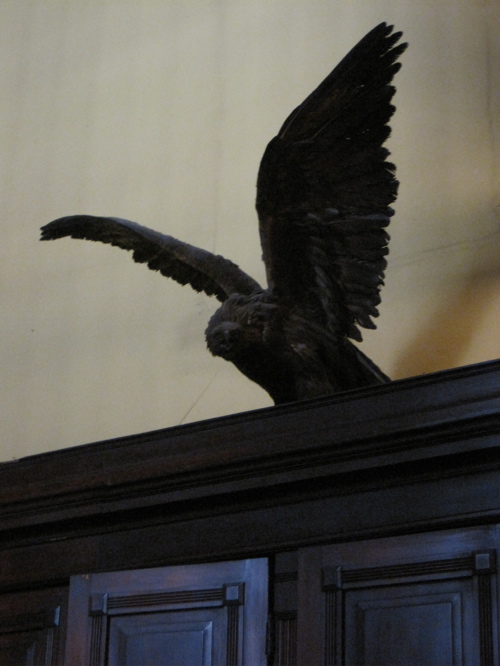
As you might expect from an unpublicized museum, the Armory is an odd duck: part military museum, part historic Gilded Age men’s club, and part exhibit hall for ultra modern performance art.  I am confident that no where else in the world can you walk through 6 inch thick armored oak doors and iron portcullis, past a stuffed eagle and a mounted moose head sitting next to a restored gatling gun lit by a nearby Tiffany stained glass window to see a 25 foot pile of laundry being picked up and dropped repeatedly by an 80 foot orange crane.  Yet that is exactly what we did today.  It’s going to be hard to top this one for bizarre museum experiences.

As with any place (or person) with this much quirkiness and character, the Armory has quite a past and has served a hodgepodge of rolls, as everything from a drill hall to indoor tennis courts to a synagogue.  It was originally built between 1877 and 1881 for the Seventh Regiment of the National Guard, State of New York.  This regiment was formed in 1806 to protect the city, after British frigates blockading New York Harbor fired at passing vessels.  It saw some action quelling riots in 1849 and helped with city fire fighting, but after NYC formed its own police and fire departments the regiment became largely ceremonial, serving as an honor guard and participating in civic events such as the inauguration of the Brooklyn Bridge in 1883 and the Statue of Liberty in 1886.


As a ceremonial guard, the regiment morphed into an elite men’s club for the sons of the city's wealthiest Gilded Age families, acquiring the nickname “Silk Stocking Regiment.”  Vanderbilts, Van Rensselaers, Roosevelts, Tiffanys, Stewarts and Livingstons all served here, and it was the immense wealth of these families that built the Armory we see today; the only armory in the United States built and furnished entirely with private funds.  And it took a lot of funds indeed.  The building itself was designed by Charles W. Clinton, the premier Gothic revivalist and designer of the famed Astor Hotel, and a veteran of the regiment himself.  He designed the exterior as a mock medieval fortress with brick crenellations, musket ports, arrow slits and a central tower. 

Inside, the club areas are lavish, designed by the era’s most prominent artists such as Louis Comfort Tiffany and Stanford White, and have been called “the single most important collection of 19th century interiors to survive intact in one building” by the New York City Landmarks Preservation Commission.  These rooms are undergoing a long restoration process, but wandering around in them is free and we highly recommend it.  Apparently two of the rooms are the only known Tiffany interiors to survive intact, and all of them are gorgeous even in their semi-neglected state.  If you squint your eyes as you wander you feel as if you can spy the shimmer of glamorous gowns and hear the clink of champagne glasses in some long ago cocktail party of New York’s storied past.
.

To raise money for the restoration, the Armory’s massive drill hall is rented out as an event and art space.  It's been used for Shakespeare festivals, operas, and most commonly, extremely large art installations.  While we were visiting we saw “No Man’s Land,” by Christian Boltanski, a performance art piece consisting of a 25-foot-high mound of used clothing, surrounded by a field of coats arranged in squares.  Every few minutes a five-story crane plucked a random piece of clothing from the top of the clothes pile, then released them to flop down haphazardly.  As we wandered among the clothes, we heard a ceaseless drum of heart beats emanating from poles at the corners of the squares.

Both Paul and I liked the exhibit.  I thought it was at least bizarre enough to be interesting, though I did come out of there wondering if I had let the laundry go too long again.  Paul loved it (as is usual for performance art) and saw it as a comment on the randomness of life: who gets chosen and who gets left behind.  Parts of the installation seemed designed to be reminiscent of a concentration camp, with a wall of numbers blocking off the entrance to the exhibit and rusty poles with low wires like fencing, although the meaning was vague enough to be open to interpretation and the people wandering the exhibit didn’t seem sure of how to take it.  Despite its size, the space felt claustrophobic, with narrow paths and low hanging lights, and dozens of heartbeats surrounding you from all sides.  Paul stood in line at an ersatz doctor’s office to get his heartbeat recorded for the exhibit, and even talked me into doing it.  Now our heartbeats will be preserved together in a permanent archive (Les Archives du Coeur) on an island off the coast of Japan.  I guess its kind of romantic, in a weird artsy sort of way.  (Paul knows its romantic in a weird artsy sort of way.)

The next museum was the Asia Society, a global organization “working to strengthen relationships and promote understanding among the people, leaders, and institutions of the United States and Asia.”  Our impression was that this organization was really more society than museum, as the gallery space was modest and much of the building closed off into what appeared to be conference space.  Looking online, the Asia Society has a full lecture schedule and seems focused on business development, with talk titles like “Why One Loves to Hate Globalization,” “Hong Kong’s Political Reforms: What Lies Ahead?,” and “Doing Business with Japan: Perspective of Australian Companies.”  Oddly, during our visit we couldn’t get a good grasp on what the goals and purpose of the society actually were, and it seemed somewhat mysterious.  Paul wonders what shadowy organizations really run the place, and what are they up to?

The art of the society is based around John D. Rockefeller’s exquisite collection of 280 Asian artifacts, which are displayed and interpreted in a variety of exhibits year round.  Today’s exhibit was “Pilgrimage and Buddhist Art,” focusing on objects from or about the major sites of Buddhist pilgrimages.  Unfortunately, the exhibits weren’t well explained, and we had to attempt to eavesdrop on a tour guide in a noisy gallery to make much sense of it.  Essentially, it looked like a lot of very similar looking Buddha statues to us

Our take on things: We found the Armory to be one of the hidden gems of NYC, well worth a look, both for the lovely designs of a by-gone era, and bizarre large-scale modern art installations.  The Asia Society seemed more focused on business than art, but might be worth a look, particularly if you go on a Friday evening when its free (as we did).  Otherwise, for the same 10 dollars, we might recommend seeing the Rubin Museum instead, with its much more extensive, varied and better explained collection of Buddhist art.

Images in this post: “No Man’s Land,” by Christian Boltanski, in the Armory drill hall; pictures of the interiors of the Seventh Regiment Armory Conservancy, including stuffed eagle, stained glass window, ceiling detail, paneling detail, and a room in the armory; two close ups of “No Man’s Land,” by Christian Boltansk; Asia Society logo on exterior of the building; Buddha Shakyamuni, Tibet 11th century; Buddha Shakyamuni with Kneeling Worshippers, Myanmar/Burma 14-15th century; Buddha Shakyamuni, India, Bihar, 9-10th century.