Showing posts with label pop culture. Show all posts

Sunday, June 6, 2010

Museum of Modern Art (MOMA)

3/12/2010, Friday

TIME: 1.5 hr
COST: $20 each

The Museum of Modern Art (MOMA) is one of the world’s greatest museums.  Oh sure, there are bigger museums and a few with greater collections (but not many), but there is little doubt that MOMA has a huge influence in the art world and on the public at large.  Quite simply, it’s a legend.  Unfortunately, our visit this day was fraught with peril and mishap and we didn’t see as much of it as we would have liked, but we can’t blame that on the museum.  Our troubles really started when a tree fell in Dobbs Ferry, but more on that later.

Much of MOMA’s fame is derived from its massive collection (over 150,000 works), which includes iconic works such as Vincent van Gogh's Starry Night, Picasso's Les Demoiselles d'Avignon, Salvador Dali's Persistence of Memory, and Andy Warhol’s Marilyn Monroe, and is considered by some to be the best collection of modern Western masterpieces in the world.  But this museum doesn’t collect just paintings.  MOMA has 6 different departments: Painting and Sculpture, Architecture and Design, Photography, Prints and Illustrated Books, Drawings, and Film and Media.  Film and Media alone has 22,000 films and 4 million film stills. 

A substantial portion of MOMA’s fame comes not from its collection, but from it’s daring.  Past and present curators have held true to the philosophies behind modern art, and love to shake things up.  The Architecture and Design, Film, and Photography departments were the first of their kind in any museum.  Groundbreaking MOMA exhibitions have included Fantastic Art, Dada, Surrealism (1936), The Family of Man (1955), and Primitivism (1984).  Right now the exhibit just finishing up is a series of performance pieces featuring, among other things, 38 completely naked men and women in various poses, including lying under a skeleton and facing each other in a doorway that visitors have to push past.  Needless to say, the exhibit attracted a great deal of media attention, and not just because there were naked people in a museum.  Apparently not all visitors have kept their hands to themselves

Even MOMA’s origins are controversial, with its beginnings forged in a long lasting marital disagreement in New York’s most famous family, the Rockefellers.  John D. Rockefeller Jr. was brought up a strict Baptist, with a deep respect for traditional values and a love of traditional art.  His extensive collection of medieval art forms the core of the Cloisters (a huge medieval museum in Manhattan).  However, his wife, Abby Aldrich Rockefeller, had completely different tastes.  She loved modern art.  J.D. became increasingly disturbed by the art his wife brought into their home, and as a result the allowance he gave her was quite modest in relation to the fortune he controlled.  Despite her limited funds, Abbey managed to amass a large collection of prints and small paintings during the 1920’s and 30’s.  One might say she eventually won their argument, as their sons Nelson and David became avid lovers of modern art, and if you ever visit Kykuit, the Rockefeller estate in Hudson Valley, you’ll find Nelson’s large collection of modern art and sculpture looking very jarring and out of place next to his father’s Neoclassical architecture and nymph fountains.  The guide of the Kykuit tour I took called it a textbook case of a son’s rebellion, just done with a bit more money than most.


Due to Abby Aldrich Rockefeller’s more limited funds, MOMA began as collaboration between her and two of her friends, Lillie P. Bliss and Mary Quinn Sullivan (pictured above from left to right), over an idea Abby proposed literally over lunch.  Nelson Rockefeller later remarked, "It was the perfect combination. The three women ... had the resources, the tact and the knowledge of contemporary art that the situation required. More to the point, they had the courage to advocate the cause of the modern movement in the face of widespread division, ignorance and a dark suspicion that the whole business was some sort of Bolshevik plot." 
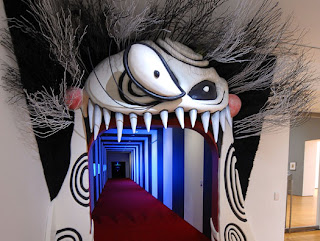
In keeping with MOMA’s revolutionary attitudes, the headline exhibit when we visited featured the works of Hollywood superstar Tim Burton, not someone you’d normally think of being exhibited in a museum (see entrance to the exhibit in picture at left).  In case you’ve been living under a rock for the last three decades, Burton is famous for his dark and quirky films, featuring sensitive misfits triumphing over a world of repressive mediocrity.  His biggest hits include “Pee-wee’s Big Adventure,” “Beetlejuice,” “Edward Scissorhands,” “The Nightmare Before Christmas,” and “Batman.”  The exhibit featured models, costumes and set pieces from his well-known films, but also many non-film works, such as sketches, photography and even sculpture.  Burton was an illustrator for Disney early in his career, and is a talented sketch artist.  I particularly liked the pieces he drew during his childhood in Burbank California, like his drawing for the parks department litter campaign.  Paul was fascinated by the big pink angora sweater worn by Johnny Depp in “Ed Wood.”  The exhibit also featured earlier and less well known short films, like the excellent “Vincent”, depicting a young boy who fantasizes that he is his (and Burton's and Paul’s) hero Vincent Price, with Price himself providing narration. 

The works all feature Burton’s particular brand of gothic macabre horror, which is funny and a little scary at the same time, and has made him famous.  Both Paul and I like many of his films, but the exhibit highlighted a problem that we both have with Burton’s work.  It all feels homogenous, with very little variety, and after wandering around looking at caricature after caricature with exaggerated proportions and bizarre disfigurements, we actually felt a bit bored.  Burton isn’t trying to say anything new with his art, he just seems stuck in the same “weirdo makes good” rut that he’s always been in.  All in all, the exhibit was fun for a while, but ultimately a bit of a let down.  Paul found a humorous short video to help explain our perceptions of Burton's lack of originality. 

The Burton exhibit generated a lot of fuss in the press, and was heavily advertised.  It’s been held up as an example of a shift in museum attitudes.  Many museums have been attempting to throw off their stodgy image and attract a younger audience.  To do this, they’re hiring younger curators and embracing popular trends, like Burton.  (This show was currated by the shockingly young 37-year-old Rajendra Roy, chief curator of film at MOMA.)  The strategy seems to have worked in this case, as Burton visitors were relatively young, averaging in their 30’s, and the show was a blockbuster.  Every weekend was completely sold out, which is where our problems began.

As we don’t live or work in Manhattan, it can be difficult for us to get into the city during the week.  I managed to get a ticket for a Friday afternoon visit (one of the few left) and Paul and I arranged to be free that afternoon so we could drive into the city BEFORE rush hour.  However, that afternoon a tree fell in Dobbs Ferry, knocking out power to all traffic lights in the vicinity, and Paul was stuck in a 2-hour traffic jam on his way home.  From there on it was a disaster, for now we were driving into the city during rush hour (another 2 hour traffic jam).  When we finally arrived at the museum, we were cranky, exhausted and extremely late for our ticketed time.  Fortunately the museum is open late on Fridays and they were still willing to let us in to the exhibit.  Unfortunately, the museum is open late on Fridays because that when it is free and it was completely packed.  We had to fight our way through crowds to see every piece in the Burton exhibit, and when we were done with that we just couldn’t face the rest of the museum in these insane crowds.  We had both seen MOMA in its entirety when we visited New York as tourists 2 years ago, so we called it a day and went home.

In conclusion, of course we would recommend MOMA for a visit; it’s in all NYC tourist guides for good reason, but try to avoid the crowds if you can. 

Images in this post, from the top: "Baboon Boy," by Tim Burton, in the lobby of MOMA; A visitor at MOMA walks between Jacqueline Lounsbury and Layard Thompson in "Imponderabilia," from the exhibit "Marina Abramovic: The Artist Is Present"; John Bonafede in "Nude with Skeleton," from the exhibit "Marina Abramovic: The Artist Is Present"; photograph of sculpture in the gardens of Kykuit, the historic Rockefeller estate; photographs of Abby Aldrich Rockefeller, Lillie P. Bliss and Mary Quinn Sullivan (from left to right); entrance to the Tim Burton exhibit; sculpture at the Tim Burton exhibit;"The boy with nails in his eyes" figure; sketch from the short film "Vincent," by Tim Burton.

Sunday, February 21, 2010

Madame Tussauds Wax Museum

2/6/10; Saturday (continued)  
MUSEUM: Madame Tussaud’s Wax Museum
TIME: 1.5 hr
COST: $35 for both (with 2 for 1 coupon)
          + $15 for 2 booklets and 2 photos made into fridge magnets

Pauline here: Normally Paul “ghost writes” on our blog; i.e. we discuss the museum together and I try to capture both viewpoints and experiences when I write. However, Madame Tussaud’s Wax Museum hit close to Paul’s interest in side shows (perhaps I should say obsession), and he wished to write this one on his own, so what follows is Paul’s first solo entry to the blog. I should also mention that Paul went through the museum as if he were a carnival barker and recruited several marks, ahem, I mean people, to pose for our blog with programs in front of their faces next to the wax celebrities. Thank you to all of you who were gracious enough to help us out. (No, Paul, I don’t mean gullible.)
 
Paul here: Our trip to Madame Tussaud’s Wax Museum on 42nd street in Times Square was different than any other museum we had been to previously. Firstly, it was the first museum located off the museum mile. Hence it was one of first “non-mansion” museums, which in itself was quite different. The building was gaudily lit up, as a museum in the “Great White Way” should be. (That’s “Times Square” to non-New Yorkers.) The second main difference is that Madame Tussaud’s origins were in the sideshow tradition and not as a cultural repository, and is designed to make money. Hence, the museum is a for-profit venture. A single admission is $35.00, making it one of the most expensive museums in the city. We looked online and found a 2-for-1 coupon, which we decided to use.  

The sideshow origins of this wax museum are pretty pervasive. The sideshows of old were intended to separate the punters from their money as quickly as possible. Tussaud’s still adheres to this mentality, by offering little services throughout the museum. They offer a “program” for $5.00 that I would not recommend purchasing. There are snack bars on almost every floor, and one could get “professional” photos taken with Johnny Depp, the Obamas, and various other people of note. All of them are available for purchase at the end of the tour as photos, key chains, and refrigerator magnets. We had our photo taken with Johnny Depp holding Oscars, which we had made into magnets. We could have also chosen President Obama, Superman or the Incredible Hulk. Not that you had to buy anything. One of the really cool things they allow you to do is to take you own photos throughout the museum.

We forgot our camera, but luckily, we had my cell phone, which has a pretty nice camera. The Museum is laid out over several different floors. The tour starts at the top of the building and you descend to the bottom floor. There are stairs, but whole thing is handicapped accessible, so it is not too taxing on people who have trouble moving. Each floor has several differently themed rooms. There was a “hall of stars” with movie celebrities, a rap-themed room, a nightclub with famous singers, a historical section with people like Napolean Bonaparte and Abraham Lincoln, a karaoke room where you could be judged by American Idol judges, a “hall of honor” with the Dalai Lama and Pope John Paul II, an “Americana” through the decades of the 1900s, and a sports-themed room. There was also a “scare room” where you walked through a near dark maze and people jumped out at you. This had no wax figures in it, and while we were there, very few people hiding to scare us, so I would probably put this down as a “non-room”.

In each room were the wax figurines. These are truly remarkable. They, in general, are pretty realistic, right down to the armpit hair. These ranged from Napoleon to Ru Paul, and included a lot of different stars in between. Some of them, like Julia Roberts, were instantly recognizable. We had trouble identifying some of them, but Pauline and I are not pop culture junkies. Some of the ones we had trouble were due to the stillness of the figures. Selma Hayek and Lou Reed were good examples of this. Both are notable for their animated looks, so when they were perfectly still, it was strange. Other choices were just weird. These included putting FDR in a wheelchair- something he never liked to be shown in a public setting, putting Princess Diana next to the Dali Lama and Albert Einstein in the Hall of Honor, and an apparent obsession with Al Roker.

One of the most “offensive” things we saw was hockey legend Wayne Gretzky decked out in a NY Ranger’s jersey, instead of his Edmonton Oilers jersey. I understand that this is New York, and he technically was a Ranger, but he should be remembered for when he was the Great One in Edmonton. Pele’, who played for the NY Cosmos in the short lived NASL, was shown in his Brazil uniform, and not as a Cosmo. But that is a quibble that we hockey fans can debate about. Also, a lot of the people were thinner than I thought they were/are in real life. But in reality, it was a lot of fun to spend a couple of hours wandering through the galleries and having some harmless fun hanging.  

Images in this post, from the top: the Dalai Lama with friends; Patrick Stewart with friend; Marylin Monroe, Jackie Kennedy and friend; Julie Roberts and friend; Neil Armstrong and Johnny Cash; and Pele'.