Showing posts with label contemporary art. Show all posts

Thursday, August 4, 2011

Metropolitan Museum of Art: Alexander McQueen

Dress, Autumn/ Winter 2010-11, Alexander McQueen
7/3/2011
     Special exhibit Alexander McQueen Savage Beauty ......... 1.5 hrs 
COST: Free with membership (otherwise suggested admission is $25)

Without a doubt, New York City's greatest museum is the Metropolitan Museum of Art.  As with many celebrities this famous museum needs only its first name to be recognized and is usually referred to as merely "the Met,” a cute moniker for an amazing museum housing over 2 million works in one of the worlds largest art galleries.  Paul and I had originally planned to save the best for last and make the Met the final museum in our trek, but a recent visit to the American Museum of Natural History changed our minds. 

Metropolitan Museum of Art
That museum took us two days and nine hours of concentrated museum viewing to get through, and we still didn't see everything.  After recovering from “natural history overload,” we decided that instead of cramming the Met into one long bleary-eyed viewing extravaganza, we would pace ourselves and see it in stages.  This was made even easier by a thoughtful relative who got us Met memberships for Christmas this year, ensuring free admission to both the Met and its sister museum the Cloisters.  Now the Met is a “suggested admission” museum, so membership may not seem like a good deal, that is until you enter its grand entrance hall and see the lines. 

This year over 5 million people visited the Met, and it can feel like you have to fight through a good portion of that number to enter the museum.  With our membership cards firmly in hand, Paul and I can now sidle up to the completely empty members desk and grab our admission tabs before most tourists figure out which line to stand in.  Then there is the fantastic benefit that members are allowed to “skip the line” at special exhibits, and the exhibit we were here to see today had a two hour wait.  It took us some time to trace the line to its head through both the Babylonian and European Painting sections, but it was a great feeling not to have to stand in it.  (Great Christmas present Mom!)

Ensemble from VOSS 2011 Alexander McQueen
We hadn’t intended on going to the Met this weekend, but a friend of ours from Seattle (lets call him Petruchio) had, like us, recently moved to the East Coast (in his case Baltimore) and was visiting New York with a friend this weekend.  Petruchio is a fan of contemporary art and of course we had some suggestions, but unfortunately he only had time for museums on Sunday, and all but the largest or most Jewish of museums are closed on Sundays.  We recommended the three biggest contemporary art museums: the New Museum, the Whitney and P.S.1 (all have Sunday hours).  However Paul and I have seen all of these, so we thought outside the box and offered to show him the hottest contemporary art exhibit in town, which, oddly for a museum best known for its ancient and classical art, has been packing them in at the Met all summer.

from The Horn of Plenty 2009-10, Alexander McQueen
This exhibit is “Alexander McQueen: Savage Beauty” and exhibits the designs of recently deceased fashion designer Alexander McQueen.  A fashion exhibit might not be the standard fare of the average museum visitor, but the combination of McQueen’s celebrity, his bizarre sense of beauty and his showmanship have been drawing record crowds.  Current estimates indicate that over ½ million people have seen the show, bringing the most visitors to the Met since 1962 when the Mona Lisa made its first and only trip to the U.S.  The closing of this exhibit has been delayed twice due to its insane popularity and the museum has extended its hours to accommodate the crowds, but the exhibit is finally closing for good on August 7th.  Paul and I suggest that you see it if you can.

Jellyfish Ensemble, Plato's Atlantis 2010
"Spine" corset, from Untitled 1998
“Savage Beauty” is the third fashion-related exhibit we’ve seen, and it left the others in the dust.  It's not that the other two were bad (we enjoyed both the history of American fashion at the Brooklyn Museum and the special exhibit on modern Japanese fashion at FIT) but those exhibits were merely clothes.  The McQueen show isn’t really about clothes.  No one you know could or would wear most of the items on display.  Most pieces would be incredibly uncomfortable, like the bondage bracelets made of long lengths of barbed wire and the steel corset shaped like a spine with a rib cage and tail.  Many were too fragile or rigid to move or sit down in, like the dresses made of dangling microscope slides, layered seashells or coiled steel.  Then there is the problem that you can’t even imagine an occasion where covering yourself head to toe in iridescent scales would be appropriate (besides a really ritzy Halloween party).  And his shoes!  I have no idea how models made it down the runway in these sculpted torture chambers. 

Prosthetic leg from No. 13, 1999; shoes from Supercalifragilisticexpialidocius 2010-11 and Plato's Atlantis 2009
 However, the fact that these items are so unwearable is part of what makes this exhibit interesting.  As there is no way you would wear them, they stop being clothes.  Instead you begin to see them as parts of the themes and stories that McQueen was trying to evoke.  The clothes stop representing real people and become bizarre characters in a play that McQueen is putting on.
 .
Ensemble from Supercalifragilisticexpialidocious 2002-03, Alexander McQueen

Its a Jungle Out There 1997-98 McQueen
The exhibit is divided into the separate themes that McQueen explored in his work and incorporates settings and films of McQueen’s elaborate theater-like fashion shows to set the mood.  For example, one room explores themes of Romantic Naturalism and Primitivism in McQueen’s work.  There are dresses made of animal parts like buzzard skulls and antlers, and pieces from a fashion show meant to depict a shipwreck and the subsequent encounter between the ship inhabitants and a primitive tribe on shore.  The centerpiece is a dress that looks like stacked oyster shells, and the entire ceiling of that room is covered with an eerie film of a woman slowly drowning.  
.
Still of a film from Irere Spring/Summer 2003, Alexander McQueen

Its Only A Game 2005 McQueen
Another room presents the outfits related to the show “Only A Game,” a fashion show staged as a chess game played between the East (Japan) and the West (America), using extremely odd adaptations of traditional dress to explore themes of racism and nationalism.  An quote from Alexander McQueen on the wall reads, "Fashion can be really racist, looking at the clothes of other cultures as costumes. . . . That’s mundane and it’s old hat. Let’s break down some barriers.”  McQueen’s most political show was “Highland Rape,” referencing the Jacobite Risings in eighteenth century Scotland.  In a film of that show, semi-naked, blood-spattered models look lost and wounded in their disintegrating clothes, evoking the bloody slaughter of war.  Paul particularly liked the show that ended with a box falling open to reveal a naked overweight woman covered in live moths and connected via a breathing tube to a monkey.  He found it a fascinating exploration of untraditional forms of beauty.

from Highland Rape 1995-96 Alexander McQueen
In short, Alexander McQueen may have been a fashion designer by trade, but the "clothes" in this exhibit transcended fashion, exploring themes and emotions that no mere dress has ever suggested to me before.  These clothes could be political, violent, twisted, tragic, macabre and primitive, in addition to being beautiful.  By the end of the exhibit I felt worn out, like I'd been on an emotional journey with a troubled yet passionate soul.  Its not often that you get to see an artist's life work collected in a single show, and the four of us agreed that it was an amazing experience, well worth fighting the crowds for.  
.
From Sarabande 2007 by Alexander McQueen

Wednesday, July 27, 2011

Noguchi Museum

Core (Cored Sculpture), Isamu Noguchi 1978
9/25/2010, Saturday
MUSEUMS: Noguchi Museum (1.5 hrs) ……………………..…… $10

This day marked our first exploration into Queens, the largest of New York City’s boroughs.  Queens doesn’t have the upscale attitude of Manhattan and seems a bit shabby next to its hip neighbor Brooklyn, but at least it doesn't have the "running gun-battle" reputation of the Bronx.  Most tourists in Queens are just passing through on their way to the two gigantic airports in this borough, but Paul and I have really enjoyed our subsequent visits here.  In Queens we’ve discovered great ethnic food and our favorite museums outside of Manhattan to date, such as the newly renovated high tech Museum of the Moving Image and the Louis Armstrong Museum (great tour).

Today we visited the Northwest-most corner of Queens, just across the river from Manhattan, consisting of the neighborhoods Long Island City and Astoria.  This area was once very industrial and it’s full of old factories and warehouses.  Some of these are still in use, like the old Steinway & Sons piano factory and the Brooks Brothers tie factory.  Others have been repurposed into the kinds of businesses that thrive in areas with low land values like Silvercup Studios where "Sex and the City" is filmed, and of course old warehouses make excellent (and cheap) artist studios.  Thus this region has the largest concentration of museums, art galleries and studios outside of Manhattan, you can see the highlights at the Long Island City Cultural Alliance.

Probably due to its limited residential space, this corner of Queens seems a particular favorite of the types of artists who need lots of room and very tolerant/non-existent neighbors (i.e. sculptors) and nearly all of NYC’s museums devoted to sculpture are located here: the Noguchi Museum, Socrates Sculpture Park and the SculptureCenter.  The Noguchi Museum and Socrates Sculpture Park are across the street from each other on the banks of the East River and made a good paring today.

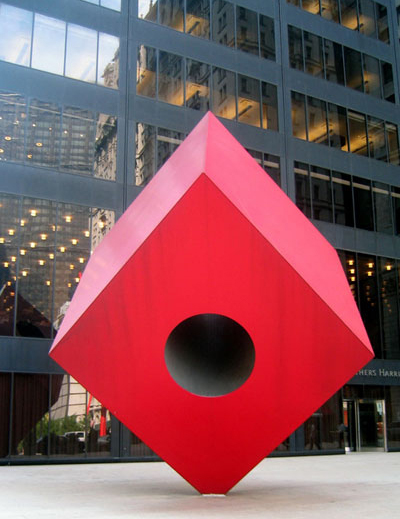
Red Cube, Isamu Noguchi 1968 (in NYC)
Without a doubt, the Noguchi Museum is the best regarded of the Queens sculpture museums.  Maybe you’ve never heard of Isamu Noguchi, but chances are good that you’ve seen his work.  His gigantic abstract sculptures were popular public works around the globe from the 1930’s until his death in 1988.  His most recognizable New York sculpture is probably the huge “Red Cube” in front of the HSBC building on Broadway but there are Noguchi sculptures in many of the world’s major cities, like Paris, Tokyo, Jerusalem, Los Angeles, Bologna and Munich.  Even Seattle, where Paul and I recently moved from, has a famous Noguchi sculpture.  Called “Black Sun,” it’s a giant flat black basalt circle with a hole in the center that frames a nice view of the Space Needle, but the source of its fame is the popular song “Black Hole Sun” by the Seattle band Soundgarden, reputed to be inspired by the sculpture.
Black Sun, Isamu Noguchi 1969 (in Seattle, WA)

Death (Lynched Figure), Noguchi 1934
One of the things that make the Noguchi museum stand out is that it was actually designed by the artist it exhibits.  In 1974 Noguchi bought a gas station across the street from his studio and gradually converted it into an exhibition space with a Japanese style walled garden at its center.  He even chose much of the work presented in the museum and determined how it was displayed.  Paul thought this very egocentric of Noguchi, and maybe it is, but I loved the way the intentions of the artist showed through in every part of his museum. 

Behind Inner Seeking Shiva Dancing Noguchi 1976-82
As an example, apparently Noguchi didn’t like to bias people with the names of his sculptures before they formed their own impression, so all of the names of art in his museum are displayed in small print on tiny white cards several feet away.  As the sculptures are fairly abstract, this made for some fun guessing games.  On the tour we were on the guide asked us to say what a particular sculpture looked like to us before reading the title.  Looking at the sculpture below, I thought it was a duck’s head, Paul saw a sideways letter S and another person guessed a baseball cap.  Noguchi’s intention?  The title was “Slowly Slowly,” in reference to a snail.  (Once it was pointed out it seemed obvious.)
.
Slowly Slowly, Isamu Noguchi 1966

The tour also went into detail on Isamu Noguchi’s life and his inspirations.  Born in 1904 as the illegitimate son of the Japanese poet Yone Noguchi and his American editor Léonie Gilmour, Noguchi was a brought up partly in Japan and partly in the U.S., but in the early 1900’s there was no way a half-Japanese half-American boy could fit in either culture and he was a lifetime misfit where ever he went.  
Floor Frame, Isamu Noguchi 1962

To me, his alienation came through in his work and I loved the shapes and textures of Noguchi’s stone sculptures in the museum’s elegant walled sculpture garden, but Paul was not a fan.  According to Paul, being a great artist is at least 50% self-promotion and he felt that the museum was the pinnacle of Noguchi’s showmanship and ego, and it left Paul cold.  Feel free to weigh in on the debate in the comments.

RATINGS FOR THE NOGUCHI MUSEUM:
Pauline: 9 out of 10.  Great modern sculpture in a beautiful setting.
Paul: 3 out of 10.  Art and ego left me cold.

Gallery in the Noguchi Museum
Images in this post, from the top:  Core (Cored Sculpture) Isamu Noguchi 1978, basalt, in the sculpture garden at the Noguchi Museum.  Exterior of the Noguchi Museum.  Red Cube Isamu Noguchi, 1968 site specific sculpture in painted steel.  Black Sun Isamu Noguchi 1969, basalt.  Death (Lynched Figure) Isamu Noguchi 1934, monel, steel, wood and rope.  Slowly Slowly Isamu Noguchi 1966, basalt.  Behind Inner Seeking Shiva Dancing Isamu Noguchi 1976-1982, basalt.  Floor Frame Isamu Noguchi 1962, bronze. Gallery in the Noguchi Museum.

Sunday, July 24, 2011

Socrates Sculpture Park

Socrates Sculpture Park
9/25/2010, Saturday
MUSEUM: Socrates Sculpture Park (30 min) …………..………. Free

Gold Rush, Rachel Beach 2010
With nearly 200 museums in New York City, it seems odd that there are very few sculpture gardens.  This gap in the museum line up is probably to to the city's sky high real-estate prices, but today we saw a sculpture park that found a way around that problem.  This park is called the Socrates Sculpture Park and it's located on the banks of the East River on land that was once an illegal dumpsite and polluted eyesore.  However in 1969 a coalition of artists and community members under the leadership of sculptor Mark di Suvero bought the land (probably very cheaply) and transformed it into an outdoor exhibition space for large contemporary sculpture.  Now this previous wasteland has walking paths, an artist in residency program, a public vegetable garden, farmers market and a free outdoor movie series in the summer.  It’s frequently referenced as a model of urban reclamation and revitalization.  
 .
Untitled Frank Haines
The Socrates Sculpture Park is across the street from the excellent Noguchi Museum (exhibiting the work of the famous modern sculptor Isamu Noguchi) and the two make a good pairing if you have them time.  Despite the name, the Socrates park is much less high-brow than the Noguchi Museum and has a slightly scruffy air.  You can still see the rotting docks and rusty cranes perched on its perimeter left over from its industrial past, yet the park is well tended and there is a wide variety of sculpture to see. 
 .
Sponge Piece for Socrates Jory Rabinovitz
Paul and I both agreed that the most beautiful thing in the park was the view of the Manhattan skyline across the river (see image below), and one sculpture thoughtfully provided a telescope to view it better, but there was a lot to see in the park as well.  I was amused by the stack of colorful sponges stacked up like they were on a flag pole (“Sponge Piece for Socrates” by Jory Rabinovitz), while Paul liked the black and yellow contrasts of “Gold Rush” by Rachel Beach and the talking rock “Megafaux” by Clive Murphy.  We didn’t like everything (the crumbling floating house failed to impress) but there was certainly a lot of variety and it made for an entertaining walk.
 .
RATINGS FOR THE SOCRATES SCULPTURE PARK:
Pauline: 3 out of 10.  Wide variety of contemporary sculpture in a riverfront park.
Paul: 3 out of 10.  Nice walk in the park is not ruined by the art.

View of the East River from Socrates Sculpture Garden
Images in this post, from the top:  Socrates Sculpture Garden, with Megafaux by Clive Murphy (2010) in foreground and the New York City skyline in the background.  Gold Rush Rachel Beach 2010, reclaimed wood beams and powder covered aluminum.  Untitled, Frank Haines 2010 mixed media.  Sponge Piece for Socrates, Jory Rabinovitz 2010, sponges, concrete and metal.  View of the East River and New York City skyline from the Socrates Sculpture Garden.

Thursday, June 23, 2011

Brooklyn Museum

Winged Genie, Nimrud, Assyria c. 883-859 BCE
 7/24/2010, Saturday
TIME: 3 hrs
COST: $10 each

Mask for Mblo Masquerade, Baule
We hate to admit it, but we have come to dread going to Brooklyn.  We don’t want to disparage the borough: it has great restaurants, cool nightlife and an interesting and diverse culture, but somehow we always have a horrible experience.  Traffic is horrendous, parking non-existent and Brooklyn museums seem to open and close on a whim, seldom updating their WebPages.  Twice now we’ve taken a wrong turn on Brooklyn’s labyrinthine expressways and ended up in an orthodox Jewish neighborhood, with everyone wearing black hats and frock coats and glaring at us, while our GPS keeps insisting that we have reached our destination.  In our three visits to Brooklyn, we’ve managed to see only three museums.  To give you an idea of how horrible that is, in three visits to Queens (Brooklyn’s larger, supposedly rougher neighbor), we’ve seen eight museums, not including one we visited twice.  Simply put, Brooklyn has been a nightmare, and we are positive that our last museums will all be in this most difficult borough.

Pierre de Weissant, Monumental by Auguste Rodin
On this very hot day in July we visited the amazing Brooklyn Museum, and while we did take a few wrong turns in heavy traffic (as usual), we consider it our most successful Brooklyn trip (largely because the museum in question was open).  We were joined by our friends Peter and Petra, visiting from Canada.  The Brooklyn Museum has a massive art collection and an international reputation, but I think our motivation for visiting this museum today had more to do with finding good air-conditioning on a scorching day, and judging from the large number of people loitering and ignoring the lovely Rodin's in the indoor sculpture garden, we were not alone.

We went to breakfast beforehand at a local restaurant we choose based on air conditioning and the advertised “soul food.”  There were a fair number of people eating good looking, interesting southern food, but unfortunately our menus had nothing but very plain breakfast entrees, and we were not allowed to order anything else.  Annoyed, we ate our dry omelets and boring pancakes while everyone around us dug into delicious looking fried chicken and biscuits and gravy.  It set a bad precedent for Brooklyn, making the place seem closed and elitist, and future visits have not dispelled this feeling for us, but at least we were able to order the excellent strawberry lemonade, so Paul maintains that it wasn't all bad.
 .
Brooklyn Museum
The Brooklyn Museum is a gigantic building (over half a million square feet), and is the lynchpin of a lovely complex of Victorian parks and gardens in this area, including Prospect Park, Brooklyn Botanic Gardens, and the Prospect Park Zoo.  The museum’s core is a splendid Beaux-Arts building, but it has a contemporary glass and steel entrance that gives it a modern vibe.  Walking in, our first impression was that it is huge.  In nearly any other city, this would be THE dominant museum.  It’s million-piece collection of art and historical pieces should be spoken in the same breath as the Met and the British museum in scope and range.  It’s truly impressive how much this museum crams into one building.  The museum is noted for major collections in Ancient Egyptian and Near East artifacts, the Art of Africa, American Art, Decorative Arts, and Feminist Art, and there are always several large temporary exhibitions as well.  We found this all very daunting but we jumped in and started looking around.  
 .
The Last Supper by Andy Warhol 1986

One of the publicized exhibitions during our visit was a collection of Andy Warhol’s later works.  Titled “Andy Warhol: The Last Decade” it examined his commercial and artistic ventures during his last years.  Clips of his TV show and his gigantic series of “Last Supper” paintings were notable, but none of us are huge fans of pop art or Warhol in general.  We agreed that it was an interesting exhibit, but despite the fame of the artist, he didn’t really capture our interest.

Tree Evening Dress by Charles James 1955
Evening Ensemble by Norman Norell 1970
A bigger hit with us was the exhibitAmerican High Style: Fashioning a National Collection.”  This exhibit was a collaboration between the Brooklyn Museum and the Costume Institute at The Metropolitan Museum of Art focusing on the most renowned clothes from the Met’s fashion collection.  The exhibit consisted of approximately eighty-five outfits and a grand selection of hats and shoes, covering early America to modern times and detailing the evolution of high fashion over the last 200 years.  Pauline loved the emphasis on clothing shape and structure.  The extensive exhibit text explained that the shape of clothes was once derived largely from rigid internal garments such as corsets, but modern clothing has transitioned to shapes derived from cloth selection and careful tailoring, resulting in less stiff looking clothes.  Paul and Petra were particularly fascinated by the evolution of footwear, noting that high heels and ribbons on shoes have gone in and out of fashion over the years, for both men and women.

George Washington by Gilbert Stuart
The American Art section is famous for the iconic portrait of George Washington by Gilbert Stuart, but there was wide selection portraits of different people, famous and otherwise.  Peter and Petra spent some time playing what they claimed was a traditional Canadian game called “Dude or Not Dude.”  In it players decide whether portraits of women were in fact woman, or men in drag.  There were a number of portraits where arguments could be made either way, and Peter and Petra debated things like whether that was a 5 o’clock shadow or just a shadow.  It was a little surreal, but now when we see a portrait such as the one of Mrs. Thomas Mumford IV below, we can’t help wondering “Dude or not dude?”

Mrs Thomas Mumford IV by William Johnston
Another area that stuck out for us in the American section was an exhibit on landscapes, with one area concentrating totally on waterfalls.  (Paul grew up near Niagara Falls and has worked as a tour guide there, so this is a subject near to his heart.)  This part of the exhibit showed many different ways that waterfalls have been represented in art: such as realistic oil paintings, romantic Hudson River School paintings, direct modeling in sculpture and abstract representations in contemporary art.  Examining the different styles made us consider what each brought to the common subject and what they were able to evoke, turning a simple landscape piece into a thought-provoking exhibit.  This was one of the first times we’ve really thought beyond the wall text about what the curator was trying to say with an exhibit (bringing us one step closer to being real art critics).
.
Niagra, by Louis Remy Mignot 1866

Moorish Smoking Room, Worsham-Rockefeller House
The fourth floor of the Brooklyn Museum is devoted to two installations: the Decorative Arts Center and the Elizabeth A. Sackler Center for Feminist Art.  Demonstrating just how big this museum is, the Decorative Art Center takes the rather grandiose approach of including several entire houses and over twenty rebuilt furnished rooms.  They range from the older, plainer wood paneled Reuben Bliss house (1754) to more opulent rooms like the Moorish Smoking Room from the Worsham-Rockefeller House (1881).  Paul wanted to move into the Art Deco styled Weil-Worgelt study (1928); we only got him to leave after he took detailed photos of the paneling, muttering about “future plans.”  
.
Weil-Worgelt Study by Alavoine, 1923

The Dinner Party, by Judy Chicago, 1974-79
Also on this floor was the Center for Feminist Art, which is most well known for the major installation “The Dinner Party” by Judy Chicago.  The Dinner Party comprises a massive triangular table with thirty-nine place settings, each commemorating a woman from history or myth.  The settings consist of embroidered runners, gold chalices and utensils, and painted porcelain plates with raised motifs.  All the items in each place setting are rendered in styles appropriate to the individual women being honored.  The names of another 999 women are inscribed in gold on the white tile floor below the triangular table.  The amount of intricate work was stunning.  The exhibit came with a booklet explaining why each woman was included: some were well known and obvious (e.g. Mary Wollstonecraft, Georgia O’Keefe and Sacagawea) but others were much more obscure (Elizabeth Blackwell? Ethyl Smyth? Anna van Schurman?), with the implication being that maybe they shouldn’t be.
Mary Wollstonecraft place setting from The Dinner Party, by Judy Chigaco

Senwosret III, Hierakonpolis c 1836 BCE
Nespanetjerenpere c 945 BCE
Our last stop of the day was the impressive Egyptian section on the third floor.  It was packed with carvings and wall reliefs, and had some very impressive mummy cases.  Petra and Pauline were particularly intrigued by the Mummy Chamber, which had a number of human and animal mummies, a 25 foot long scroll of the book of the dead, and detailed instructions on the different ways that mummies were made. (They were all pretty disgusting.)  The museum has done CT scans of several mummies and has movies showing how everything is preserved.  Petra and Pauline felt that this was both educational and gruesomely fascinating.  The rest of the exhibit was broken down into the major epochs of the classical period and made for an interesting historical narrative of the area around the Nile River. 

Madonna of Humility, Sano di Pietro, 1405
By the time we finished the Egyptian exhibit, the museum was getting ready to close, so we got a cup of coffee, sat down to reflect and play “spot the Canadian.”  (Hint: If they are wearing “Roots” brand clothing head to toe, they are probably Canadian.)  We’d covered a lot of ground in three hours, but still had only seen about 70% of the museum and, despite the fact that the African Art section was closed for an exhibit change, we could have easily spent another few hours.  All of us had found the Brooklyn Museum to be both engaging and educational, and we were impressed by the huge variety of high quality exhibits.  It wasn’t quite the Met in size or scope, but it seemed more manageable and certainly less crowded, and it was a great place to spend a hot summer day.

RATINGS FOR THE BROOKLYN MUSEUM:
Pauline: 9 out of 10.  Gigantic museum with amazing variety and range.
Paul: 8 out of 10.  It would be the best museum in any other city but New York City.

Images in this post, from the top: Winged Genie. Nimrud, Assyria (modern-day Iraq) 883–859 B.C.E. Alabaster.  One of many panels that once adorned the palace of King Ashur-nasir-pal II.  Mask for Mblo Masquerades, Baule, Ivory Coast, late 19th century.  This mask's delicate, symmetrical features, ornate hairstyle, and smooth surface exemplify personal beauty and composure.  Pierre de Wiessant, Monumental by Auguste Rodin (French) 1887, bronze 1979.  Exterior of the Brooklyn Museum.  The Last Supper by Andy Warhol, 1986, acrylic and silkscreen ink on linen.  "Tree" Evening Dress Charles James, 1955.  Rose pink silk taffeta; white silk satin; red, pink and white tulle.  Evening Ensemble, Norman Norell, 1970–71. Gold organdy, beaded gold silk jersey.  George Washington by Gilbert Stuart, 1796.  Standing in the classical pose of an orator, Washington appears in civilian clothing, but holds a sword that recalls his military achievements and suggests the might of his presidency.  Mrs. Thomas Mumford VI by William Johnston, 1763, the first portraitist to work in Connecticut, where he enjoyed the patronage of prominent colonists.  Niagara by Louis Rémy Mignot 1866.  Throughout the nineteenth century, few landscape forms were more recognizable than Niagara Falls, often employed to embody the natural might that underlay America's promise.  Moorish Smoking Room, from the Worsham-Rockefeller House, 1864–65, remodeled 1881.  Weil-Worgelt Study, originally part of the Park Avenue apartment of Mr. and Mrs. Milton Weil, decorated by Alavoine of Paris circa 1928–30.  The room is in the style now known as Art Deco, paneled in veneers of palisander and olive and a painted lacquered panel designed by Henri Redard and executed by Jean Dunand.  The Dinner Party, by Judy Chicago (1974-79) with a detail of the Mary Wollstoncraft place settingCartonnage of Nespanetjerenpere. Egypt, probably Thebes, circa 945–718 B.C.E. Linen or papyrus mixed with plaster, pigment, glass, lapis lazuli.  The decoration here associates its occupant, the priest Nespanetjerenpere, with divine resurrection. Senwosret III. Egypt, from Hierakonpolis, circa 1836–1818 B.C.E. Granite. A powerful king of the Egyptian Twelfth Dynasty.  Madonna of Humility, by Sano di Pietro, Italian 1405-1481.

Saturday, April 9, 2011

New Museum of Contemporary Art / FusionArts Museum

Inochi by Takashi Murakami, in front of I’m in a Limousine (Following a Hearse) by Richard Prince
4/18/10, Sunday
MUSEUMS:
New Museum of Contemporary Art .....….….. 1 hr
FusionArts Museum……………...............…… 20 min
COST:
New Museum of Contemporary Art ............. $12 each
FusionArts Museum……………...............…… Free

Nomo by Pawel Althamer
Whatever else it may be, contemporary art is the art of our time and an expression of cultures we live in.  Thus it seems ironic that Paul and I find contemporary art to be among the least approachable and the hardest to understand.  The problem seems to stem from the influences of our “Age of Information.”  Contemporary art frequently references other art, expanding on, poking fun or criticizing specific works and themes.  If you go in blind as Paul and I do, without a background in art education, then even when you think you understand particular pieces, you often feel like you’re missing part of the story (and you usually are).  


F.O.B by Ashley Bickerton
As an example of our ignorance, take the exhibit we saw today at the New Museum of Contemporary Art.  Called “Skin Fruit,” this exhibit was highly controversial, inspiring a front page article in the New York Times and vicious attacks by multiple blogs and critics.  If you’d asked Paul and me what was so controversial, we would have guessed that was due to specific X-rated pieces, like the statues of a naked man and woman pleasuring themselves, the torso of an extremely fat person impaled on a pole like a lollipop (see image at right), the sculpture of old men doing seriously disturbed things with pigs (see image below), the mostly naked man strapped to a crucifix, or possibly the life-like sculpture of JFK lying in a coffin.  However, to the art world, none of these pieces were remotely scandalous, and that was actually the scandal.  

Paula Jones by Paul McCarthy

New Museum of Contemporary Art
Since its opening in 1977, the New Museum of Contemporary Art has declared itself the “anti-mainstream” museum, specializing in new and undiscovered artists, celebrating the off-beat and the daring.  Yet today’s exhibit was from the Dakis Joannou Collection, a famous art collection owned by a Greek billionaire, who also happens to be a trustee of the museum.  Making matters worse, the exhibit was curated by the very well established artist Jeff Koons, who selected only the most well known "mainstream" artists for the exhibition.  For the art world, this was a betrayal of the principles that the New Museum stood for.  It was called incestuous “insider trading” (jameswagner.com), a “perfect storm of wretchedness brought on by the collision of too much wealth and too little taste” (Howard Hall of Time Out New York) and the “New Museum Sausage Party” (Christian Viveros-Faune of the Village Voice).  One reporter asked, “Are shows at the New Museum essential exhibitions, or just the last word in product placement?" (Richard Lacayo of Time).
Untitled (Chocolate Mountains), by Terence Koh

One Ball Total Equilibrium Tank by Jeff Koons
Of course, Paul and I knew nothing about this as we made our way through the museum today.  We were suitably impressed by the New Museum’s ultra-modern building (it looks like a gigantic off-kilter stack of blocks, see picture above), and enjoyed the view from the seventh floor “Sky Room” with panoramic views of the lower east side.  For the most part, we liked the “Skin Fruit” exhibit as well.  We marveled at the twin towers of melted chocolate frosting, laughed at the pile of penises that made a face in profile and ogled the large sparkly butt of a rhinestone covered prostitute.  Paul's favorite piece was the intimidatingly stern 10 foot tall statue of a woman in a business suit, while I was touched by the crucifix-like "Bowed Woman" by Kiki Smith hanging in a stair well (see image at end of post).  I can’t say we understood all, or even most of the pieces.  (The basketball floating in an aquarium got a big “Huh?” from both of us, but apparently it was the most famous piece in the whole freaking exhibit!)  Yet despite occasional blank spots, we both found enough that touched us in some way, and that’s all we ask of any museum.
  
RATING: New Museum of Contemporary Art
Pauline: 6 out of 10.  Lots of variety and eye catching weirdness.  I even liked some of it.
Paul: 7 out of 10. Liking 60% of the pieces at a contemporary art museum is a pretty good percentage.

FusionArts Museum
As its name suggests, the New Museum of Contemporary art is among the newer of the enormous “blockbuster” museums of New York, but New York’s rich art scene has spawned far more than just one contemporary art museum.  The P.S.1 Contemporary Art Center (run by MOMA in Queens), the Whitney, the Fisher Landau Center, the Museum of Arts and Design, and the Bronx Museum of the Arts all devote huge amounts of high profile gallery space to contemporary exhibits.  Even better, there are a number of smaller museums scattered around the city started by contemporary artists with specific focuses, like the funky Proteus Gowanus in Brooklyn and the high tech Eyebeam Atelier hidden among the galleries in Chelsea.  Just three blocks away from the New Museum is one of these small focused contemporary museums, called the FusionArts Museum.  This tiny two-room museum is dedicated exclusively to multi-disciplinary art and made an interesting side trip today.

Wall of Cultural Confusion by Shalom Neuman
Fusion art seeks to combine all artistic disciplines, such as painting, sculpture, music, theater, video and digital art.  It incorporates light and sound into modern sculptures, often with moving interactive parts.  The day we visited, the exhibit was a retrospective of Shalom Neuman, one of the founders of both the museum and fusion art itself.  Neuman has been making fusion art since 1968, when he enlisted the help of a physics graduate student to build a computerized dimming projector and a looped sound system as part of a painted sculpture.  He found that the integration of multiple sensory inputs distorted perceptions, yet created a unified statement.  As he puts it, “if our world is composed of overlapping stimuli which create constant sensory overload, then why should visual art limit itself to any one discipline?

Isadore by Shalom Neuman
The FusionArt Museum is actually located in Neuman’s old studio.  He bought the building in 1986 when the neighborhood was a much rougher place, but full of artists.  These days the lower east side is decidedly more civilized, and the FusionArts Museum livens up the place with its colorful façade of bicycle parts, propellers, wheels and colored foot prints (see image above).  Inside the museum, gigantic robots blink and beep, phones in colorful suitcases blurt out songs, and bright sculptures made of Barbie parts have moving text commentary.  Paul’s favorite section of the museum was the basement where a room of faces made out of household objects speak cryptic messages when their buttons were pushed.  Paul tried out all of the buttons in the room, complaining whenever he found a silent one.  We both agreed that fusion art could be confusing and nonsensical, and all the flashiness fell a bit flat for me, but Paul thought it made for a fun hands-on experience and loved the idea behind fusion art: art doesn’t have to be passive.

RATINGS: FusionArt Museum
Pauline: 1 out of 10.  Flashy loud art just didn't resonate with me.
Paul: 5 out of 10.  Liking 40% of the pieces at a contemporary art museum is still a pretty good percentage.

IN SUMMARY:
Untitled (Bowed Woman) by Kiki Smith
The New Museum of Contemporary Art was a good introduction to contemporary art for us, with large, varied exhibits and a specialization in art’s leading edge, while the FusionArt Museum was a small but engaging experience in artistic chaos.  However, we should caution that neither the New Museum nor the Fusion arts museum will please everyone.  Yet, the best art is supposed to challenge us, to make us think, and even make us uncomfortable, and the art at these museums will probably do most of those things to most people.  Maybe you should go even if you know you’re going to hate it, just to say you’ve decided for yourself what art is and what it is not.  And you never know, you might end up liking some of it.  We did.

Images in this post, from the top: Inochi by Takashi Murakami 2004 in front of the painting I’m in a Limousine (Following a Hearse) by Richard Prince 2005-06; Nomo by Pawel Althamer, 2009, metal helmet, wooden spear, metal structure covered with sponge and dressed in old clothes, ski boots, and gold paint; F.O.B. by Ashley Bickerton, 1993; Paula Jones by Paul McCarthy, 2007; exterior of the New Museum of Contemporary Art; Untitled (Chocolate Mountains) by Terence Koh, 2006, mixed media: styrofoam, fiberglass, and white chocolate icing; One Ball Total Equilibrium Tank, by Jeff Koons, 1985, glass, iron, water, and basketball; the exterior of the FusionArts Museum; Wall of Cultural Confusion by Shalom Neuman, 2002-2010, multisensory sculptural instruments, oils, found objects, audio and incandesent light on plywood; Isadore (Amerika Series #2) by Shalom Neuman; Untitled (Bowed Woman) by Kiki Smith 1995 hangs high on the wall leading to the stairway. Made of brown wrapping paper, cellulose and horse hair.