Showing posts with label architecture. Show all posts

Tuesday, March 1, 2011

Eldridge Street Synagogue / Tenement Museum

Eldridge Street Synagogue
4/18/10, Sunday
MUSEUMS:
Museum at Eldridge Street  ……….....…...  2.5 hrs
Tenement Museum …................................. 1 hr
COST:
Museum at Eldridge Street ……......……... $10 each, tour included
   Lecture on synagogue art …….........…... Free
Tenement Museum ..................................... $20 each, tour included

Eldridge Street Synagogue window
The more we get to know New York City, the more we realize that this city of immigrants is not a melting pot, it’s more like a kaleidoscope.  Manhattan and most of the boroughs are broken up into distinct regions, often with visible boundaries, defined by the widely divergent cultures, languages and attitudes of the groups that live there.  Several neighborhoods have had cultures so powerful that they became iconic, forever changing the fiber of the city in a way that echoes even after the neighborhoods have shifted and moved on.  These neighborhoods have names like Harlem, South Bronx, Hell’s Kitchen, Park Slope, Little Italy and East Village; names that evoke a zeitgeist and identity that have become part of NYC’s landscape.  Today we visited one of these legendary neighborhoods: the Lower East Side.

The Lower East Side has long been a starting point for families immigrating from far away lands.  Germans, Poles, Ukrainians, Jews, Irish, Italians, Puerto Ricans, Chinese and just about every other nationality that has passed through this city have settled here en masse at one time or another.  The Lower East Side includes some of the most infamous areas in NYC history (the Bowery, Five Points and Alphabet City), as well as some of the most celebrated (East Village and Chinatown).   The region is continuously reborn with each new wave of immigrants, and is a mix of old and young, rich and poor, hipsters and hippies, and small shops and large conglomerates.  Currently, this traditionally lower class neighborhood is undergoing a gentrification of sorts, but its roots are clearly visible.  Landmarks like the Essex Street market, Katz’s Deli and Gus’s pickles still do a brisk business, and old tenement buildings stand shoulder to shoulder with the gleaming glass and steel condominium towers of modern NYC.

Eldridge Street Synagogue
Not surprisingly, this neighborhood is absolutely chock-full of museums.  There are several art museums, notably the controversial New Museum of Contemporary Art.  However, most Lower East Side museums focus on the history of this great neighborhood, like the Museum of Chinese in the Americas and the Museum of the American Gangster.  Today’s museums both focused on immigrant lives around the turn of the century.  These museums were the Museum at Eldridge Street (which exhibits the Eldridge Street Synagogue) and the Tenement Museum.

Eldridge Street Synagogue woman's balcony
The Eldridge Street Synagogue is one of the oldest Eastern European Orthodox Jewish places of worship in North America.  When it was completed in 1887, close to 400,000 Jews lived in this neighborhood, and the synagogue demonstrates the wealth and piety of this community.  At the time, local press marveled at its imposing Moorish inspired edifice, elaborate brass fixtures and stained glass windows.  We fell in love with its beautiful murals, arches and spectacular circular windows.  It reminded us of mujedar places of worship that we’ve seen in southern Spain, and we both felt it was a jewel of NYC architecture.

Synagogue before restoration
For fifty years, the Eldridge Street Synagogue flourished, not just as a place of worship, but as community center where Jewish immigrants could get help, lodging, food, and jobs. However, as time passed, the congregation dwindled.  Immigration laws began to limit new arrivals, the Great Depression reduced congregants' fortunes and many Jews moved out of the city into less crowded housing in the suburbs.  In the 1930s, the shrunken congregation moved out of the great sanctuary and began to use the smaller, cheaper-to-heat house of study in the basement.  By 1950, the roof leaked, widows were broken, the inner stairs were unsound, and the remaining congregants cordoned off the sanctuary.

Thus the beautiful sanctuary room remained empty for twenty-five years, falling slowly into ruin.  Fortunately for us, New York was unwilling to let this treasure fade away, and in 1986 the non-sectarian, not-for-profit Eldridge Street Project was founded to restore the synagogue.  The restoration has been extensive, taking 20 years, $18.5 million, and legions of artists, but, with the installation of the stunning circular sanctuary window, it was finally completed in 2010.
 
Eldridge Street Synagogue Sanctuary Window, by Kiki Smith

The synagogue is seen with a guided tour that lasts about 30 minutes.  Our tour guide was an immigrant herself, from Eastern Europe, and her tour covered the history of the building and neighborhood, and also gave a highly informative hands-on comparative religion course on the rituals of Orthodox Judaism, all of which was definitely new to us.  We felt the grooves in the floor were men slid their feet as they prayed, learned the difference between a cantor and a rabbi, and stood at the head of the synagogue and slid open the beautiful carved doors of the ark where Torah scrolls were kept.  We loved experiencing pieces of a house of worship that were at once both foreign and familiar to us, and by the end of the tour we could almost hear the voices of ghostly cantors echoing in this beautiful building.

RATING: Eldridge Street Synagogue 
Pauline: 9 out of 10.  Stunning architecture, interesting history and a great tour.
Paul: 9 out of 10. A beloved building built by a community, for a community and saved by a community.

The Tenement Museum
A few blocks from the synagogue is the Tenement Museum, a museum in an old tenement apartment building.  Tenements were once the first homes of the newly immigrated in New York City and this building is the complete opposite of the synagogue; instead of beauty, wealth and spaciousness, tenements are ugly, poor and cramped.  Yet despite the surface differences, its interesting to note these museums cover the same time period, and the same people who lived in these tiny, crowded apartments may have worshiped at the synagogue down the street.  The contrast for these people must have been staggering, as it certainly was for us.


Stairway in entrance hall of tenement apartments
The museum is in a real tenement building, which served as extremely high density housing from the time it was built in 1863 until it was shuttered in 1935 for not meeting building codes (codes requiring un-reasonable things like heat and toilets).  As with the synagogue down the street, the building was a near ruin by the time it was discovered in 1988, but, as it had been uninhabited for 50 years, the building had never been restored and was still in largely original condition, which was exactly what the museum founders were looking for. 

The museum is only seen via guided tours, with each tour telling the story of the actual families who lived in the building and showing their apartments.  An estimated 7000 people lived in this building between 1863 and 1935; the museum has identified 1,300 of them and focuses on just a few families.  You learn about their day-to-day lives: what they did for a living, what they did for fun, their tragedies (like the deaths of their children) and their triumphs (like starting a successful business).  Every fact has been meticulously tracked down from public records (births, deaths, census and tax records), neighbors and descendants.  The museum has also done thorough dissections of the walls and floors in order to restore the original look of the apartments, and the appropriate furnishings were determined from floor marks, living descendants and crime scene photographs.  Every piece of every apartment was meticulously researched, from soap to sofas, and it definitely feels authentic.

Jane Moore, daughter of James and Bridget
We’ve visited the museum twice now and taken two tours: The Moores (an Irish-Catholic family) and Getting By (German-Jewish and Irish-Catholic families), and they covered different parts of the building and had very different stories.  To me, the Moores had the most impact.  This tour focused on people fleeing the Irish Potato Famine, covering the childhood of Bridget Meehan during the famine, the price of her escape and her new life in 19th century New York married to Joseph Moore.  We heard the details about the horrors of the public outhouse (only 4 toilets for the entire building including the bar downstairs), sanitation levels in the neighborhood (garbage and rats everywhere), and the scandalous milk scam that took the life of at least one of Bridget’s children.  It really brought home what early immigrants were up against, and the miracle that many members of the Moore family not only survived but thrived.  Even though Bridget herself died at the early age of 36, her descendants are alive and well in NYC and elsewhere.

RATING: Tenement Museum 
Pauline: 7 out of 10.  Interesting and accurate history, but tours can be inconsistent.
Paul: 8 out of 10.  Excellent preservation of a part of New York's history that should never be forgotten.

NOTES ON VISITING THE TENEMENT MUSEUM:
The Tenement Museum is one of New York’s newest museums, and has received a ton of attention from the local press.  This museum has been touted as a new kind of museum, one devoted to the contributions of the common man instead of the wealthy.  Hence this museum is very popular, and we ran into dense crowds on our weekend visit.  Also, the museum is not well organized and we’d advise a little preparation work before your visit

Despite the sign, this is not the entrance.
The first problem is finding the museum entrance, which is actually in an unlabeled gift shop across the street from the museum’s address.  Once you enter the shop you’ll see a counter with a crowd milling about in front and a chalkboard behind.  Names are written on the chalkboard, with times and check marks underneath.  After you elbow your way to the counter, you’ll need to get today’s handout, which lists the tours available.  These tours have the names of families covered by each tour.  Each tour covers only one or two apartments, and no tour covers the entire building.  Compare the handout with the chalkboard to determine what is sold out.  We recommend cruising the tours listed on the museum’s website ahead of time to determine which you want to go on.  With an admission price of $20, the Tenement Museum is one of NYC’s most expensive museums, so make sure you pick a tour that interests you.  If you’re really organized, you can purchase in advance and skip the crowds.

Proceed with some caution: the Tenement Museum has worked hard to restore six apartments, but the building is still a work in progress.  Most floors have construction zones, and other areas have been left deliberately un-restored to show the original condition of the building.  You’ll see holes in the walls, exposed plumbing and hanging wires on every tour.  Additionally, due to the fact that this building was built before most building codes, it’s a rough place to walk.  Stairs are step and narrow, hallways are dark, floors are uneven, and rooms are very small.  The museum is not handicapped accessible, and if you prefer not to navigate the stairs and cramped quarters, the museum also gives several good walking tours of the neighborhood.

Wednesday, April 14, 2010

Scandanavia House

2/20/10, Saturday (continued)

MUSEUM: Scandanavian House  (http://scandinaviahouse.org/)
TIME: 0.5 hr 
COST: Free + Lunch for 2 at Smörgås Chef ($34) 

Museum food has come a long way.  I’ve vivid memories from my childhood of great museum visits followed by time in the horrible cafeterias that lurked in museum basements like leviathans, ensnaring weary travelers who just wanted a place to rest from a long day on their feet.  I remember the broken plastic chairs and the tangerine/avocado color scheme at the Smithsonian.  McDonald’s was classier, and had better food.  And who could forget the rotten milk smell of the damp cement echo chamber that passed for the café at the art museum in Portland, OR.  Yet as bad as the décor was, the food was worse: stale hamburgers, rubber hotdogs, soggy fries and sandwiches with questionable expiration dates, all sold at shockingly high prices.  The thinking of the museum staff at the time could only be something like that of airports today: if people have no other choices, you can charge high prices for awful food in ugly environments. 


Yet at some point something changed.  Somewhere, somehow, a wise curator or docent with epicurean leanings finally made a suggestion that was listened to, and it caught on.  Paul and I eat at many of the museums we visit, and we’ve had no bad experiences: no dirty dungeons, no dated décor and not one soggy French fry.  Dishes have been imaginative, flavorful and strongly supportive of the Museums’ theme, managing to be both educational and tasty.  For example, El Café at the Museo del Bario had great Latin American food, with dishes like spicy black bean conch stew, hand rolled tamales, and tacos with the tortillas grilled in front of your eyes.  Sure the décor was simple, but the food was cheap, and if you wanted entertainment you could watch the Cuban children’s folk tales being read aloud at one end of the café.  It felt laid back and homey, like you could be in a popular café somewhere south of the border.

And speaking of transporting experiences, the best museum cafe for capturing a “Zeitgeist” was the glamorous Café Sebarsky in the Neue Gallerie.  The elegant black and white art deco décor and German language menus plop you down in turn of the century Austria.  The Austrian pastries are rich and delicious, and the coffee, rumored to be the best in New York, is pulled from antique copper espresso machines in a thick, strong European style, with froth thick enough to hold the intricate flower patterns the baristas create in your cup.  The cafe even has live cabaret performances in the evenings, in German of course.

The latest star in our series of excellent museum meals was at Smorgas Chef, the restaurant on the ground floor of the Scandinavia House.  The museum itself wasn’t much to speak of.  It’s a small gallery space on the 5th floor of the Scandinavia House, the headquarters of the American-Scandinavian Foundation, an American non-profit organization that “works to build cultural and educational ties between the United States and Denmark, Finland, Iceland, Norway, and Sweden.”  While we were there, the gallery had an exhibit on Snohetta, a Norway-based group of architects known for innovative modern designs.  There were models, photographs and films of the group’s major works including Egypt’s Alexandria Library (the modern one), the Norwegian Opera House in Oslo, and the controversial plans for the 911 Memorial in NYC.  All of these were impressive thought provoking pieces of architecture, but honestly the thing that made the biggest impression on both of us was an interactive desk with a massive touch screen for selecting, moving and viewing files.  It felt like we were in a science fiction movie, and we were both wondering when we could get one for the office.....

By this point, we’ve seen a few museums for cultural exchange (like the Onassis Cultural Center and the Austrian Cultural Forum) but what made this one stand out was that it wasn’t just a museum.  It seemed to be more of a community center for Scandinavians in New York, importing Scandinavian TV series for weekly viewings, organizing classes in Scandinavian crafts like weaving and furniture making, and hosting a legitimate Scandinavian restaurant, serving what appears to be comfort food for homesick Scandinavians.  Apparently Smorgas Chef is legendary for its Swedish meatballs, and we certainly saw quite a few meatballs eaten by actual Swedes, but both Paul and I wanted to be adventurous and opted for the house-cured gravlaks, cold water shrimp salad, the pickled herring platter with cucumber salad, and aquavits flavored with cloudberry.  We didn’t know what most of this was when we ordered it, but it was all fantastic.  Gravlaks sounds like a type of space alien, but is actually tasty raw salmon cured in salt, sugar, dill and vodka.  The pickled herring was amazing, much better than pickled herring has any right to taste, and the cloudberry aquavit turned out to be vodka with actual cloudberries, and had a sort of a sweet and tart raspberry taste.  
If you happen to find yourself in this area of midtown, stop by and see what’s showing in the gallery space (it's free), but for a real Scandinavian experience, we recommend you try the food!


Ta for now.  I'll fill you in on the International Center for Photography next time, and Paul has promised a post about our visit to the New York Historical Society, which was much more interesting than it sounds.


Images in this post, from the top: King Abdulaziz Center for Knowledge and Culture, designed by Snohetta; exterior of the Scandinavia House; Tuballoon, a pavillion for the Konigsberg International Jazz Festival, designed by Snohetta; Ras Al-Khaimah Gateway Project, designed by Snohetta.

Sunday, March 14, 2010

Morgan Library and Museum

2/20/10, Saturday
MUSEUM: The Morgan Library and Museum (http://www.themorgan.org/home.asp)
TIME: 2 hr 
COST: $12 each

An astute observer might have noticed that we’re a bit behind on our goal.  To reach our target of 180 museums in a year, we need to see 15 a month. We started this folly on 1/16/10, so by 2/20 (week 5), we should have seen about 17 museums, but we’d seen only 11.  At this rate we’re going to be spending next December seeing 74 museums in a month.  So today we were determined to make up for lost time and planned an ambitious schedule of 5 museums in a day.  To give you an idea of how ambitious this was, our record before this was 3, viewed in a very full day of 5.5 hours of museum time, which did not include travel between museums or meal breaks.  But this Saturday we’d chosen a group of smallish museums closely grouped in midtown and were planning to be in position by 9AM with our fit and ready friend “Peter,” and felt sure we could break the 3 museum barrier.  We were wrong.  Very, very wrong.

The first sign of things to come occurred when we picked up Peter, red-eyed, hungover and still partially drunk from the night before.  He’d gone out drinking with his brother, who was visiting from Tennessee and apparently starved for night life.  As we plied Peter with coffee and a slightly fussy aspirin from the bottom of my purse, he gave a blurry account of the night before.  I think his clearest memory was smoking a hookah while watching his bother feel up a waitress, until she said her name, which was the same as their mother.  Apparently that’s a big turn-off for guys.  We took pity on poor Peter and dropped him off at the train station, pointed in the correct way home, and then proceeded to the task at hand.  However the diversion put us in a different area of town, and running late.  It got worse from there: one of the museums was not a museum at all, one was closed for an event, and one was closed for no reason we could find.  By now, Paul and I have realized that museum staff can be as whimsical and flighty as the artists they exhibit, and the smaller the museum, the more whimsical it can be.  Rules are often non-sensical; signs and maps misleading, out of date, or just plain absent; and opening dates and times are flexible and change without notice. 


After hiking around midtown banging on closed doors and negotiating a few unstaffed phone trees, we stumbled upon a museum that had not even been on our list for the day, but we pounced on it like water in a desert.  I don’t want to disparage The Morgan Library and Museum though.  This stunning museum is one of the gems of New York.  It had not made the list for the day simply because we knew this museum would be worthy of several hours, and it did not disappoint.  The Morgan Library and Museum displays the private library and collections of John Pierpont Morgan (1837 -1913), a very wealthy financier and banker, famous for the mergers that created companies such as General Electric, United States Steel Corporation, and the original J. P. Morgan bank.  He was so wealthy he organized a bailout of the US economy during the panic of 1907.  (In his day, banks bailed out the government, not the other way around.)  Much of J. P. Morgan’s art collection was either sold during the great depression to Baron Thyssen-Bornemisza (and is now part of the Thyssen-Bornemisza Museum in Madrid), or was donated to the Metropolitan Museum upon his death.  Imagine a collection so vast that it forms the core of not one, but two of the world’s greatest museums.  There are still some great pieces, including “Old Master” works from Rembrandt, Raphael and Michelangelo.  But as stunning as the art is, it’s not what this museum is really about.  This museum houses one of the greatest collections of books in the world; its a shrine for bibliophiles. 

The museum itself is actually 4 buildings morphed into one: the original library building done in the style of a grand Italian Renaissance style palazzo, a lovely Italianate brownstone (the previous home of J. P. Morgan’s son), a modern annex building, and a large blocky atrium-like structure that joins everything together with a series of internal covered courtyards and gallery spaces.  The atrium structure was done in a simple modern style that contrasts jarringly with the classic designs of original library and brownstone, and has been heavily criticized in the press.  One paper described it as looking like someone “dropped a box of tissues, Gulliver-sized, between the buildings.”  I think I agree with the critics; looking at his original library buildings, Morgan obviously had a very clear idea of what he liked (elaborate Renaissance style architecture) and it really doesn’t mesh with something that looks like it was designed by Ikea.

The original library building is by far the most impressive part of the museum, and showcases wealth and extravagance to a gaudy extreme.  You enter into a dramatic rotunda (see picture above), with a marble mosaic floor, columns of lapis lazuli, and variegated marble wall panels.  Statues and busts peer at your from all corners, and above your head this lavish hall is topped with a gilded ceiling mural inspired by Raphael's ceiling paintings for the Vatican.  This was the original entrance to the library and study of J. P. Morgan and was clearly intended to shock and awe the visitor and establish that you are about to see the one of the wealthiest and influential men of the time.  On one side of the rotunda you enter J. P. Morgan’s study, once called “the most beautiful room in the world.”  His portrait glowers at you from above the massive fireplace, and pieces of his incredible collection lie scattered about the room like the world’s most expensive knickknacks: an Etruscan cista (bronze jar) from 300 B.C. engraved with figures from the Trojan War sits on a table near the fire; an ancient Chinese oxblood vase hides in a shadowed corner; paintings by Italian masters line the walls, and myriad marble carvings and bejeweled golden altars lie scattered on shelves like trinkets. 

As lovely as all this is, you have yet to see the largest and grandest room of all.  On the other side of the rotunda is the library itself (see picture at the top of the post).  The 30 ft walls are lined with a triple tier of inlaid walnut bookcases containing a collection so vast it’s difficult to describe, some examples are: the original manuscript of Dickens's “A Christmas Carol”; the scraps of paper on which Bob Dylan jotted down "Blowin' in the Wind"; Henry David Thoreau’s journals; a Percy Shelley notebook; originals of poems by Robert Burns; autographed and annotated scores from Beethoven, Brahms, Chopin, Mahler and Verdi; Mozart's Haffner Symphony in D Major; three Gutenberg bibles; and over 600 volumes of the world's finest collection of illuminated medieval and Renaissance manuscripts (see pictures).

As you walk along the lower tiers of the library and read the titles you can tell that the scope is amazing, but one of the problems that both Paul and I had with the museum is that the majority of the collection is inaccessible.  You only see what is put out for exhibit that day.  While we were there, they had exhibits on illuminated manuscripts and “The Hours of Catherine of Cleves” (considered the most beautiful illuminated book in the world), notebook pages and letters of the poet Dylan Thomas, and the writings of Jane Austin.  The Morgan Library has over a third of Jane Austin’s known letters and papers in the world, but these works haven’t been exhibited in over 25 years, making the point that you only see a sliver of the museum’s collection at any one time.  And even when you actually see a particular book you only see the one page that the curator left open.  We don’t blame the museum for this, of course you can’t have the public handling everything, the lack of access just seems to be an unfortunate consequence of exhibiting books versus other art forms.
Paul’s favorite part of the collection was not a book at all, but a collection of Mesopotamian seals, carved between 3500 - 300 BC.  These small carved cylinders were meant to be rolled over clay tablets (see image of imprint with seal above), marking them as official records.  The carvings on these cylinders were tiny yet unbelievably intricate and beautiful, and it made for an interesting glimpse of record keeping in ancient times.  

My favorite part of the museum was not a book either.  The librarian’s study was open for the first time, and with it a small exhibit on J. P. Morgan’s librarian, the elegant Belle da Costa Greene (1883 – 1950; see photo at right).  She was only in her 20’s when Morgan hired her to build his collection, but she rapidly became one of the most influential woman of her time, known for ferocious bargaining, quick wit and outspoken bohemian ways.  With the backing of Morgan’s bottomless wealth, Miss Greene wielded unmatched power in the art world and was known as the most astute appraiser of her day.  She moved easily in the most elite of society, but hid a secret all her life; she was actually a light skinned African American.  I find her amazing success in that fiercely racist and sexist era to be inspiring.


In summary, Paul and I both agree that this living memorial to J. P. Morgan’s incredible wealth and extravagance was definitely worth a visit.  Book lovers will be awe inspired.  But we strongly suggest you check the web page to see what’s on display before you come, as what is on exhibit will be the only things you see. 

Images in this post, from the top: photographs of the library, rotunda and rotunda ceiling of the Morgan Library and Museum, designed by Charles Follen McKim (1847–1909); gilt silver, enamel, and jeweled bookcover, probably Salzburg, ca. 760–90; details of St. Ambrose and The Mouth of Hell, from the Hours of Catherine of Cleves, Illuminated by the Master of Catherine of Cleves, The Netherlands ca. 1440; A Winged Hero Pursuing Two Ostriches, a cylinder seal and impression, Mesopotamia ca. 1250–1150 B.C.; and photograph of Belle de Costa Greene, image taken from the cover of the book “An Iluminated Life; Belle de Costa Greene’s Journey from Prejudice to Privilege” by Heidi Ardizzone.

Friday, February 26, 2010

Onassis Cultural Center/Austrian Cultural Forum


2/13/10, Saturday

MUSEUMS:
Onassis Cultural Center ……………….…...... 1.5 hr 
Austrian Cultural Forum …………………....… 30 min

COST: 
Onassis Cultural Center ………………........... Free 
Austrian Cultural Forum………………......….. Free 

Today we went to two museums dedicated to two completely different forms of art: icon painting and modern “found” art. These art forms may not have much in common, but up until now I’ve despised both for exactly the same reason: they don’t have meaning for me. To me, icon art is always the exact same scenes and people painted over and over. The thousandth Madonna and Child painted in that same old flat stilted way fails to conjure up little emotion in me other than a vague pity for the artists who could paint nothing else due to church doctrine, and boredom combined with the desire to see something else. Found art also leaves me flat. Once again, I feel some measure of pity for the talentless hack who can come up with nothing better than to pull something out of the garbage and call it art, and of course boredom combined with the desire to leave. Today one of these museums completely changed my mind about one of these art forms. The other museum confirmed everything I’ve felt about the other. 

The Onassis Cultural Center exists to “disseminate Greek culture and civilization of all time periods in the United States of America” and is funded through the will of famous Greek Aristotle Onassis: controversial shipping magnate, lover of the world’s most glamorous women (Jacqueline Kennedy and Maria Callas), and one of the world’s wealthiest men at the time of his death. The cultural center is oddly positioned beneath the lobby of Onassis’s Olympic Tower, a generic looking office building in midtown Manhattan, and the museum is reached by descending an unassuming stairway tucked behind a café and partially hidden behind the lobby’s massive marble columns. It’s a modest beginning for an impressive museum. 

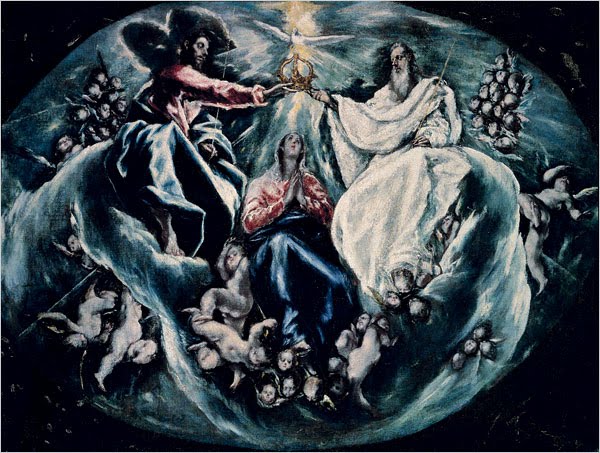
The center’s exhibits are small, but tend to showcase the most exquisite of Greek artifacts, rare centuries old treasures that often have never before left their native lands. The exhibition today was of that ilk. “The Origins of El Greco: Icon Painting in Venetian Crete” collects about 50 icon painting from the 14th, 15th and 16th centuries, but isn’t satisfied with just showcasing them. Instead, the exhibit uses these paintings to illustrate that Greece was an artistic melting pot during this time period, and to tell a story about how this merging of multiple art movements shaped one of Greece’s most famous artists, the painter Domenikos Theotokopoulos, better known as “El Greco” (translated as simply “The Greek”).

El Greco is one of Paul’s favorite artists and is considered one of the fathers of modern painting, which is a pretty shocking thing to say about an icon painter of the 16th century. He’s known for his dramatic, emotional images which frequently border on the abstract. His figures are often elongated and non-proportional, his colors overly vivid and unreal, and his bright light used for emphasis, giving an intense and surreal energy to his compositions. His style has always been difficult to pin down, as it seems very modern and separated from the styles of his era, but this show points out that El Greco actually drew elements from the many painting movements of his time and fused them to create his unique style.

I don’t know much about ancient painting styles, but from this exhibit I discovered that the older Byzantine icon paintings are the ones I dislike so much, with their flat images, gold backgrounds and little variety. However El Greco seems to have pulled much of his abstract elements out of this style, like the elongated faces, and non-proportional figures. Greece was a colony of Venice during this period, so the Venetian Gothic style creeps into many of the paintings, adding vivid colors, animated poses and realistic details. Variety explodes in this style, and saints are seen slaying dragons, fighting wars, and riding fanciful lions. Then the influence of the Renaissance shows up, and suddenly the images aren’t flat. Depth and dimension are added and light is used for dramatic emphasis. Due to the meeting of cultures in Greece, all of these styles were present during El Greco’s time, sometimes all in the same painting, and it’s easier to see El Greco’s origins in these predecessors and contemporaries.

I have to say that this exhibit really won me over. I found plenty of variety in the many painting styles, poses, subjects and meanings, and, to my utter shock, I was not bored. I promise the next time I come across an icon section at a museum, I won’t be so quick to pass it over. I should note here that Paul has always loved icon painting. He claims his Slavic soul is programmed to love flat awkward non-dimensional gaudy religious paintings. He has always found them oddly fascinating for their alien qualities. He thoroughly enjoyed the exhibit, but he didn’t need to be won over by it.


The second museum of the day was the Austrian Cultural Forum, located in a midtown office building a block away. The forum is an agency of the Republic of Austria that “seeks to enhance the appreciation of contemporary Austrian creative achievements in the United States.” The mission statement sounds similar to the previous museum, but that’s where the similarities end. By far the most remarkable thing about the forum is the building, which looks a bit like a modern interpretation of a Swiss chalet done in grey sheet metal, stretched into a 24 story tower and squeezed into a shockingly narrow 25 ft space between office buildings. No, that’s not a misprint; apparently they needed to fit the tower into the space occupied by their previous townhouse. Manhattan real estate prices make people do crazy things.

The exhibit for this spring is called “Solace”, and is supposed to contain “art in a very mundane sense as a source of solace.” I can’t say I felt much solace, more like puzzlement, sometimes bemusement, and definitely boredom. I don’t want to critique the art too much, as Paul and I promised each other at the beginning of this project that we would try not to be overly negative about things we didn’t like, as art is by its nature extremely subjective. One person’s da Vinci is another person’s dreck. So instead I’ll just give the titles and descriptions of some pieces and let the reader be the judge. 

 “Untitled (Balloon Equilibrium)”, eight helium balloons on strings floating in a corner in various stages of deflation (we didn’t think the deflation was on purpose, but could be wrong); “Sands Masturbation”, a video of half naked girls playing on a beach and fondling their breasts, with a home movie of a guy masturbating playing beside it; “I Was Down”, three red circles projected on the wall (see picture); “Now That We Can Talk About (Lament as Praxis)”, sticks lying against a stand next to objects such as a can of wood stain and the top of a rusty fire hydrant (see picture); and lastly “The Act of Drinking Beer With Friends is the Highest Form of Art”, a card table and rows of empty beer bottles on shelves (see picture).

Critiques of the art quality aside, we didn’t feel like we learned anything about Austrian culture, other than they like to masturbate and drink beer, which we had thought was fairly universally human.

Ta for now, will fill you in on the excellent Paley Center for Media next time. 

Art in this posting, from the top: “Pieta,” early 16th century probably by Nikolaos Tzafouris; “Christ Pantokrator,” late 14th century, artist unknown; "Virgin Hodegetria," artist unknown; “The Crucifixion,” late 15th century by Andreas Pavias ; “Saint Theodore Tiro, from Candia,” 15th century, artist unknown; “Saint Demetrios on Horseback” by Donatos Bitzamanos, "The Adoration of the Magi" 1585 by Michael Damaskenos; “Coronation of the Virgin” 1603 by El Greco; the exterior of Austrian Cultural Forum; "I Was Down" by Koudlam; “Now That We Can Talk About (Lament as Praxis)” by Misha Stroj; and “The Act of Drinking Beer With Friends is the Highest Form of Art” by Toni Marioni.

Saturday, February 13, 2010

Guggenheim Museum

2/6/10; Saturday, continued
TIME: 2hr
COST: Pay-what-you-wish Sat evening

At last we visited the Solomon R. Guggenheim Museum: architectural icon, New York City landmark, and home to an internationally renowned art collection. Known to locals simply as “the Gugg”, it’s both one of New York’s most famous museums and most recognizable buildings, and I’ve wanted to see it since long before I came to New York.

The Guggenheim’s permanent collection is a who’s who in modern art. If you’ve heard of any artist, you probably heard of those at the Gugg, with names like Picasso, van Gogh, Cézanne, Gauguin, Manet, Monet, Pissarro, and Renoir. I got a sense of deja vou walking through the exhibits; these are the paintings famous enough to be featured in everything from car commercials to movie sets and you’ve definitely seen them before.

But as great as the art is, the real star here is the building. When the museum was first opened in 1959, the New York Times described it as a “a war between architecture and painting in which both come out badly maimed.” It’s Paul’s and my opinion that architecture won. Designed by Frank Lloyd Wright, the Guggenheim is considered one of the 20th century's greatest buildings and its blindly white modern curves stand out starkly from the traditional buildings of 5 th avenue, and have been described in many picturesque ways, including: a curving wave that never breaks; an upside down seashell; or, my personal favorite, a grand balloon in the Macy’s Thanksgiving Day Parade. As great as the art was, I find what I really remember about our time in the museum is this wonderful building. Even the bathrooms are memorable, situated in the hollow oval pillars that line the central ramp, in the middle of the exhibition space. Thus you find yourself doing something very private in the middle of a very crowed public place; its oddly exhibitionist.

We visited the Guggenheim during the “Pay What You Wish” time (Saturday evenings). As we had been warned, the line for this was over a block long. I haven’t seen a line that long since “Lord of the Rings” opened in Seattle. That line was very different, containing lots of people dressed up as elves and chatting excitedly in the drizzle. This one was made up of grouchy New Yorkers shivering in the cold February wind, commenting on other people’s accessories and wondering loudly what could possibly be so important for so many people to be lined up. I can’t decide if this demonstrates that New Yorkers are not easily impressed, or if they were hoping to get other people in the line to leave.

Once we got into the museum, the first thing we saw was a man and a woman making out on the lobby floor, in the great rotunda space of the museum. Their necking progressed until they were writhing on the cold marble floor in a sort of clothed soft porn. The couple continued this the entire two hours we were in the museum and attracted quite a crowd. We were initially puzzled by them, along with everyone else in the lobby, but eventually determined that several of the Guggenheim exhibits during our visit were by Tino Sehgal, a performance artist, and that this was not the weirdest of his art pieces. After making our way awkwardly around the couple, giving them a wide berth, we made it to the start of the Guggenheim’s inner ramp. This is a wide ramp that gently spirals up the seven floors of the museum and normally contains a great deal of artwork, but not today. Today we were greeted by a young boy of about 14 in a suit who asked if we would like to take part in an art project. Eyeing the couple on the floor, I decided that I didn’t want to be publicly embarrassed and declined. Paul, of course, said yes.

Paul’s art project turned out to be a conversation. The boy asked Paul to define progress, and they talked about it as they headed up the ramp. Each time they completed a turn of the spiral, Paul’s conversation partner would be replaced with an older person, who would continue the conversation and refine the ideas discussed. This progressed through a teenager, an earnest 20-something, a more experienced middle-aged man and so on, until, on the top floor Paul was talking to a grey haired philosophy professor from Columbia University. Paul loved it. He claimed it was the best experience that he’s ever had in a museum. As for me, talking to strangers has never been my favorite thing, so I’m glad I declined. Just goes to show you that art is truly in the eye of the beholder, or in this case the ear…

Ta for now. In our next blog, Paul will fill you in on Madame Tussaud’s and the Jewish Museum.

Pictures featured above, from the top: the interior ramp and skylight of the Guggenheim Museum; the exterior of the Guggenheim Museum; The Soldier Drinks, by Chagall; Le Moulin de la Galette, by
Picasso; and Before the Mirror by Manet.