Showing posts with label performance art. Show all posts

Tuesday, July 27, 2010

7th Regiment Armory Conservancy / Asia Society

5/21/2010, Friday (continued): 

MUSEUMS:
Asia Society and Museum ………………..... 30 min

COST:
Seventh Regiment Armory Conservancy …. $12 each
Asia Society and Museum ……................… $10, but free after 6 on Friday
.
When we were making the list of museums in New York City for this project, we found most museums easily enough.  Most had reasonable P.R. and made the lists on New York Parks and Recreation or tourist information sites.  But during our travels we’ve found a few museums not mentioned in any guide.  We’ve come to call these the “hidden museums of New York,” known only to locals and a select few in the arts crowd. 

The Seventh Regiment Armory Conservancy (called “the Armory” by those in the know) is one of these hidden museums.  We discovered it through an article about the artist who exhibited there this month, but if I hadn’t read the arts section of the newspaper that day, we would have walked right by it today.  Which is actually a bit ironic, as the Armory is gigantic.  It takes up an entire city block on the Upper East Side, and its 55,000 square foot drill hall is among the largest interior spaces in NYC, just shy of Grand Central Station.

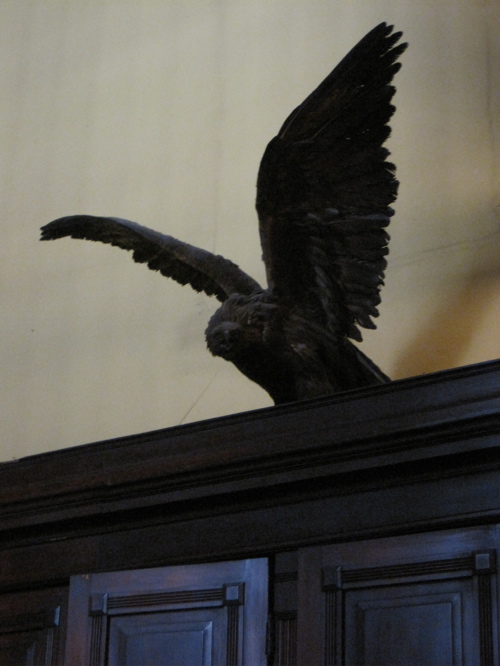
As you might expect from an unpublicized museum, the Armory is an odd duck: part military museum, part historic Gilded Age men’s club, and part exhibit hall for ultra modern performance art.  I am confident that no where else in the world can you walk through 6 inch thick armored oak doors and iron portcullis, past a stuffed eagle and a mounted moose head sitting next to a restored gatling gun lit by a nearby Tiffany stained glass window to see a 25 foot pile of laundry being picked up and dropped repeatedly by an 80 foot orange crane.  Yet that is exactly what we did today.  It’s going to be hard to top this one for bizarre museum experiences.

As with any place (or person) with this much quirkiness and character, the Armory has quite a past and has served a hodgepodge of rolls, as everything from a drill hall to indoor tennis courts to a synagogue.  It was originally built between 1877 and 1881 for the Seventh Regiment of the National Guard, State of New York.  This regiment was formed in 1806 to protect the city, after British frigates blockading New York Harbor fired at passing vessels.  It saw some action quelling riots in 1849 and helped with city fire fighting, but after NYC formed its own police and fire departments the regiment became largely ceremonial, serving as an honor guard and participating in civic events such as the inauguration of the Brooklyn Bridge in 1883 and the Statue of Liberty in 1886.


As a ceremonial guard, the regiment morphed into an elite men’s club for the sons of the city's wealthiest Gilded Age families, acquiring the nickname “Silk Stocking Regiment.”  Vanderbilts, Van Rensselaers, Roosevelts, Tiffanys, Stewarts and Livingstons all served here, and it was the immense wealth of these families that built the Armory we see today; the only armory in the United States built and furnished entirely with private funds.  And it took a lot of funds indeed.  The building itself was designed by Charles W. Clinton, the premier Gothic revivalist and designer of the famed Astor Hotel, and a veteran of the regiment himself.  He designed the exterior as a mock medieval fortress with brick crenellations, musket ports, arrow slits and a central tower. 

Inside, the club areas are lavish, designed by the era’s most prominent artists such as Louis Comfort Tiffany and Stanford White, and have been called “the single most important collection of 19th century interiors to survive intact in one building” by the New York City Landmarks Preservation Commission.  These rooms are undergoing a long restoration process, but wandering around in them is free and we highly recommend it.  Apparently two of the rooms are the only known Tiffany interiors to survive intact, and all of them are gorgeous even in their semi-neglected state.  If you squint your eyes as you wander you feel as if you can spy the shimmer of glamorous gowns and hear the clink of champagne glasses in some long ago cocktail party of New York’s storied past.
.

To raise money for the restoration, the Armory’s massive drill hall is rented out as an event and art space.  It's been used for Shakespeare festivals, operas, and most commonly, extremely large art installations.  While we were visiting we saw “No Man’s Land,” by Christian Boltanski, a performance art piece consisting of a 25-foot-high mound of used clothing, surrounded by a field of coats arranged in squares.  Every few minutes a five-story crane plucked a random piece of clothing from the top of the clothes pile, then released them to flop down haphazardly.  As we wandered among the clothes, we heard a ceaseless drum of heart beats emanating from poles at the corners of the squares.

Both Paul and I liked the exhibit.  I thought it was at least bizarre enough to be interesting, though I did come out of there wondering if I had let the laundry go too long again.  Paul loved it (as is usual for performance art) and saw it as a comment on the randomness of life: who gets chosen and who gets left behind.  Parts of the installation seemed designed to be reminiscent of a concentration camp, with a wall of numbers blocking off the entrance to the exhibit and rusty poles with low wires like fencing, although the meaning was vague enough to be open to interpretation and the people wandering the exhibit didn’t seem sure of how to take it.  Despite its size, the space felt claustrophobic, with narrow paths and low hanging lights, and dozens of heartbeats surrounding you from all sides.  Paul stood in line at an ersatz doctor’s office to get his heartbeat recorded for the exhibit, and even talked me into doing it.  Now our heartbeats will be preserved together in a permanent archive (Les Archives du Coeur) on an island off the coast of Japan.  I guess its kind of romantic, in a weird artsy sort of way.  (Paul knows its romantic in a weird artsy sort of way.)

The next museum was the Asia Society, a global organization “working to strengthen relationships and promote understanding among the people, leaders, and institutions of the United States and Asia.”  Our impression was that this organization was really more society than museum, as the gallery space was modest and much of the building closed off into what appeared to be conference space.  Looking online, the Asia Society has a full lecture schedule and seems focused on business development, with talk titles like “Why One Loves to Hate Globalization,” “Hong Kong’s Political Reforms: What Lies Ahead?,” and “Doing Business with Japan: Perspective of Australian Companies.”  Oddly, during our visit we couldn’t get a good grasp on what the goals and purpose of the society actually were, and it seemed somewhat mysterious.  Paul wonders what shadowy organizations really run the place, and what are they up to?

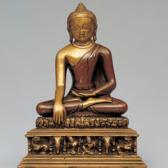
The art of the society is based around John D. Rockefeller’s exquisite collection of 280 Asian artifacts, which are displayed and interpreted in a variety of exhibits year round.  Today’s exhibit was “Pilgrimage and Buddhist Art,” focusing on objects from or about the major sites of Buddhist pilgrimages.  Unfortunately, the exhibits weren’t well explained, and we had to attempt to eavesdrop on a tour guide in a noisy gallery to make much sense of it.  Essentially, it looked like a lot of very similar looking Buddha statues to us

Our take on things: We found the Armory to be one of the hidden gems of NYC, well worth a look, both for the lovely designs of a by-gone era, and bizarre large-scale modern art installations.  The Asia Society seemed more focused on business than art, but might be worth a look, particularly if you go on a Friday evening when its free (as we did).  Otherwise, for the same 10 dollars, we might recommend seeing the Rubin Museum instead, with its much more extensive, varied and better explained collection of Buddhist art.

Images in this post: “No Man’s Land,” by Christian Boltanski, in the Armory drill hall; pictures of the interiors of the Seventh Regiment Armory Conservancy, including stuffed eagle, stained glass window, ceiling detail, paneling detail, and a room in the armory; two close ups of “No Man’s Land,” by Christian Boltansk; Asia Society logo on exterior of the building; Buddha Shakyamuni, Tibet 11th century; Buddha Shakyamuni with Kneeling Worshippers, Myanmar/Burma 14-15th century; Buddha Shakyamuni, India, Bihar, 9-10th century.

Sunday, June 6, 2010

Museum of Modern Art (MOMA)

3/12/2010, Friday

TIME: 1.5 hr
COST: $20 each

The Museum of Modern Art (MOMA) is one of the world’s greatest museums.  Oh sure, there are bigger museums and a few with greater collections (but not many), but there is little doubt that MOMA has a huge influence in the art world and on the public at large.  Quite simply, it’s a legend.  Unfortunately, our visit this day was fraught with peril and mishap and we didn’t see as much of it as we would have liked, but we can’t blame that on the museum.  Our troubles really started when a tree fell in Dobbs Ferry, but more on that later.

Much of MOMA’s fame is derived from its massive collection (over 150,000 works), which includes iconic works such as Vincent van Gogh's Starry Night, Picasso's Les Demoiselles d'Avignon, Salvador Dali's Persistence of Memory, and Andy Warhol’s Marilyn Monroe, and is considered by some to be the best collection of modern Western masterpieces in the world.  But this museum doesn’t collect just paintings.  MOMA has 6 different departments: Painting and Sculpture, Architecture and Design, Photography, Prints and Illustrated Books, Drawings, and Film and Media.  Film and Media alone has 22,000 films and 4 million film stills. 

A substantial portion of MOMA’s fame comes not from its collection, but from it’s daring.  Past and present curators have held true to the philosophies behind modern art, and love to shake things up.  The Architecture and Design, Film, and Photography departments were the first of their kind in any museum.  Groundbreaking MOMA exhibitions have included Fantastic Art, Dada, Surrealism (1936), The Family of Man (1955), and Primitivism (1984).  Right now the exhibit just finishing up is a series of performance pieces featuring, among other things, 38 completely naked men and women in various poses, including lying under a skeleton and facing each other in a doorway that visitors have to push past.  Needless to say, the exhibit attracted a great deal of media attention, and not just because there were naked people in a museum.  Apparently not all visitors have kept their hands to themselves

Even MOMA’s origins are controversial, with its beginnings forged in a long lasting marital disagreement in New York’s most famous family, the Rockefellers.  John D. Rockefeller Jr. was brought up a strict Baptist, with a deep respect for traditional values and a love of traditional art.  His extensive collection of medieval art forms the core of the Cloisters (a huge medieval museum in Manhattan).  However, his wife, Abby Aldrich Rockefeller, had completely different tastes.  She loved modern art.  J.D. became increasingly disturbed by the art his wife brought into their home, and as a result the allowance he gave her was quite modest in relation to the fortune he controlled.  Despite her limited funds, Abbey managed to amass a large collection of prints and small paintings during the 1920’s and 30’s.  One might say she eventually won their argument, as their sons Nelson and David became avid lovers of modern art, and if you ever visit Kykuit, the Rockefeller estate in Hudson Valley, you’ll find Nelson’s large collection of modern art and sculpture looking very jarring and out of place next to his father’s Neoclassical architecture and nymph fountains.  The guide of the Kykuit tour I took called it a textbook case of a son’s rebellion, just done with a bit more money than most.


Due to Abby Aldrich Rockefeller’s more limited funds, MOMA began as collaboration between her and two of her friends, Lillie P. Bliss and Mary Quinn Sullivan (pictured above from left to right), over an idea Abby proposed literally over lunch.  Nelson Rockefeller later remarked, "It was the perfect combination. The three women ... had the resources, the tact and the knowledge of contemporary art that the situation required. More to the point, they had the courage to advocate the cause of the modern movement in the face of widespread division, ignorance and a dark suspicion that the whole business was some sort of Bolshevik plot." 

In keeping with MOMA’s revolutionary attitudes, the headline exhibit when we visited featured the works of Hollywood superstar Tim Burton, not someone you’d normally think of being exhibited in a museum (see entrance to the exhibit in picture at left).  In case you’ve been living under a rock for the last three decades, Burton is famous for his dark and quirky films, featuring sensitive misfits triumphing over a world of repressive mediocrity.  His biggest hits include “Pee-wee’s Big Adventure,” “Beetlejuice,” “Edward Scissorhands,” “The Nightmare Before Christmas,” and “Batman.”  The exhibit featured models, costumes and set pieces from his well-known films, but also many non-film works, such as sketches, photography and even sculpture.  Burton was an illustrator for Disney early in his career, and is a talented sketch artist.  I particularly liked the pieces he drew during his childhood in Burbank California, like his drawing for the parks department litter campaign.  Paul was fascinated by the big pink angora sweater worn by Johnny Depp in “Ed Wood.”  The exhibit also featured earlier and less well known short films, like the excellent “Vincent”, depicting a young boy who fantasizes that he is his (and Burton's and Paul’s) hero Vincent Price, with Price himself providing narration. 

The works all feature Burton’s particular brand of gothic macabre horror, which is funny and a little scary at the same time, and has made him famous.  Both Paul and I like many of his films, but the exhibit highlighted a problem that we both have with Burton’s work.  It all feels homogenous, with very little variety, and after wandering around looking at caricature after caricature with exaggerated proportions and bizarre disfigurements, we actually felt a bit bored.  Burton isn’t trying to say anything new with his art, he just seems stuck in the same “weirdo makes good” rut that he’s always been in.  All in all, the exhibit was fun for a while, but ultimately a bit of a let down.  Paul found a humorous short video to help explain our perceptions of Burton's lack of originality. 

The Burton exhibit generated a lot of fuss in the press, and was heavily advertised.  It’s been held up as an example of a shift in museum attitudes.  Many museums have been attempting to throw off their stodgy image and attract a younger audience.  To do this, they’re hiring younger curators and embracing popular trends, like Burton.  (This show was currated by the shockingly young 37-year-old Rajendra Roy, chief curator of film at MOMA.)  The strategy seems to have worked in this case, as Burton visitors were relatively young, averaging in their 30’s, and the show was a blockbuster.  Every weekend was completely sold out, which is where our problems began.

As we don’t live or work in Manhattan, it can be difficult for us to get into the city during the week.  I managed to get a ticket for a Friday afternoon visit (one of the few left) and Paul and I arranged to be free that afternoon so we could drive into the city BEFORE rush hour.  However, that afternoon a tree fell in Dobbs Ferry, knocking out power to all traffic lights in the vicinity, and Paul was stuck in a 2-hour traffic jam on his way home.  From there on it was a disaster, for now we were driving into the city during rush hour (another 2 hour traffic jam).  When we finally arrived at the museum, we were cranky, exhausted and extremely late for our ticketed time.  Fortunately the museum is open late on Fridays and they were still willing to let us in to the exhibit.  Unfortunately, the museum is open late on Fridays because that when it is free and it was completely packed.  We had to fight our way through crowds to see every piece in the Burton exhibit, and when we were done with that we just couldn’t face the rest of the museum in these insane crowds.  We had both seen MOMA in its entirety when we visited New York as tourists 2 years ago, so we called it a day and went home.

In conclusion, of course we would recommend MOMA for a visit; it’s in all NYC tourist guides for good reason, but try to avoid the crowds if you can. 

Images in this post, from the top: "Baboon Boy," by Tim Burton, in the lobby of MOMA; A visitor at MOMA walks between Jacqueline Lounsbury and Layard Thompson in "Imponderabilia," from the exhibit "Marina Abramovic: The Artist Is Present"; John Bonafede in "Nude with Skeleton," from the exhibit "Marina Abramovic: The Artist Is Present"; photograph of sculpture in the gardens of Kykuit, the historic Rockefeller estate; photographs of Abby Aldrich Rockefeller, Lillie P. Bliss and Mary Quinn Sullivan (from left to right); entrance to the Tim Burton exhibit; sculpture at the Tim Burton exhibit;"The boy with nails in his eyes" figure; sketch from the short film "Vincent," by Tim Burton.

Saturday, February 13, 2010

Guggenheim Museum

2/6/10; Saturday, continued
TIME: 2hr
COST: Pay-what-you-wish Sat evening

At last we visited the Solomon R. Guggenheim Museum: architectural icon, New York City landmark, and home to an internationally renowned art collection. Known to locals simply as “the Gugg”, it’s both one of New York’s most famous museums and most recognizable buildings, and I’ve wanted to see it since long before I came to New York.

The Guggenheim’s permanent collection is a who’s who in modern art. If you’ve heard of any artist, you probably heard of those at the Gugg, with names like Picasso, van Gogh, Cézanne, Gauguin, Manet, Monet, Pissarro, and Renoir. I got a sense of deja vou walking through the exhibits; these are the paintings famous enough to be featured in everything from car commercials to movie sets and you’ve definitely seen them before.

But as great as the art is, the real star here is the building. When the museum was first opened in 1959, the New York Times described it as a “a war between architecture and painting in which both come out badly maimed.” It’s Paul’s and my opinion that architecture won. Designed by Frank Lloyd Wright, the Guggenheim is considered one of the 20th century's greatest buildings and its blindly white modern curves stand out starkly from the traditional buildings of 5 th avenue, and have been described in many picturesque ways, including: a curving wave that never breaks; an upside down seashell; or, my personal favorite, a grand balloon in the Macy’s Thanksgiving Day Parade. As great as the art was, I find what I really remember about our time in the museum is this wonderful building. Even the bathrooms are memorable, situated in the hollow oval pillars that line the central ramp, in the middle of the exhibition space. Thus you find yourself doing something very private in the middle of a very crowed public place; its oddly exhibitionist.

We visited the Guggenheim during the “Pay What You Wish” time (Saturday evenings). As we had been warned, the line for this was over a block long. I haven’t seen a line that long since “Lord of the Rings” opened in Seattle. That line was very different, containing lots of people dressed up as elves and chatting excitedly in the drizzle. This one was made up of grouchy New Yorkers shivering in the cold February wind, commenting on other people’s accessories and wondering loudly what could possibly be so important for so many people to be lined up. I can’t decide if this demonstrates that New Yorkers are not easily impressed, or if they were hoping to get other people in the line to leave.

Once we got into the museum, the first thing we saw was a man and a woman making out on the lobby floor, in the great rotunda space of the museum. Their necking progressed until they were writhing on the cold marble floor in a sort of clothed soft porn. The couple continued this the entire two hours we were in the museum and attracted quite a crowd. We were initially puzzled by them, along with everyone else in the lobby, but eventually determined that several of the Guggenheim exhibits during our visit were by Tino Sehgal, a performance artist, and that this was not the weirdest of his art pieces. After making our way awkwardly around the couple, giving them a wide berth, we made it to the start of the Guggenheim’s inner ramp. This is a wide ramp that gently spirals up the seven floors of the museum and normally contains a great deal of artwork, but not today. Today we were greeted by a young boy of about 14 in a suit who asked if we would like to take part in an art project. Eyeing the couple on the floor, I decided that I didn’t want to be publicly embarrassed and declined. Paul, of course, said yes.

Paul’s art project turned out to be a conversation. The boy asked Paul to define progress, and they talked about it as they headed up the ramp. Each time they completed a turn of the spiral, Paul’s conversation partner would be replaced with an older person, who would continue the conversation and refine the ideas discussed. This progressed through a teenager, an earnest 20-something, a more experienced middle-aged man and so on, until, on the top floor Paul was talking to a grey haired philosophy professor from Columbia University. Paul loved it. He claimed it was the best experience that he’s ever had in a museum. As for me, talking to strangers has never been my favorite thing, so I’m glad I declined. Just goes to show you that art is truly in the eye of the beholder, or in this case the ear…

Ta for now. In our next blog, Paul will fill you in on Madame Tussaud’s and the Jewish Museum.

Pictures featured above, from the top: the interior ramp and skylight of the Guggenheim Museum; the exterior of the Guggenheim Museum; The Soldier Drinks, by Chagall; Le Moulin de la Galette, by
Picasso; and Before the Mirror by Manet.