Showing posts with label modern art. Show all posts

Sunday, June 12, 2011

Hipanic Society of America

Portrait of the Duchess of Alba by Francisco De Goya, 1797
7/17/2010, Saturday
TIME: 45 min
COST: Free

Harpy door detail
Our favorite experiences of this great museum adventure have been discovering the hidden treasures of New York City.  This city is so packed full of wonders that not even natives know them all, and every now and then we stumble upon jewels of world-renown overlooked by the masses passing by on the sidewalk.  One good example is the 7th Regiment Armory, once a golden age men’s club whose gilded but unrestored halls show off the last known intact interiors by Tiffany and Stamford White, with mother of pearl inlays and stained glass glistening in every corner, but visitors are so rare you feel outnumbered by ghosts of Rockefellers.  Then there’s the Neue Gallery, exhibiting legendary Germanic artists like Klimt and Klee, including a painting that set the record in 2006 for the largest sum ever paid for a painting, but mention it to a New Yorker and you’ll probably just get a puzzled look.
 
The Holy Family, by El Greco, 1590
Today we found the best “hidden treasure” yet.  Hidden in a semi-dodgy largely residential neighborhood on the upper Upper West Side is the Hispanic Society of America.  From the name you might picture contemporary Latin American art, but you’d be wrong.  For that you should check out El Museum del Barrio on the northern reaches of Museum Mile.  Instead, the Hispanic Society houses what appears to be the largest collection of Spanish treasures this side of the Prado

Bowl, Manises (Valencia), ca. 1370-1400
All the legends of historical Spain are here: portraits by Francisco de Goya, Diego Velázquez and El Greco line the walls, you’ll find yourself stumbling over tombs of 16th century Spanish noblemen and marveling at first-century Iberian mosaics, medieval pottery and Roman busts.  This museum’s collection is so renowned that it makes loans to museums like the Met and the Frick, and when Queen Sofia of Spain came to New York, this is the museum she picked to see.  Yet most New Yorkers have never heard of it, and despite its free admission, visitors are few and far between.

The Hispanic Society of America, in Audubon Terrace
The reason for this can only be explained by the Hispanic Society’s location, far from the art rich areas of Midtown and the Upper East Side, well outside tourist zones, and not somewhere the average New Yorker would go without a reason.  The area of the city (called Washington Heights) is so desolate that we had difficulty even finding a place for lunch.  But we felt the museum well worth the hassle. 

El Cid, by Anna Hyatt Huntington
The Hispanic Society is located in a lovely Beaux Arts complex called Audubon Terrace, built in 1904 by Archer M. Huntington, heir to a vast railroad fortune.  Huntington envisioned the terrace as a museum complex and it once housed the American Geographical Society, the Museum of the American Indian and the American Numismatic Society, but most left for the greater crowds of the touristy Financial District.  Now the terrace is largely empty, filled only by impressive statuary such as the gigantic statue of El Cid in front of the museum.  However you might recognize its echoing expanse as you search for the museum entrance; it was a film site of the popular TV show Law and Order where it was depicted as Hudson University.

Central exhibit hall of the Hispanic Society

Once you step into the museum, you can understand why this museum didn’t leave with the others when the neighborhood went downhill.  The exhibit halls are breathtaking: long galleries of deep red terra cotta and dark wood, intricately carved and tiled, with spacious balconies and expansive lead framed skylights throughout the building.  Our single complaint was that it was not air conditioned, but this was a big problem as it was mid-July and temperatures were in the upper 90’s.  It was so hot that the museum canceled the tour for the day due to worries about the guide’s health.  We managed to survive, but were certainly not comfortable.  Earlier this year, after an equally sweltering day in an un-air conditioned historic house, Paul made me swear to pick only air-conditioned museums on hot days.  I had thought a museum with art of this quality would have central air, but was obviously wrong and had to endure some grumbling from Paul’s direction as we made our way into the museum.

Paul may not have liked the temperature, but his grumbling stopped when he saw what the museum contained.  Paul has been obsessed with Spain and Spanish culture since he visited it on a school trip when he was 11.  Since then his obsession has branched into many areas of his life.  He can give lectures on Spanish history and wanted to model our patio in Seattle on the Court of the Lions in the Alhambra (if only we'd had a little more cash).  He is a fantastic self-taught Spanish cook, with 4 different kinds of paprika stacked next to the stove and a legendary bravas sauce recipe that he sweet-talked out of a Barcelona chef.  Paul has been a fanatic fan of the Spanish National Soccer team since the 1980’s and has hours of Flamenco and Fado music, often musing that he might have been a Flamenco dancer in a past life.

Lucienne Breval como Carmen by Zuloaga
In an interesting parallel, the founder for the Hispanic Society, Archer M. Huntington, also had a lifelong obsession with Spain that started at the age of 12 after reading an account of the Gypsies of Spain called ''The Zincali.”  As a young boy, Huntington learned to read Arabic and his early attempt at writing was a novel of the adventures of the heroic knight ''Amadis of Gaul,'' parodied in ''Don Quixote.''  (The Hispanic Society has a first edition of “Don Quixote,” of course.)  As an adult, Huntington hired photographers and painters to chronicle disappearing Spanish rural culture, and his goal in life was to be the champion of Spanish art outside of Spain, which, with the help of his family’s money, he certainly became.  It makes me wonder what Paul would do with a similar fortune.

Portrait of a Little Girl by Diego Velazquez
Paul’s favorite Spanish artists are Francisco de Goya and Diego Velázquez from Spain’s great Golden Age, and the Hispanic Society has beautiful examples of each, such as de Goya’s striking “Portrait of the Duchess of Alba” (1797) that greets you as you enter with an imperious finger pointed to the floor (see image at top of post), and Diego Velázquez’s petite “Portrait of a Little Girl” (c. 1638-44) tucked away on the second floor balcony, rumored to be a portrait of Velázquez’s granddaughter.  But the paintings that blew us away were the more modern canvases of Joaquín Sorolla y Bastida (1863-1923).   

The Vision of Spain, by Sorolla, in its own room at the Hispanic Society
Sorolla is the great Spanish impressionist, called the “master of light” for his sunlight drenched scenes.  In 1911, Sorolla was employed by Huntington to paint a chronicle of Spain.  Over the next 8 years Sorolla visited every province of Spain and painted 14 enormous canvases, largely on site using locals as models and depicting regional costumes and occupations.  Together these are called “The Vision of Spain,” and they take up an entire room in the Hispanic Society.  Each painting celebrates the landscape and culture of its region in gorgeous sun drenched panoramas of laborers, dancers and locals out for a good time.  Flamenco dancers stomp in a crowded market in Seville, fisherman bargain on the wharves of Ayamonte and mounted ranchers herding cattle in Andalusia seem to meet your eyes below their wide brimmed hats.
Andalusia, The Round Up, by Sorolla, part of The Vision of Spain
The paintings are actually more well-known in Spain than in New York.  During a recent restoration of the Hispanic Society, “The Vision of Spain” took a two-year tour of Spain’s major museums and 2 million people lined up to see these paintings, breaking all attendance records.  It was the most successful exhibition in Spanish history. Yet if you see it in New York, chances are you’ll be the only visitor.

IN SUMMARY
The Hispanic Society is a world-class museum than no one in New York City seems to know about, so this is one museum where you won’t have to fight the crowds.  We both felt it well worth the trip to Washington Heights.  However we’d recommend not going on a hot day unless they install air-conditioning.

RATING: Hispanic Society of America
Pauline: 10 out of 10.  World-class art, beautiful interiors and the thrill of discovering a hidden gem. 
Paul: 9 out of 10.  Nearly a perfect museum, but they need air-conditioning.

Detail of Seville, The Dance, by Sorolla, part of The Vision of Spain
Images in this post, from the top: Portrait of the Duchess of Alba by Francisco De Goya y Lucientes, 1797.  Door detail on Audubon Terrace.  The Holy Family, by Doménikos Theotokópoulos (El Greco), c. 1590.  Bowl, Manises (Valencia), ca. 1370-1400.  Exterior of the Hispanic Society of America, in Audubon Terrace.  El Cid, by Anna Hyatt Huntington, notable American sculptress and wife of the museum founder Archer M. Huntington.  Central exhibit hall of the Hispanic Society.  Lucienne Bréval como Carmen by Ignacio Zuloaga y Zabaleta.  Portrait of a Little Girl by Diego Rodríguez de Silva y Velazquez c. 1638-44.  8 of the 14 paintings of The Vision of Spain, by Joaquín Sorolla y Bastida (1911-1919), exhibited in one room at the Hispanic Society.  Andalusia, the Round Up, by Sorolla, part of The Vision of Spain.  Detail of Seville, The Dance, by Sorolla, part of The Vision of Spain.

Thursday, January 6, 2011

Staten Island Museum / Noble Maritime Collection

Soul of Sails, by John A. Noble
Sunday 8/15 and Monday 8/16 
MUSEUMS:
Staten Island Museum …………………………. 0.5 hr
Noble Maritime Collection …………………….. 0.75 hr
Snug Harbor Botanical Gardens ......................  1 hr

COST:
Staten Island Museum …………………………. $2
Noble Maritime Collection ……………….……. $6
Snug Harbor Botanical Gardens ..................... Free

Paul’s favorite thing about our visit to Staten Island was its retro feel.  Unlike Manhattan and much of Brooklyn, Staten Island remains un-gentrified and has a rough around the edges “old-school” New York look, but without the crime rates of Queens or the Bronx.  Movies like the Godfather and Goodfellas have filmed on the island looking to capture the rough streets of New York in the 50’s and 60’s.  There are no skyscrapers here, no designer boutiques, and Staten Island’s version of haute cuisine is Enoteca Maria, a restaurant where a rotating roster of Italian grandmothers cook old world comfort food (sounds like a brilliant idea for a restaurant to us). 

Staten Island Museum
The Staten Island Museum is a good example of the island’s retro attitude.  Every borough of NYC has an eponymous museum.  In Manhattan, the Metropolitan Museum of Art reins supreme with its massive 2 million piece collection that includes world famous holdings of old master paintings and ancient artifacts, such as an entire Egyptian temple rebuilt brick by brick in the museum courtyard.  The Brooklyn Museum comes in a close second with 1.5 million works, including a well-regarded modern art collection, a large Egyptian section and several complete houses built into its decorative arts section. 

Perhaps knowing that there is no beating these guys, the Staten Island Museum does its own thing.  It models itself as a “general interest” museum, with diverse exhibits on biology, geology, art, culture and history.  This is an old fashioned model for a museum, and the only one left of this type in NYC, but the Staten Island Museum pulls it off with style and ended up being fun, educational and kind of cool. 

Lenape carving
Part of the fun of this museum is that it focuses exclusively on its home borough, Staten Island.  Instead of temples from Egypt, the Staten Island Museum exhibits the stone carvings of the Lenape, the Paleo-Indians who lived on the island more than 10,000 years ago.  Instead of sculptures from Greece, the Staten Island Museum has a large taxidermy bird collection collected from the island.  Instead of paintings by Michelangelo, the Staten Island Museum exhibits Staten Island artists. 

Portrait of Otto Wigand, by Adeline Albright Wigand
While we were there, the museum had a large exhibit called "Beauty Rediscovered" on Staten Island painters Adeline Albright Wigand and Otto Charles Wigand, married artists from the late19th – early 20th century.  The two studied the classical painting in New York and Paris, but lived and worked on Staten Island from 1916 until their deaths in 1944.  The Wigands were well regarded in their day, but they did not embrace the modern art movements that took hold in their time and their notoriety faded.  The paintings in the exhibit were lovely and well executed, with colorful images of children, people and landscapes.  The couple often chose subjects they loved, such as their family, their home and each other, and the warmth showed in their art.  Both Paul and I enjoyed the look at these forgotten but lovely paintings.
Polly, by Adeline Albright Wigand

Butterfly from the Staten Island Museum
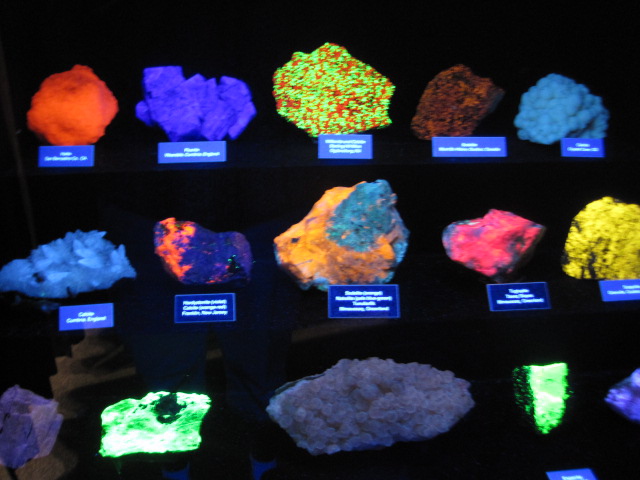
Fluroescent minerals from the Staten Island Museum
Our favorite section of the museum was the natural history room.  We had fun examining the jars of pickled amphibians and the large collection of taxidermy animals.  It brought back fond memories of school trips from our childhood.  My favorite section was the bug wall.  The museum has a half a million preserved insects, and we spent several minutes examining the multitudes in the beetle and butterfly cases.  Another great section was a collection of naturally fluorescent rocks.  It was childish fun to switch the lights off and watch the rocks glow.  Paul loved the microscopic mineral exhibit, complete with an actual microscope.  The minerals were collected by a single person, and Paul felt like he was sharing his secret miniature world.

Nobel Maritime Collection
As fun as the Staten Island Museum was, our favorite museum on Staten Island was the Noble Maritime Collection, within a large museum complex called the Snug Harbor Cultural Center.  Snug Harbor was once a retirement home for sailors.  After being abandoned and falling into neglect for years, this lovely collection of Greek Revival and Beaux Arts buildings was reclaimed by hardworking Staten Islanders and has been gradually remade into a community center and botanical gardens.  Much of the site is still being developed, but it's affiliated with the Smithsonian and has a lot of promise.

Neptune Fountain at Snug Harbor
Snug Harbor is a large complex, occupying 83 acres on the awesomely named Kill van Kull (the waterway that separates Staten Island from New Jersey).  Several different types of gardens are scattered throughout the grounds.  Some are still being landscaped or are in the early planting stages, but several gardens are complete enough to make pleasant walks.  We enjoyed the Tuscan garden, the elaborate Chinese scholar's garden, with a quiet pond and shaped trees, and the recently planted “Garden of Healing” with fountains and a stream
Chinese Scholar's Garden at Snug Harbor

Currently there are 3 museums in Snug Harbor: the Staten Island Children’s Museum, the Newhouse Center for Contemporary Art (closed today for an exhibit change), and the Noble Maritime Collection.  The Noble Collection is housed in a former hospital of Snug Harbor, and the museum preserves a few remnants of the building’s past, such as a small dormitory room and an old fashioned wheel chair.  The museum also has a small maritime section, taken up by an exhibit on tugboats, with lots of boat models and movies on how tugboats work.  However, the main focus of the museum is the work of artist John A. Noble (1913 - 1983)

Dying in the English Kills, by John A. Noble
Noble was born in Paris and grew up in a family of artists, but at a young age he became obsessed with the sea and started to work as a seaman in the New York harbor at the age of 15.  In 1928, while towing a schooner down the Kill van Kull, he caught sight of the old Port Johnston coal docks.  The sight changed his life.  At the time, the "Age of the Sail" was ending, and sailing vessels were being rapidly replaced by steam powered metal ships.  Port Johnston was the final resting place of the now obsolete wooden sailing vessels in the NY harbor, and was once one of the largest ship graveyards in the world

John A. Noble's houseboat studio
In 1941, Noble built a studio in the floating graveyard out of pieces salvaged from moldering ships and began to draw and paint the ships around him.  He eventually became successful enough to work full time as an artist, documenting the final chapter of the Age of the Sail.  The museum preserves his houseboat/studio and a replica of his parent’s studio in Paris, and exhibits a large number of his paintings in the long hallways of the former dormitory.  These are haunting, often romantic, remembrances of sailing, depicting not just the ships, but also the industries, people and viewpoints of the era

Ship's wheel at the Noble Maritime Collection
For Paul, the most impressive thing about the Noble Collection was an exhibit on the "Noble Crew," a small group of local volunteers who donated a million dollars worth of labor and materials to the restoration of the building, transforming it from an abandoned shell with collapsing walls and exposed wiring to an immaculate museum.  We have seen this huge outpouring of volunteer effort in other maritime museums around NYC, and it clearly demonstrates the connection and love New Yorkers have to their storied seafaring past.  Paul thinks that these labors of love are often more beautiful than the artwork in the museum.

Snug Harbor Botanical Gardens
In summary, the Staten Island Museum and the Noble Maritime Collection were our favorite museums on Staten Island.  The Staten Museum exclusively shows art and artifacts from Staten Island, doing what the borough museums were designed to do in the first place: celebrate their home borough.  It has the retro design of a general interest museum and manages to be both fun and educational.  The Noble Maritime Museum exhibits beautiful maritime paintings surrounded by the lovely Snug Harbor Botanical Gardens.

VISITING THESE MUSEUMS:
Ship lanterns at the Noble Maritime Collection
If you’re in Manhattan and want to see some great parts of Staten Island, these museums are easily accessible and make a fun day trip.  We recommend taking the free Staten Island Ferry from Battery Park.  The ferry leaves every half hour and is a well-known tourist favorite with an excellent view of the Statue of Liberty and the harbor.  Instead of getting back on the ferry with the rest of the crowds, walk a block to the Staten Island Museum.  After that, return to the ferry terminal and maybe pause for lunch at the excellent Gourmet Dog across the street from the terminal (try the Popeye Dog, with chicken sausage, spinach and mozzarella).  Then hop on the S40 bus from the ferry terminal to Snug Harbor.  It’s a short trip on the bus, and it drops you at the front gate of Snug Harbor.  Alternately, you can walk along the waterfront- its a scenic 40 minutes.  For dinner, return to the ferry terminal for a meal cooked by your favorite Italian grandmother at the fabulous Enoteca Maria, one block from the terminal.  On the return ferry trip, enjoy the site of the sun setting behind Manhattan, and the lights of the city sparkling in the harbor.


RESTAURANTS ON STATEN ISLAND
We were recently asked about our favorite restaurants on Staten Island, so we offer this list:

524 Port Richmond Ave
You won’t find goat cheese on Denino’s menu, and the décor consists largely of the residue of 50 years of cigarettes (now banned) and an old PacMan machine, but you will find fantastic old school New York pie, unchanged since Carlo Denino opened the place in 1951.  The place is a legend among the connoisseurs of New York pizza.  (Yes, there are such people.)

27 Hyatt St. (One block from the Staten Island Ferry Terminal)
This restaurant has no head chef and no set menu.  Instead, a rotating roster of Italian grandmothers make fabulous old world Italian comfort food in one of the more unique restaurants in NYC.  They also have an amazing wine list.

40 Richmond Ter. (Across the street from the Staten Island Ferry Terminal)
Excellent hot dogs adorned by any topping(s) you can picture on a hot dog, plus a few you can’t.  Also has great fries.

817 Castleton Ave
Extensive menu of delicious German fare and a great selection of German beers on tap.  Its not expensive, but go with a big appetite because portions are huge.  Full of friendly locals.

90-92 Taylor Street
It’s not technically a restaurant, but we had breakfast here. This is where we stayed on our visit to Staten Island and we found it to be an inexpensive bed and breakfast with immaculate, spacious rooms and a friendly proprietress, in a quiet but centrally located neighborhood.  We’d definitely recommend it for any stay in Staten Island.  This Bed and Breakfast is also popular with the budget conscious NYC tourist, as you can use the free ferry to visit Manhattan on a daily basis, but not pay Manhattan hotel and parking prices (which are highway robbery).

Moon and Venus, 5am, by Otto Charles Wigand
Images in this post, from the top: Soul of Sails, by John A. Noble 1968, oil on canvas; entrance to the Staten Island Museum; stone head found in Concord, Staten Island in 1884; Portrait of Otto Wigand, by Adeline Albright Wigand 1895, oil on board; Polly, by Adeline Albright Wigand, 1915-1920, oil on board; examples from the insect and fluorescent mineral collections at the Staten Island Museum; Neptune Fountain, a replica of an 1892 fountain made by John W. Fiske Iron Works, recast in 1994 by the Modern Art Foundry in Queens; Chinese Scholar's Garden at Snug Harbor; Dying in the English Kills, by John A. Noble 1965, oil on canvas; John A. Noble's houseboat studio; ship's wheel at the Noble Maritime Collection; the Snug Harbor Botanical Gardens; Moon and Venus, 5am, by Otto Charles Wigand 1930, oil on canvas.

Sunday, June 6, 2010

Museum of Modern Art (MOMA)

3/12/2010, Friday

TIME: 1.5 hr
COST: $20 each

The Museum of Modern Art (MOMA) is one of the world’s greatest museums.  Oh sure, there are bigger museums and a few with greater collections (but not many), but there is little doubt that MOMA has a huge influence in the art world and on the public at large.  Quite simply, it’s a legend.  Unfortunately, our visit this day was fraught with peril and mishap and we didn’t see as much of it as we would have liked, but we can’t blame that on the museum.  Our troubles really started when a tree fell in Dobbs Ferry, but more on that later.

Much of MOMA’s fame is derived from its massive collection (over 150,000 works), which includes iconic works such as Vincent van Gogh's Starry Night, Picasso's Les Demoiselles d'Avignon, Salvador Dali's Persistence of Memory, and Andy Warhol’s Marilyn Monroe, and is considered by some to be the best collection of modern Western masterpieces in the world.  But this museum doesn’t collect just paintings.  MOMA has 6 different departments: Painting and Sculpture, Architecture and Design, Photography, Prints and Illustrated Books, Drawings, and Film and Media.  Film and Media alone has 22,000 films and 4 million film stills. 

A substantial portion of MOMA’s fame comes not from its collection, but from it’s daring.  Past and present curators have held true to the philosophies behind modern art, and love to shake things up.  The Architecture and Design, Film, and Photography departments were the first of their kind in any museum.  Groundbreaking MOMA exhibitions have included Fantastic Art, Dada, Surrealism (1936), The Family of Man (1955), and Primitivism (1984).  Right now the exhibit just finishing up is a series of performance pieces featuring, among other things, 38 completely naked men and women in various poses, including lying under a skeleton and facing each other in a doorway that visitors have to push past.  Needless to say, the exhibit attracted a great deal of media attention, and not just because there were naked people in a museum.  Apparently not all visitors have kept their hands to themselves

Even MOMA’s origins are controversial, with its beginnings forged in a long lasting marital disagreement in New York’s most famous family, the Rockefellers.  John D. Rockefeller Jr. was brought up a strict Baptist, with a deep respect for traditional values and a love of traditional art.  His extensive collection of medieval art forms the core of the Cloisters (a huge medieval museum in Manhattan).  However, his wife, Abby Aldrich Rockefeller, had completely different tastes.  She loved modern art.  J.D. became increasingly disturbed by the art his wife brought into their home, and as a result the allowance he gave her was quite modest in relation to the fortune he controlled.  Despite her limited funds, Abbey managed to amass a large collection of prints and small paintings during the 1920’s and 30’s.  One might say she eventually won their argument, as their sons Nelson and David became avid lovers of modern art, and if you ever visit Kykuit, the Rockefeller estate in Hudson Valley, you’ll find Nelson’s large collection of modern art and sculpture looking very jarring and out of place next to his father’s Neoclassical architecture and nymph fountains.  The guide of the Kykuit tour I took called it a textbook case of a son’s rebellion, just done with a bit more money than most.


Due to Abby Aldrich Rockefeller’s more limited funds, MOMA began as collaboration between her and two of her friends, Lillie P. Bliss and Mary Quinn Sullivan (pictured above from left to right), over an idea Abby proposed literally over lunch.  Nelson Rockefeller later remarked, "It was the perfect combination. The three women ... had the resources, the tact and the knowledge of contemporary art that the situation required. More to the point, they had the courage to advocate the cause of the modern movement in the face of widespread division, ignorance and a dark suspicion that the whole business was some sort of Bolshevik plot." 

In keeping with MOMA’s revolutionary attitudes, the headline exhibit when we visited featured the works of Hollywood superstar Tim Burton, not someone you’d normally think of being exhibited in a museum (see entrance to the exhibit in picture at left).  In case you’ve been living under a rock for the last three decades, Burton is famous for his dark and quirky films, featuring sensitive misfits triumphing over a world of repressive mediocrity.  His biggest hits include “Pee-wee’s Big Adventure,” “Beetlejuice,” “Edward Scissorhands,” “The Nightmare Before Christmas,” and “Batman.”  The exhibit featured models, costumes and set pieces from his well-known films, but also many non-film works, such as sketches, photography and even sculpture.  Burton was an illustrator for Disney early in his career, and is a talented sketch artist.  I particularly liked the pieces he drew during his childhood in Burbank California, like his drawing for the parks department litter campaign.  Paul was fascinated by the big pink angora sweater worn by Johnny Depp in “Ed Wood.”  The exhibit also featured earlier and less well known short films, like the excellent “Vincent”, depicting a young boy who fantasizes that he is his (and Burton's and Paul’s) hero Vincent Price, with Price himself providing narration. 

The works all feature Burton’s particular brand of gothic macabre horror, which is funny and a little scary at the same time, and has made him famous.  Both Paul and I like many of his films, but the exhibit highlighted a problem that we both have with Burton’s work.  It all feels homogenous, with very little variety, and after wandering around looking at caricature after caricature with exaggerated proportions and bizarre disfigurements, we actually felt a bit bored.  Burton isn’t trying to say anything new with his art, he just seems stuck in the same “weirdo makes good” rut that he’s always been in.  All in all, the exhibit was fun for a while, but ultimately a bit of a let down.  Paul found a humorous short video to help explain our perceptions of Burton's lack of originality. 

The Burton exhibit generated a lot of fuss in the press, and was heavily advertised.  It’s been held up as an example of a shift in museum attitudes.  Many museums have been attempting to throw off their stodgy image and attract a younger audience.  To do this, they’re hiring younger curators and embracing popular trends, like Burton.  (This show was currated by the shockingly young 37-year-old Rajendra Roy, chief curator of film at MOMA.)  The strategy seems to have worked in this case, as Burton visitors were relatively young, averaging in their 30’s, and the show was a blockbuster.  Every weekend was completely sold out, which is where our problems began.

As we don’t live or work in Manhattan, it can be difficult for us to get into the city during the week.  I managed to get a ticket for a Friday afternoon visit (one of the few left) and Paul and I arranged to be free that afternoon so we could drive into the city BEFORE rush hour.  However, that afternoon a tree fell in Dobbs Ferry, knocking out power to all traffic lights in the vicinity, and Paul was stuck in a 2-hour traffic jam on his way home.  From there on it was a disaster, for now we were driving into the city during rush hour (another 2 hour traffic jam).  When we finally arrived at the museum, we were cranky, exhausted and extremely late for our ticketed time.  Fortunately the museum is open late on Fridays and they were still willing to let us in to the exhibit.  Unfortunately, the museum is open late on Fridays because that when it is free and it was completely packed.  We had to fight our way through crowds to see every piece in the Burton exhibit, and when we were done with that we just couldn’t face the rest of the museum in these insane crowds.  We had both seen MOMA in its entirety when we visited New York as tourists 2 years ago, so we called it a day and went home.

In conclusion, of course we would recommend MOMA for a visit; it’s in all NYC tourist guides for good reason, but try to avoid the crowds if you can. 

Images in this post, from the top: "Baboon Boy," by Tim Burton, in the lobby of MOMA; A visitor at MOMA walks between Jacqueline Lounsbury and Layard Thompson in "Imponderabilia," from the exhibit "Marina Abramovic: The Artist Is Present"; John Bonafede in "Nude with Skeleton," from the exhibit "Marina Abramovic: The Artist Is Present"; photograph of sculpture in the gardens of Kykuit, the historic Rockefeller estate; photographs of Abby Aldrich Rockefeller, Lillie P. Bliss and Mary Quinn Sullivan (from left to right); entrance to the Tim Burton exhibit; sculpture at the Tim Burton exhibit;"The boy with nails in his eyes" figure; sketch from the short film "Vincent," by Tim Burton.

Sunday, April 18, 2010

International Center of Photography

2/20/2010, Saturday (continued)

MUSEUM:  
International Center for Photography ......................... 1.5 hrs
ICP Education Gallery ............................................ 20 min


COST:
International Center for Photography ......................... $12 each
ICP Education Gallery ............................................ Free


Deep in midtown Manhattan lies a plaza so ugly its been nominated as one of the worst public spaces in the world. The implausibly named Grace Plaza consists of an enormous barren white concrete slab boxed in by the windowless north façade of the WR Grace building, which looms like huge, blank prison walls 50 stories high on two sides of the plaza. During NYC’s seedy days, Grace Plaza was an infamous drug spot; today it's a haven for smokers, and no one else. Yet below this hideous ashtray of a square lurks the International Center for Photography (ICP), a prestigious school and unique museum.


ICP was founded in 1974 by Cornell Capa, a well-known Hungarian photographer, to preserve the legacy of his brother, the legendary Robert Capa (see picture above; 1913 –1954). Robert Capa was a 20th century combat photographer considered one the greatest photojournalists of all time. He covered five different wars: the Spanish Civil War, the Second Sino-Japanese War, World War II across much of Europe, the 1948 Arab-Israeli War, and the First Indochina War. He took insane risks getting shots of actual combat, becoming famous for photographing soldiers as they fell beside him in the Spanish Civil War and swimming ashore on D-Day to photograph the second assault wave on Omaha Beach. His lover, Gerda Taro, also a photojournalist, died in a battle while they were covering the Spanish Civil War, and Robert Capa was killed by a landmine while photographing a troop advance under fire, literally dying with his camera in his hand.

In keeping with its roots, the museum often mounts thought-provoking shows on divisive, sometimes violent topics such as gangs in L.A. and the war in Iraq. This day’s exhibits were no exception to the ICP museum’s almost pugnacious love of controversy. Can a photography museum have an “in your face” attitude?  We think so. 

The largest exhibit was devoted to the first American showing of the eccentric, possibly insane Czech photographer Miroslav Tichy. Tichy’s photographs appear to be badly damaged snapshots of girls and young woman in streets and public parks, going about their business and mostly unaware of the camera. The photos seem clumsy, often showing only pieces of a scene, like a woman’s foot or backside, and are blurry, badly printed and in terrible condition: battered, dog eared, scratched and water damaged. The juxtaposition of clearly sexual images, the surreptitious nature of the photography, and the trashed condition of the photos give the pictures an oddly dreamy but eerie quality. One reviewer called it an “uncanny fusion of eroticism, paranoia and deliberation” and it’s both captivating and highly unsettling. Obviously this was Paul’s favorite exhibit, EVER. He liked it so much he bought the Tichy exhibition catalogue from the gift shop, a first for us.


The exhibit takes on more depth as you learn more about Tichy from a film playing in the exhibit, made by one of his neighbors. Tichy studied at the Academy of Fine Arts in Prague and was for a time a celebrated painter. He was a nonconformist and a former member of the Brono Five, a group of painters who broke with the state-sanctioned Socialist Realism. Yet he also has a history of mental illness, and has been in and out of metal institutions for most of his life. He clearly considers his photographs to be a form of political protest, yet his monologues are not those of a completely sane person. Some things are clear however. The amateur look of his art is deliberate, and the product of a carefully orchestrated series of missteps that begin with crude, homemade cameras. These cameras are on display at the exhibit and are made out of rubbish, fashioned from materials like shoeboxes, toilet-paper rolls and Plexiglas, the lenses polished with toothpaste and cigarette ash.  The cameras look like trash, explaining why a lot of his subjects don’t seem to know that they are being photographed. As he says in the film, “If you want to be famous, you must do something more badly than anybody in the entire world”.

Tichy had a set routine for his photography.  Allowing himself three rolls of film a day, he wandered the streets of his town performing his own personal version of the Czech government’s surveillance program.  He wore a uniform of sorts, an unbelievably ratty coat that Tichy elaborately unraveled.  Taking his trash cameras with him, he cruised the same bus stops, parks and swimming pools everyday, looking for young women to photograph.  Looking at the photographs, the first thing that came to my mind was that if he tried that in America, he would be arrested as a potential molester, and that’s exactly what happened in Czechoslovakia.  He was repeatedly thrown into jails and mental hospitals, beaten and starved, but always released as a harmless old coot.  Upon his release, he would repeat his behavior until his next arrest.  According to his neighbors, his arrests were routine, always happening before holidays or official visits to remove a potential embarrassment.  As we left the exhibit Paul and I were still unsure how much of his art was political protest and how much was insanity, and where the line was between the two.


The other photography exhibits at the ICP are less radical today, but when they were first taken they were shocking.  “Surrealism, Photography, and Paris” was a collection of surrealist photographers of Paris in the 20’s and 30’s.  At the time, these artists were the height of the avante guarde, using fragmented and manipulated images to project a frenetic disjointed view of urban life in a rapidly modernizing city.  Many of the pictures were of prostitutes and dance halls, exposing the seedy dark side of Paris.  Others contrast new and old parts of the city.  In a 1934 picture of the Eiffel Tower, it soars against the night sky with electric lights illuminating its corners.  The tower is a beacon of the future, and in the foreground the silhouette of an old brick chimney is visible as a sign of a rapidly disappearing past.  Once again, this was more Paul’s type of art than mine, and it highlighted more of Paul’s favorite artist, Man Ray (although Tichy and Tino Sehgal are rapidly challenging that coveted spot).  We saw an entire exhibition on Man Ray at the Jewish Museum, and, for me at least, he does not improve with repetition.

Another exhibit highlighted the work of Alan B. Stone.  In many ways this exhibit echoed Tichy’s.  Stone was a gay photographer in Montreal in the 50’s and 60’s, a time when it was very dangerous to be gay.  The walls of this exhibit are lined with Montreal newspapers of the time, featuring stories of beatings of homosexuals and raids of gay bars, underlining the risks that Stone was taking in his work (although its all in French so we had to take the curator's word for it).  Stone was a purveyor of beefcake, specializing in pictures of male pin-ups, theoretically for women.  More risky were his photographs of his native city, where he wandered, Tichy-like, looking for good-looking young men to photograph.  The walls of this exhibit are lined with well-muscled construction workers, shirtless and glistening, swinging heavy hammers, and young nubile dockworkers flinging heavy ropes to each other.  Strangely, Paul did not find this photography as compelling as I.


The last exhibit was one Paul and I stumbled upon by accident.  The address we had for ICP puts it under Grace Plaza, but what is actually under the plaza is the ICP School.  (The museum is across the street.)  This school is one of the world's most extensive and best-equipped schools of photography, offering 400 courses every year, and it exhibits a constant rotation of student works.  We recommend taking a look at the (free) student gallery if you are visiting the ICP museum.  While we were visiting there were photos from several photojournalist projects from around the world, and it was worth a look to see the next generation of budding Robert Capas.

Images in this post, from the top: Leonore Fini, 1933 by Dora Maar; photograph of Robert Capa by Gerda Taro; 3 untitled images by Miroslav Tichy; one of Tichy's cameras; ; Eiffel Tower, 1934 by Ilse Bing; Molin Rouge, 1933 by Ilse Bing; Untitled, by Alan B. Stone 1964.